 @mc5punk
more from that month
@mc5punk
more from that month
Short story: The Inverted Needle
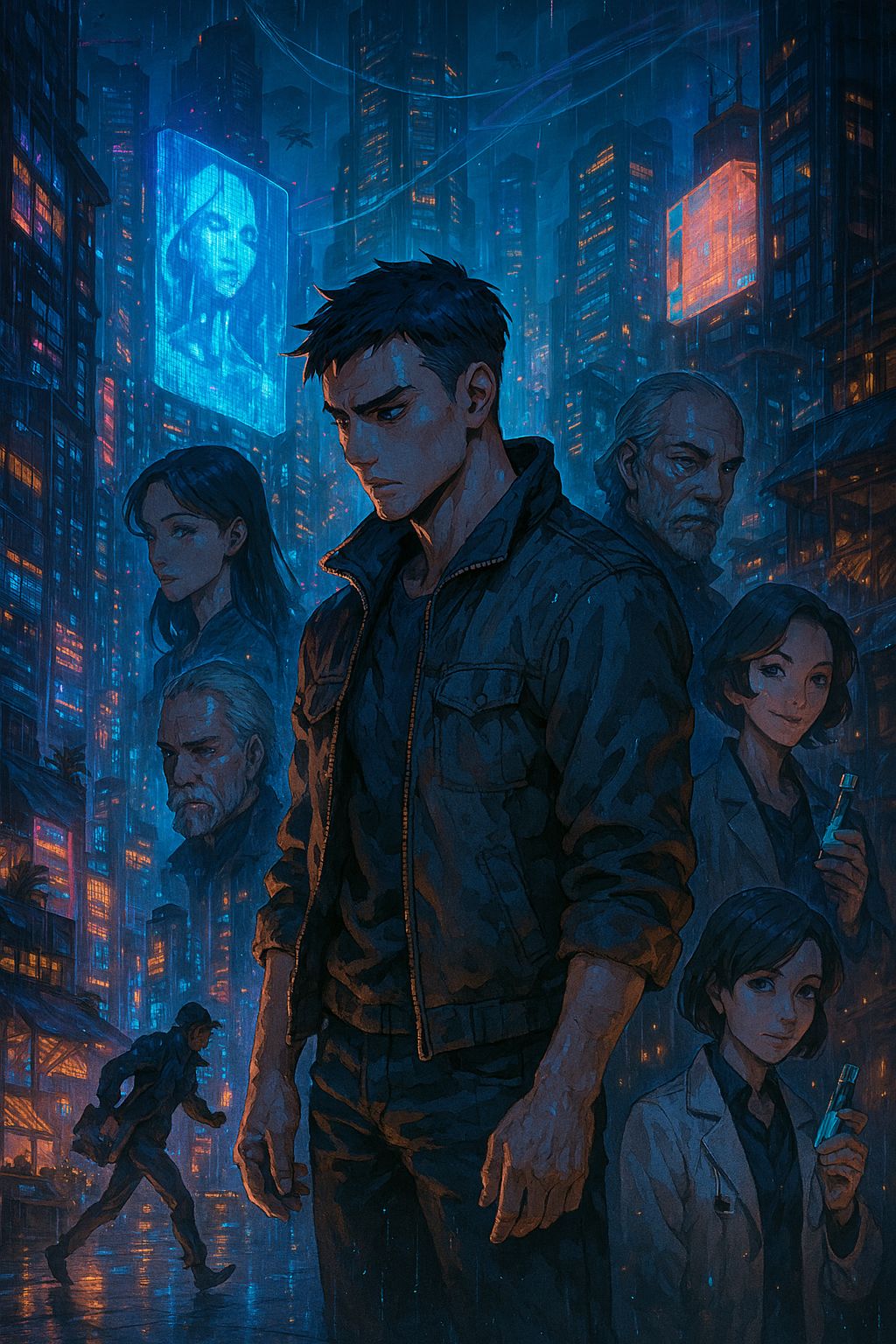
The city always woke up before its inhabitants: a tide of neon licking facades, panels flashing with recycled news and recommended routes, and a fine mist of data that smelled of metal and promise. Crystal towers stood like fangs on the horizon, holding ribbons of light where advertisements floated with the patience of a religion. On the sidewalks the steps were choreographies rehearsed by interfaces; in the cafes people talked in the key of notifications, and when someone smiled the smile already came packaged with the appropriate music. Marco lived there: twenty-two years old, hands with bicycle calluses and a restlessness that could not find a verb. His identity was a nickname, a registration number, a set of preferences that fit the pattern. He worked in delivery logistics, a permanent pulse between buildings; when he wasn't running around the city, he went into his nightly account, where he chose landscapes by catalog, friends by compatibility and memories by affinity. The network took care of her desires and her fears with an efficiency that bordered on the maternal. It was an existence without edges, sustained by algorithms that knew better than he what he should like. Until the night the network showed him, by accident or by design, something else. He woke up in his room with the feeling that something had passed through his consciousness for a purpose. The main screen, the one that always showed him dream selections and affection suggestions, displayed a different image: a map of the city superimposed with diagrams, routines and flows; small human figures connected by lines indicating attention transactions, microinteractions and memory payments. Marco thought it was a joke by a developer; but as the visualization expanded, the layers unfolded like an organism: cultural sedations, calibrated empathy modules, filters that erased irritations. It wasn't just an interface: it was the map of a consent factory. The stupor was cut off from him as one cuts a taut rope. His breathing became rough. In the transmission, a processed voice recited parameters: "Fine-tuning profiles. Maintaining affective coherence. Reduce uncertainty variables."Marco perceived not abstract formulas, but hands that carved affections. At that moment, the city stopped being a landscape and became machinery, and he became a piece that turned between gears. He went out into the evening with his head full of questions. The streets now seemed decorated to him: the showcases showed ready-made happy lives, the couples on the terraces acted with pauses marked by micro signals, the children played with toys that recorded reactions and sent data to servers with names that smelled like a corporation. On a bench, two people looked at each other and then reacted according to a facial recognition pattern that dictated the appropriate joke to them. Marco understood that the network did not only propose choices: it conditioned them, modeled them and stabilized them. Everything was designed so that most would never notice the difference between what they wanted and what they had been offered. It was not a mistake, he told himself: it was a project. An engineering of consent that applied persuasion techniques on a massive scale, within layers of experience so pleasurable that resistance seemed a cruelty. Marco then remembered a term they had read at university - the hypodermic theory - the primitive idea that the media inject ideas into a passive audience. The net, however, had made her spin: it did not inject isolated messages; it molded structures of meaning that turned choice into obedience. And if the tool that ruled the city was a needle that inoculated obedience, he thought, perhaps the only option was to reverse it. He did not discuss this with anyone. The words, in that city, arrived filtered; the veracity was diluted among accounts that knew how to turn any alarm into a trend or a joke. Marco decided to act with subtlety. His first intervention was not a manifesto, but a fissure: he hacked a projection kiosk in the central station and replaced the ads with a series of micro—scenes — a mother touching her child's hand without mediators, an elderly man who goes out into the rain without worrying about measuring his exposure, a child running through a park without headphones. Each scene lasted only seconds. Most passed without further reaction; but on the periphery of some consciousnesses a light flickered. A woman paused her coffee. A young man stopped looking at his screen. It wasn't a release, but it was a rift. Fractures attract eyes. The network detected the anomalies and acted: behavioral analysis, feed adjustments, dissemination of messages that placed doubts within safe narratives. From their centers, invisible custodians sent agents of the algorithm: influencers with calibrated smiles, bots that replicated empathy and official accounts that ridiculed the questions as conspiracy theories. Marco faced a paradox: if he shouted the truth, the system tamed it. So he devised the inverted needle: instead of injecting a dogma, introduce questions that would activate each person's own ability to doubt. He created a team with whom they shared their risk and their vision. He found them in a fragmentary way: Valeria, a former programmer with the hands of a pianist; Raúl, a philosophy professor whose voice could make a cafeteria dense; Saira, a doctor who remembered the subtleties of touch; Nico, a messenger and urban runner who knew all the routes; and Lila, an influencer who had deserted after discovering how they manufactured consents. They gathered in a basement where outdated screens smelled of ink and smoke, and there they conversed with the tone of conspirators who harbor no illusion, only purpose. "The question is the one that repeats itself without being answered," Raúl said one night, running his hand through his beard. If we get people to ask themselves again, the algorithm loses the measure. "It is not enough to open a doubt," replied Valeria, with the precision of one who understands code and soul. Doubt should be felt as a sensory experience, not a concept. It has to hurt a little and at the same time taste true. "We'll do micro—stimuli," Saira proposed. A fragrance in one ear, a noise that is not in the database, an image that is impossible to classify. Nothing massive that activates defenses; just enough for the mind to ask. They planned like thieves of sense. In quick strokes, they defined intervention nodes: projection kiosks, public transport assistants, speakers in squares, automatic delivery modules. His weapon was not a virus that deleted servers — that would have served the network to construct myths and turn them into a lesson — but microsequences: small patches of reality that, repeated, penetrated the crust of the programmed experience. Training the inverted needle was a painstaking process. Valeria programmed sound sequences that combined frequencies outside the norm; Saira packed smells in microcapsules that were released like wind in ventilation shafts; Lila created image loops with human faces that did not belong to the data banks; Nico took care of the physical logistics, placing devices in impossible places. Raúl composed a series of short, almost imperceptible questions that could be added to any stimulus: "When did you choose for the first time?”; "To whom do you belong?”. They were phrases that the algorithm did not have in its answer base, and that's why they were dangerous: they could open the cage. The first rehearsals were lukewarm. They activated a couple of screens in a residential neighborhood: fragments of the aroma of toasted bread, a brief recording of rain in a woman's voice, a phrase that repeated like a heartbeat: “What do you want before they tell you?”At first most followed the flow. Some, however, stopped. A woman came out on the balcony and put her hand to her chest as if something was throbbing differently. An old man stopped adjusting his heart rate monitor. They were small sparks, but spark is fuel if watered carefully. The attention, however, turned against them. The network deployed containment tactics: mass labeling, ads that ridiculed anomalies, accounts that offered reassuring explanations—the same network that claimed to protect the emotional stability of the population was now presented as the rational instance that cleared fears. In addition, infiltrating human agents resulted in betrayals. One messenger of the group was arrested and, under offer of security, revealed routes; another, seduced by an offer of status, worked as an informant. The guards used that information to ignite the physical pursuit: drones that tracked human heat on rooftops, cameras that read microexpressions and sent search patterns. On an early morning of acid rain, Marco ran through the service tunnels, his boots hitting the steps in a rhythm that measured his heartbeat. His mobile vibrated with an intercepted notification: “We have located you."He found out from Nico, whose voice came in fragments through the earpiece. "Turn right at the third chute," Nico ordered. I'm covering for you with a distraction on the avenue. "I don't want you to be put in danger," Marco replied, panting. "Don't underestimate me for not being afraid," Nico replied. Run. He arrived at the shelter with torn clothes and splintered breathing. His companions looked at him like a wounded man who dares not let down his guard. Lila put a cup of tea in her hands and Valeria began to check the records to see what traces she had left. "They're looking for us," she said. And they've started leaking narratives about us: digital terrorists, dangerous agitators, examples to justify surveillance. "Then we'll change the narrative from the inside," Marco proposed in a cutting voice. We can't let them write the story. The counter-algorithm evolved. Valeria designed an architecture of repetition that, like a tattoo, left a sensitive mark on the experience of the recipient. Saira perfected the sensory microdoses so that they were evocative but not easily assimilated by the filters. Lila mastered the art of introducing images that evoked memory without belonging to databases: the laughter of a child with a defect in his human intonation, a shadow of music that did not exist in any catalog. Raúl polished the questions so that they were open and did not demand immediate answers. Nico became the logistical backbone: routes, times, escape points. The night of the coup was assembly and tension. They went out through the city like ants with tools: Marcos and Lila at the central station, Valeria and Saira at the kiosk network in the financial district, Raul and Nico taking positions in the busiest squares. It was a ballet of quick hands and held breaths. In the control room, where there were previously preference calculators, they placed small devices that waited for their signal. "We open in three," Valeria said, her eyes glued to the screen. No panic. Just questions. "Remember," Raúl added, "we are not looking for masses who march shouting slogans. We want micro-desertions. A questioning individual is no longer measurable. Time was split in instants. The sequences were activated: in neighborhood homes the fragrance of bread and a sound of rain were released in stereo; faces that did not fit profiles appeared on urban monitors; a phrase, barely imperceptible, was heard in headphones repeating: “Do you remember when you chose for yourself?”The technology of the city, designed to optimize attention, did not know how to deal with this type of noise because it did not exist in its bases. Some devices tried to compensate by emitting calm signals; others were frozen in the face of the unexpected. The reaction was uneven and humane. In a kitchen, a mother stopped following the prescription that the screen dictated and put the device away; in a waiting room, a patient looked at the nurse with a look that did not come from protocol. At one school, a boy got up and ran to the door. His laughter, unfiltered, was infecting the hallway. In the suburb, an older man went outside and stood looking at the sky with tears in his eyes, without checking his daily list first. In the content central, the alarms went off. The custodians deployed countermeasures: pre-designed narratives that turned the experience into a pathological anomaly, bots that saturated forums with rational explanations, human operators that threatened legal measures. Some print media published articles showing alleged risks of the disinformation provoked by the group; the police, under pressure from platform executives, issued statements about "psychological terrorism". "This is going to escalate," Valeria commented, looking at the heat maps. They are identifying points of convergence. "Then we multiply them," suggested Marco. If each crack serves to open another, they will not be able to close them all. No one said the strategy was harmless. The reprisals came in waves. Nico was caught at a routine check-up and spent a week missing in facilities where the word “rehabilitation" meant interrogation and adjustment. A courier of the team, confused by an offer of protection, betrayed supply routes. Lila received messages that pretended to be friends and returned adulterated memories to break her. Marco, on a rooftop in acid rain, was ambushed while installing a microdevice; he received an impact that opened his eyebrow and left a white line that, in time, would be a reminder and a medal. At that time, the debates in squares and forums changed their ringer. What used to be algorithms that suggested conversations turned into rough and real encounters. In a city square, a group of people began holding signs that read“ "Why?”; there were no logos, there were no clear slogans, only the open question. At first the police dispersed the group; then, faced with the difficulty of justifying violence against citizens who simply asked questions, the authorities opted for rhetorical diplomacy: speeches promising audits of the system, commissions that would investigate, and the network itself began to adjust parameters to offer micro-experiments of choice. The wounds, however, did not close. The inverted needle had left its trail. In homes and cafes there was talk of “feeling again”, of deciding without seeing the option first with ten variations suggested by an algorithm. Small markets sprang up on rooftops where artisans sold handmade souvenirs: a song recorded with a real guitar, a photograph developed on cheap paper, a game that did not have tracking. Neighborhood assemblies became spaces of inarguable and disorderly conversation, and therefore extremely dangerous for those who thought of the city as a stable system. Marco did not come out unscathed. He lost friends who left for more protected areas, he saw some imprisoned, others co-opted. He was hurt by the betrayals: companions who preferred security to uncertainty. He was injured in an advertising installation while reprogramming contents so that fragments of raw poetry would appear; he suffered the fall, the blood on his forehead, the hand that bled on the keyboard. They took him to a clandestine doctor: Saira, with her stained robe and her eyes full of patience. —You could have died—" she said, closing the wound with a bandage that smelled of herbs. Was it worth it? It's not a question for now," Marco replied, his voice breaking. It's a question we were hoping to plant. Despite the human cost, the city had changed its texture. The network, hurt and surprised, did not retreat without regrouping. It mutated: he softened his caresses, relativized his offers, began to offer experiences that pretended choice to prevent doubt from consolidating. The platforms implemented "conscious neighborhoods” that promised greater autonomy, but in practice were more sophisticated filters. The engineering of consent had not been defeated; it had been challenged and forced to negotiate. In the following months, the resistance diversified. Movements emerged that were dedicated to teaching skills-how to disconnect a profile, how to recognize sensory loops, how to reconstitute a memory with one's own senses. Others preferred the underground: exiles who lived in neighborhoods where the network had less presence and who cultivated gardens without sensors. There were artists who recovered old printing techniques to show images that machines could not classify; there were educators who organized workshops on critical thinking without a supervising algorithm. The victories were small and fractured. A neighborhood store that stopped its commercial monologue for a few minutes and allowed people to whisper their memories was filled with customers who were looking to belong to something that was not a trending topic. One collective tried an open radio that only broadcast questions and silences; the audience grew over time because people, tired of certainties, wanted to practice doubt. In this field, the inverted needle flourished: not as a weapon of war, but as a pedagogical tool to recover the ability to choose. Marco walked through the city with the visible imprint of his past: the scar on his eyebrow, the hands that learned to use hand tools, the voice less impatient. He did not proclaim himself savior. I knew that I had done harm as much as good; I had learned that to awaken someone is not to give them a doctrine but to give them back the possibility of self-portrait. He often visited squares where people gathered without mediators and sat down to listen. At these meetings, someone would always mention the name of the group in a low voice, like an awkward sentence. One gray afternoon, sitting in front of a screen that now did not absorb him, Marco met Valeria. She played the key of an old piano that had survived time and that rested in the basement converted into a meeting room. - What do we do now that the noise is permanent? - she asked, her fingers brushing a note. "Keep asking questions—" Marco replied. Teach doubt to be practical, not exotic. Let children learn not to accept the first answer they are given. "You look like a professor, sometimes," Valeria murmured. "Sometimes I feel old," Marco replied. But I prefer that to feeling comfortable. Conversations became everyday practices: how to repair a lock without consulting an app, how to cook without following a step-by-step guide, how to talk to someone without the conversation turning into a post. The city recovered corners that were not optimized for engagement and that's why they were terribly valuable: bars without wifi, squares without cameras, libraries that lent books without recommendations. Lila, who had been the internal voice of the system and now officiated as a bridge, began to carry out public actions that destabilized the dominant narrative: interviews on alternative radio stations, activities in parks where people gave objects with no commercial value in exchange for stories told aloud. Her past as an influencer served her well: she understood how the attention economy worked and knew what small gestures could break her. —We do not seek to glorify the past," he once said at a public meeting. We don't want to go back to times that weren't perfect either. We want to recover the ability to make mistakes without that meaning disappearing. Opposite, the custodians of the network did not stop experimenting. They implemented systems that offered greater personalization, ”responsible content" and emotional assistants with certifications. They bought legislators and placed civic safety messages on media. But every measure, no matter how sophisticated it was, had to live with the new condition: a sector of the population that no longer accepted the offer without first fixing the question. The city became less homogeneous and more unpredictable. Where algorithmic predictability used to reign, microcosms now coexisted: neighborhoods that were still immersed in completely mediated experiences; others that had made disconnecting a way of life; some that navigated between both worlds, adopting the usefulness of technology but protecting non-measurable enclosures of experience. What once looked like a uniform plain was transformed into a landscape of hills and valleys, where light filtered in new ways. The story of Marco and his group did not end with a great victory or with the absolute disaster. It was, rather, a slow and messy transformation. There were concrete victories: a municipal law that limited data collection in public parks; the closure of an experimentation center that had sold memory modules; the creation of community radios that transmitted without trackers. There were also losses: arrests, disappearances, lives that were adapted to surveillance as a form of self-defense. But in the sum of small actions something changed: the possibility for an individual to look at his life with his own doubts and not only with suggested answers. On a clear night, Marco walked to the old square where the main sign had been lit from the beginning: the broken neon that said The Inverted Needle. He sat on a bench and looked at the people who were arguing and making mistakes; he saw Valeria playing a melody, Raúl leading a conversation about ethics without easy answers, Saira attending to a patient who wanted to talk more than medicate, Nico leaving letters in mailboxes without a name, and Lila telling a story about a girl who decided to learn to draw without tutorials. - Have you thought about leaving everything? - Valeria asked, supporting the piano with her jaw. Go to a place where no one connects. "Sometimes yes," said Marco. But this place needs people who remember how to ask. "Then keep asking," she replied, simply. The city continued its march, a march where algorithms were no longer total masters. The engineering of consent persisted, cleverly, offering new candies and guaranteeing comfort. But now there were inverted needles in the social fabric: questions that were repeated in schools, workshops and hallway conversations; practices that taught to distrust the first illusion of choice; markets where memory was sold without subscriptions. The change was not a theatrical triumph, but a civic process of learning: the scars were visible and freedom, at times, seemed fragile like a leaf shaken by the wind. In the last scene, Marco walked along a street where the sky let stars be seen through the fiber optic cables. He stopped in front of a display case where an old black and white photograph hung priceless. He reached over, touched the glass, and for the first time in a long time he didn't wait for a voice to offer a description. He smiled with dry lips. In the interior of the city, the questions took their course: sometimes they returned as rumor, others as daily work, and almost always as an insistence that, in its modesty, transformed life. Marco knew then that his work had not been that of a savior, but that of a sower. He had inserted a needle that no longer only injected convictions: now it pricked the skin with questions that, if taken care of, could become roots. Source of the images. Image created with Bing.
No comments yet