 @mc5punk
more from that month
@mc5punk
more from that month
Short story: The Wheel Lighthouse
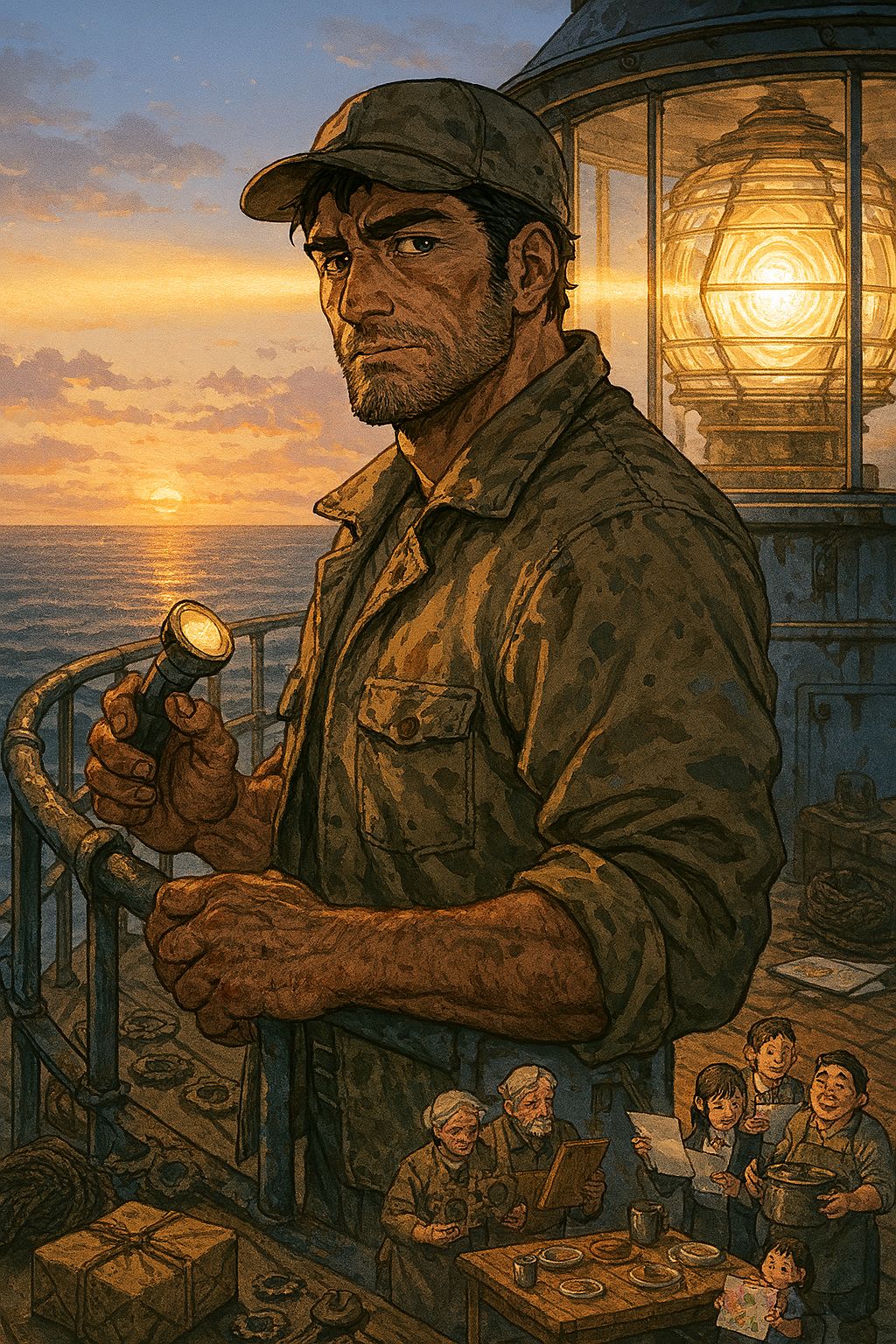
He stands about 1.80 m tall. His shoulders are broad and his body retains the mass of someone who has worked with tools for years; his hands are calloused and stained with oil, revealing a life of fitting parts and tightening bolts. His olive skin bears small scars on the right forearm; a short, slightly unkempt beard accentuates his rugged expression. His eyes are gray, deep and watchful, and his nose, slightly aquiline, defines his profile. He usually wears a worn cap and a canvas jacket that still carries the smell of the workshop and freshly sanded wood. He arrived in the village without hurry. It was not the abrupt arrival of a tourist nor the rushed move of a new entrepreneur; it was the kind of arrival that happens slowly, in small installments: a shared meal, helping to repair a boat, two hours of work with Don Julián, an afternoon at Lucía’s inn. No one remembers exactly when he stopped being a visitor and became part of the landscape, but everyone recognizes his figure on the waterfront: steady, oil-stained hands, cap tipped low. The lighthouse became the doorway. One morning he held a package wrapped in kraft paper against his chest and walked toward the keeper’s shed. He had obtained a wheel from an old clock that he hoped would fit the mechanism that kept the watches. Doña Carmen, the former lighthouse keeper, was waiting with gears and springs spread out on a worn cloth. “Did you bring the piece?” she asked without taking her eyes off the work. “Yes,” he replied. “They told me it’s in good condition.” Don Julián appeared with his creaky toolbox; Tomás, the man in charge of the lighthouse, came closer to inspect the wheel under the pale midday light. His hands, skilled and well-formed, moved with the natural ease of someone who had been repairing mechanisms since youth. “It has good teeth,” Tomás murmured, touching the wheel with respect. “If it fits, it will be the difference between a safe night and a night without a guide.” They set everything up in the shed: an improvised table, a lamp, oil for the gears. They worked patiently. Don Julián polished the axles, Tomás adjusted the spring tension, Doña Carmen brushed away the oxide residue the salt air had left. The man with the cap offered tools, held parts, applied a precise tap where needed. In every movement you could sense the precision of his craft. Lucía, as always, arrived with food: a large pot of broth that warmed hands and spirits. When the wheel clicked into place, the silence in the shed filled with a contented noise: parts grinding, tension settling. Doña Carmen lit the lamp and the clock chimed the hour for the first time in months. They climbed to the lighthouse terrace to check the beam: the light swept the sea, drawing a path for anyone approaching. “I will never tire of seeing it turn,” Doña Carmen said with a mixture of relief and memory. “This tower holds stories; when it goes out everything becomes more uncertain.” Below, Nico, a boy whose knees were always dirty, hurried up and offered him a toy flashlight. The offering had the solemnity of a rite. “For you so you won’t get bored,” he said. He accepted the flashlight with a contained smile. “I’ll keep the light,” he replied. “And watch over anyone who needs it.” The repair and the communal dinner were reasons to gather, but calm was soon broken when Elena, Tomás’s sister and the village schoolteacher, arrived alarmed. She brought news from the city: Rodrigo, a developer who had started appearing around town with promises and plans, wanted to buy part of the pier to build a tourist complex. He offered jobs and promises of progress, but he demanded privatizing the fishing areas and the old dock where boats had been moored for generations. When Rodrigo came to present his offer, he did so in a lightweight suit and with immaculate folders. He spoke of investment, order, and tourists that would bring money. His words were as polished as his shoes. “It’s a necessary investment,” he said. “The village needs to modernize. Think of the opportunities.” Faces in the square moved from disbelief to a low, silent indignation. Don Julián muttered, “And my son’s boats?” Doña Carmen pressed her lips together. “We won’t sell the coast for money,” she said, her voice small but firm. The man with the cap then realized his role could be more than that of a fixer of parts: he could be the bridge between what the village wanted and what they needed to present to the city to persuade the authorities. Elena suggested a different path: organize the community to develop small-scale, responsible tourism, craft workshops, a lighthouse museum managed by the people, and a communal fund for pier maintenance. She proposed gathering signatures and proof of the cultural and economic value of keeping the pier in local hands. “If we organize,” Elena said, “we don’t need someone to come and decide for us.” He was entrusted with drafting the proposal and visiting contacts outside the village; he knew artisans and small NGOs that could back a community-led initiative without imposing conditions. He could also translate into practical terms what the townspeople wanted: guided routes run by fishermen, family-run lodging, a workshop to repair nets and boats. The following days filled with different work. Lucía organized dinners to collect signatures; children drew the coastline for an exhibition to accompany the proposal; Doña Carmen opened the lighthouse shed as a coordination center. Each afternoon the man with the cap sat down to write, to call, to assemble the document that would need to convince the municipal council. His hands, accustomed to nuts and timber, now traced paragraphs and lists of cultural and economic activities. Rodrigo returned with contracts and ready papers, pushing the pace of decisions. But the community presented itself united on the day of the public hearing: signatures, children’s drawings, the restored lighthouse as an example of what they could do for themselves. He read the proposal in a steady voice: “We propose a responsible tourism program: craft workshops, fisherman-guided routes, a communal maintenance fund for the pier, and collective management of visits. We will not sell our heritage; we will care for it.” There was debate, formal questions, and the councilor’s doubts. The evidence—signatures, concrete projects, the functioning lighthouse—carried more weight than Rodrigo’s promises. The resolution granted a trial period for the community project and modest funds for necessary repairs. Rodrigo left, his departure less confident than his arrival. The night of the vote was celebrated as real victories are: with shared food, soft music, laughter and a long table where no one paid attention to the man who had brought the best suit, but to those who had worked. Doña Carmen raised her cup. “For the light and for the pier,” she said. “For what we care for without selling it.” Nico, ever eager, insisted the flashlight be kept with the person who would watch the lighthouse at night. He offered it again, trusting as only a child can. He accepted and slipped the toy into the pocket of his canvas jacket. He looked at the tower guarding the coast and felt a calm satisfaction: his past and name had not changed, but he had woven new belongings with his hands. The villagers no longer saw him only as the gray-eyed foreigner with a worn cap; he was the one who had returned the light to the lighthouse and helped birth a project that kept the pier in the hands of its people. Over time, the pier’s workshop filled with sounds: hammers, voices telling stories of nets torn and mended, small groups of visitors coming to learn how to tie knots or how to cook fish over wood fires. He kept doing what he did best: fixing parts, teaching young people how to care for tools, helping manage the workshop, and—when needed—going down to the port to tie a line or caulk a plank. The oil-stained hands gained other marks: calluses from writing too much, specks of paint from the signs announcing the routes, and gratitude tattooed in looks and words. At night, when the lighthouse beam swept the sea, he climbed the terrace, rested his elbows on the railing and watched the coast sleep. He knew that every time the lamp turned, the community slept a little more secure; in that thought he found a home not made of papers or promises, but of shared work and mutual responsibility. Source of the images. Image created with Bing.
No comments yet