 @mc5punk
more from that month
@mc5punk
more from that month
Short story: Beneath the Corner's Pulse
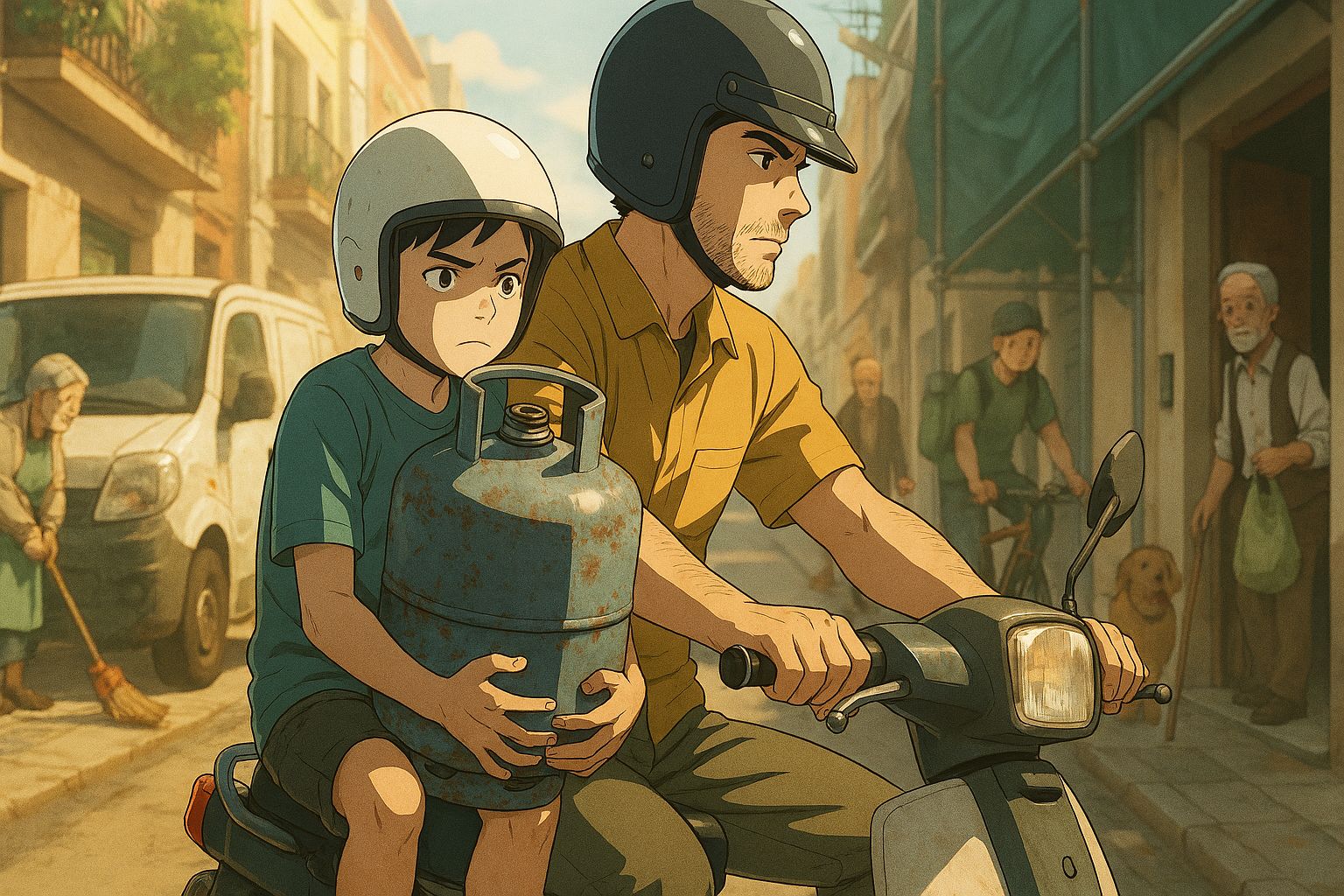
It was a clear, luminous morning, one of those when the air smells of fresh bread and the plane-tree leaves shine like mirrors. Marco, a man in his forties with sun-darkened skin and hands hardened by years of driving, rode a small but sturdy motorcycle. Riding behind him was Dani, a lean twelve-year-old with an alert gaze, sitting upright on the rear seat. Both wore their helmets fastened. Between the boy’s legs and chest lay a small household gas cylinder: not heavy, but demanding care. Marco gripped the handlebars with one hand while steadying the bike with the other; Dani held the cylinder with one arm and rested his other hand on the driver’s back to keep his balance. As they approached the turn that led into the alleys, the neighborhood’s picture shifted: a white van had been poorly parked, partially blocking the lane, and a metal scaffold—its tarps hanging half-down—reduced visibility of the side street. The pieces of the scene fit badly together, as if someone had moved the tiles right before they passed. On the sidewalk, Mrs. Rosa, the building’s concierge, swept with methodical movements and paused, frowning as she watched. “Careful, young ones!” Mrs. Rosa called out in a protective, emphatic voice. “That crossing is always dangerous—can’t you see the potholes and how they leave the van?” Marco let out a half-laugh that didn’t quite form and answered calmly, trying to make his voice sound lighter than he felt. “Yes, Mrs. Rosa. We’ll go slowly,” he said. “Don’t worry—we’re being careful.” Marco’s reply sought to soothe, but tension lingered in the air. In that moment Jorge appeared from the right: a young, athletic-looking delivery rider pushing a bicycle loaded with bags and boxes. Jorge came fast, dodging pedestrians and driven by the urgent pace of deliveries. The van had left him a narrow passage, and out of necessity he decided to cross quickly. When Marco saw the bicycle silhouette cutting across the lane, he grabbed the brake sharply. The rear wheel squealed and the motorcycle skidded just a little—a sensation that ran through the body like a chill; the small cylinder they were carrying began to slide, upsetting the fragile balance of the scene. “Grab it, Dani!” Marco shouted, voice taut, heart pounding in his temples. Dani reacted with the speed of someone who knows each second counts. He released the hand resting on Marco’s back and wrapped both arms around the cylinder. He felt the cold texture of the metal, the bike’s vibration, and the pavement beneath the wheels that seemed to move. For an instant the world narrowed to that slick cylinder and the helmet shell shielding his thoughts. “I’ve got it!” Dani said, determination clear in his voice, his fingers clenched until his knuckles paled. “It’s not coming loose.” Jorge, having braked a few feet away, jumped off his bicycle and took a deep breath, his shirt clinging to his back from the effort. His eyes showed the mix of apology and vertigo typical of someone who nearly caused an accident. “Sorry, sorry,” he stammered sincerely. “I didn’t think I’d cross that fast. Are you all right?” Marco let the tension go in a long exhale and looked at the boy as one checks that nothing serious has happened. “Thanks to you, kid,” he said, his voice softening. “We’re fine. But that crossing is a trap; you have to be careful.” Mrs. Rosa stepped forward, accompanied by Félix, a retired neighbor who walked slowly and smiled easily while taking Paco—an ear-pricked mixed-breed dog with a deceptively fierce look—out for a stroll. Félix leaned lightly on his cane but not on a lack of will to take part. “What a scare!” Félix commented, in the tone of someone who enjoys the neighborhood. “Those kids always carry so much… If only the City would put up a sign or fix this.” “That’s right,” Mrs. Rosa added, shaking her head. “The other day I almost tripped over the scaffold, and the couriers rush by. We must do something.” At that moment Don Arturo, the elderly man they were supposed to deliver the gas to, appeared at his doorway. His face was a map of wrinkles that told stories of decades in the neighborhood; he held a shopping bag in one hand and, seeing the commotion, his tired expression brightened into attention and curiosity. “Everything all right?” he asked with a trembling but kind voice, leaning in the doorframe. “Yes, Don Arturo,” Dani replied, still breathing a little fast, offering the cylinder with the same steadiness he had shown in the street. “We arrived safely.” The old man smiled with genuine gratitude and rubbed his hands as if about to welcome dear guests. “Thank you, lads,” he said. “I’m glad to see you. You have a steady hand, kid,” he added, looking approvingly at Dani. “Come in—I’ll invite you for coffee to thank you.” The invitation acted like a balm on the group. They entered Don Arturo’s home: a small warm living room, framed old photographs on the walls, a table with a blue-stained tablecloth and a shelf with books and tins. Don Arturo set the shopping bag on the counter and busied himself making coffee—the aroma filled the room in seconds. Félix eased into a chair and watched with satisfaction; Mrs. Rosa picked up a cup and set aside the dustpan, still holding her broom; Jorge leaned his bike against the wall, still regaining his breath. As they settled, Félix spoke up in his practical tone. “Look,” he said, “we could talk to the residents’ association to request temporary signs or cones until they fix the scaffold. If each courier knew alternate routes, the risk would drop.” Mrs. Rosa nodded firmly. “I’ll call the president right now,” she announced. “If we organize, we can ask the City for urgent repairs and, meanwhile, put up markings.” Jorge loosened a strap on his helmet and smiled with the sincerity of someone who’d learned a first lesson in the city. “Count me in,” he said. “I can warn my courier mates and, if necessary, change routes for now. It wouldn’t be a problem.” Marco looked at Dani and patted his shoulder with affection and pride. “Good job,” he murmured softly. “Today you learned that haste is worth less than safety.” Dani blushed slightly and his shy smile was honest. He answered with a tone of accomplishment. “I promise next time we’ll go even slower,” he assured. The afternoon passed amid conversations and plans. Don Arturo prepared a tray with cookies and more coffee; the talk grew brisk and collaborative. Félix, with experience in paperwork and meetings, suggested drafting a short petition for the residents’ association: a request detailing the dangerous points of the crossing, photographs, and a proposal for provisional measures. Mrs. Rosa offered to coordinate homemade signage, and Jorge contributed information about peak courier hours and possible alternative routes. Marco and Dani committed to placing temporary cones at midday when they had time, while Don Arturo offered some of his old canvas bags for marking the area. With the agreement underway, that same afternoon the community gathered in the neighborhood square. Neighbors from different walks of life came: a mother with a stroller, a teacher who lived around the corner, a couple of young bakery workers, and several couriers whom Jorge had persuaded to attend with curiosity and goodwill. Mrs. Rosa coordinated logistics with a firm hand: she chose where to place signs and organized teams for each alley entrance; Félix drew sketches and maps by hand to be photocopied later; Marco and Jorge set out cones and reflective tape at the most critical spots, while Dani helped with serious dedication, handing parts where his father asked him. The meeting didn’t instantly resolve all the structural problems: the scaffold remained, and the badly parked van didn’t vanish by magic, but the collective action produced noticeable effects. Couriers began to respect the new marked routes, older residents found a safer passage in the early morning, and the visible presence of signs and cones reduced the sense of danger. In addition, the residents’ association pledged to submit the formal petition to City Hall with the signatures collected that afternoon. Don Arturo, pleased, served another round of coffee and, in a low voice, said: “We didn’t fix everything, but together we make the neighborhood a better place.” There were murmurs of agreement, tired but satisfied smiles, and a shared feeling of community that spread like an invisible weave among the houses. That night, as lights went on in the flats and shutters came down, Marco and Dani returned home with the sense of having done something useful. Dani, lighter than that morning, walked alongside the bike pushing it and watched the now-empty cylinder resting in his kitchen, as if he had gained a measure of maturity. In the following days the small measures continued: the residents’ association received a reply from City Hall requesting a technical report, neighbors took turns watching the crossing during peak hours, and many couriers adjusted their routes. The neighborhood did not change overnight, but the initiative left a lasting mark: the certainty that the sum of simple gestures and neighborly cooperation can mitigate risks and improve daily life. And, above all, the image remained of a boy who, by grasping a slippery cylinder, held not only an object but the trust of his community. Source of the images. Image created with Bing.
No comments yet