 @mc5punk
more from that month
@mc5punk
more from that month
Short story: The Seam of Fire
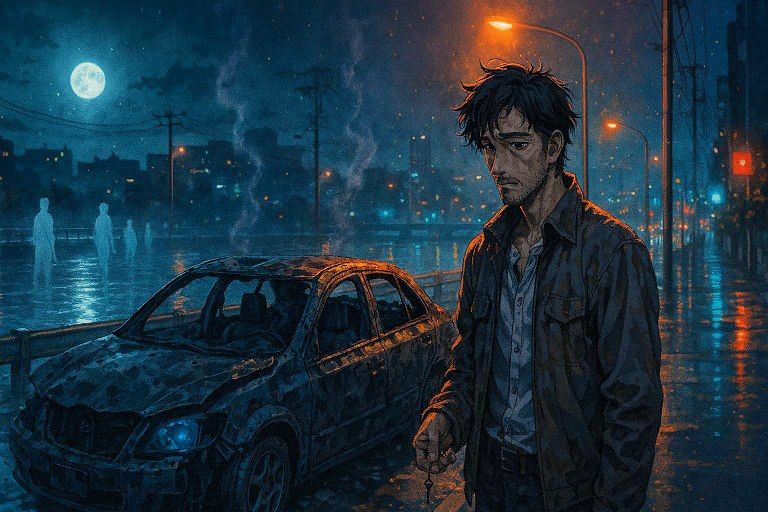
The street smelled of rubber and molten steel when the orange glow appeared in the gloom. Monteluz Avenue had, for a moment, become a throat that exhaled flame; the vehicle gave a long whine and surrendered in silence. Álvaro stood a few steps away, his shirt clinging to his skin, his hands trembling, watching his car burn. He had arrived when the first flames licked the dashboard; he had time—one second, maybe two—to push the door, grip the cold steering wheel, and run to the curb. His eyes searched for something to explain it, a sign of why. The sirens announced relief and order. The Loma Alta Fire Department arrived within minutes, followed by a municipal unit that deployed hoses and lights. Paramedics forced their way through the crowd with practical hands and clipped voices. A neighbor, his hands black with soot, spoke under his breath: “Only material damage.” The phrase found immediate comfort among the crowd, but in Álvaro’s eyes it left the impression of a missing piece in a puzzle too small to explain everything. “Are you okay?” asked a firefighter as he offered a thermal blanket. “Yes,” Álvaro answered, too curtly. “I think so.” The flames were put out and the vehicle remained a blackened skeleton on the avenue. The firefighters worked with the precision of their trade; yet when Captain Mendoza explained to Álvaro that there were no clear signs of an electrical origin nor evidence of deliberate tampering, the reply barely comforted him. “Sometimes they ignite from things we don’t see,” Mendoza said, shrugging. “Factors escape us.” The vagueness of that explanation stuck to his palate like a metallic clove. That night he slept poorly. Every time he closed his eyes, the fire returned and took on details he had not lived: sparks born from the seam of the dashboard, a bluish glow inside the metal, a murmur bubbling between the seats. He could not remember lighting any spark, but he couldn’t place the exact moment when it all began. There was an empty space that vibrated, a carbonized zone in his memory. In the days that followed, the city continued its rhythm—street vendors, honking, and the stubborn light of the posts—but for Álvaro, Monteluz Avenue was marked differently. At dusk the roadway smelled of burnt rubber even when there was no blaze, a smell that clung to his throat and brought voices. They were not clear voices but interruptions, as if someone had put an old radio in his head and let it run with interference: cracklings, paper disintegrating, cut-off phrases. A dry whisper carried images: the way metal remembers heat, how things try to belong to others. He tried to talk to his friend Marcos to filter the anxiety. “It’s probably stress,” Marcos said with the certainty that closes doors. “What you went through was intense. Relax, take some days off.” “I don’t know,” Álvaro replied. “It’s like something is calling me from the car.” “You’re imagining things,” Marcos shot back, though his voice sounded less confident now that he had spoken. Still he added, “Come by, let’s talk and get your mind off it.” But at night the whispers returned sharper. They appeared as he lay down on that thin border between sleep and waking. They were phrases without a sender, orders that seemed to seek only to be heard: “Return this to me,” murmured a voice. “It’s not yours.” A week later he went to the garage where the car’s shell still waited. The sight was worse than he expected: the body stood blackened on intact tires, a skeleton preserved by fire and time. Don Elías, the mechanic who tended the shop, crawled under the hood as if searching for a cause on an archaeological map. “I don’t see a clear fault,” Don Elías said. “No trace of burnt wiring, no obvious short circuit. Nor signs someone tampered with the tank.” “So what then?” Álvaro asked, a mix of hope and exasperation. “What happened?” “Sometimes it happens,” Don Elías repeated with the resigned phrase of those who have seen cars burn for weak reasons. But the evasion left Álvaro with more questions than answers. That night sleep came in the form of a room lined with photographs: in each picture he appeared at different moments, the camera inside the car. In the last shot his eyes were dull, as if veiled by a film the fire could not erase. In the dream, when he touched the photo it creaked like hot sheet metal. The boundary between dream and reality blurred. Whenever he closed his eyes before sleep, he saw a sequence: the engine trying and failing to sing, a spark that hesitates, withdraws, and then launches. In the rearview mirror he believed he recognized ashes that did not belong to metal—shadows with human traits composing and dissolving within the outline of the seats. He began speaking to himself in the street, touching the car’s body like someone learning the texture of a ghost. People began to notice his behavior. Some whispered that he had lost his mind; others, more compassionate, said trauma does that. Paramedics saw him in passing, firefighters recognized him—but no one told him that what he heard might have a logic. Only the avenue knew. One dawn, while sitting on the curb as he often did, a dry knock jolted him: a loud metallic closing. He looked toward the carcass and watched it breathe. Under the lamplight the blackened surface undulated and gave off heat that did not match the cold of the night. He approached without thinking. The lock gleamed with an inner spark it shouldn’t have. When he laid the pad of his finger on it, the sheet metal was warm and he left a dark trail where his print slid: a smudge that seemed to absorb the light. The voice that emerged was not external; it rang in his head with crystalline clarity. “You kept something of mine,” the voice said, without anger but with the certainty of a debt. Álvaro stepped back. The world seemed to tilt, as if the horizon had been misaligned. Back home he found small objects placed as if someone had come to deliver misplaced mail: a smooth stone, a rusted key, a photograph cut from a larger portrait he did not recognize. Some nights more things lay on his pillow when he woke—buttons, a game token, a list of names. He gathered everything with a care bordering on superstition. He tried to get rid of the objects. In the backyard he lit a small fire and threw the stone and the photo on it. The flames rose hungry but stopped as if they had hit an invisible membrane; the stone cooled without burning, the photograph crinkled slightly and returned intact. Darkness thickened around him and a sensation of presence clung to his skin: these things did not belong to the world that fire could touch. Days became weeks and the voices grew in clarity and volume. They no longer whispered; they recited fragments of lives, small anecdotes that demanded completion. They compelled him to places where the city kept what others had lost: flea markets with vendors who said they didn’t remember selling anything, lots where people abandoned belongings, dumpsters where papers with names turned up. They gave him coordinates and propelled him to an abandoned factory by the old dock on the Lirio River. One night, driven by the accumulation of commands, Álvaro went. The factory was an industrial corpse: graffiti-covered walls, windows like broken teeth, dampness clinging to the interior. Moonlight filtered through panes and projected rectangles that seemed like doorways into emptiness. Between worn machinery and fallen planks a car rested exactly as he had seen it in dreams: same dashboard, same seats, an oily smell that filled his throat. It wasn’t his car, yet it bore scratches that could have been his own. He sat in the driver’s seat and suddenly understood. It was not reasoned—an avalanche of comprehension fell on him: these vehicles were containers for subtler refuse than scrap. At some point the city deposited fragments of existence where nothing else would take them: loose memories, small griefs, voices without rest. Fire, when it sprang up, both liberated and sealed. Some things adhered to the sheet metal, stuck to the memory of the metal, and waited. The flames had not been an accident; they were both mechanism and prison. Back in his apartment he opened a toolbox and put away a wrench like a secret: carefully, ready for use. That night the voices offered truces in exchange for small favors: find this, place that; return it to that corner. He became a collector of loss, a gatherer of crumbs. He roamed the city picking up lost things and leaving them by his burned-out car, that carcass that was altar and tomb. Some nights, when he placed an object down, the glow inside the car would fade for an instant and a momentary calm would purify him. “Why bother?” one of the voices asked one night, cold and curious. “No one has to do this.” “Because someone must remember,” Álvaro answered, unsure to whom or whether he had courage. But the bargain had a cost. As his collection grew, the voices stopped whispering and began to narrate whole lives. They told him fragments with names, dates, and habits. They revealed small betrayals, forgotten loves, domestic rituals that seemed trivial until heard at midnight. Álvaro began losing track of time; days melted into nights and nights into tales. He lost odd jobs, disappointed friends, and answered calls prompted by the voices rather than by people. Apathy gripped him: he would remain motionless, as if his body were drained by attention to others’ memories. One dawn the car’s shell gave one last gesture. No visible flames appeared; instead, a collective murmur rose until it became a metallic howl. The shadows inside stirred and began to take shape: hands, torsos—figures that seemed composed not of skin but of plates tattooed with memories. They slid out of the car and walked toward Monteluz Avenue, a procession that did not seek vengeance but return. Álvaro watched them move and for the first time grasped the scale of the exchange: not all the presences he had soothed wished to come back to claim anything. Some wanted to leave. The figures walked with an ancient calm, leaving a trail of tobacco- and motor-oil scent. Upon reaching the bank of the Lirio River, they halted and, one by one, dissolved into the water. The river accepted them without question, integrating them as water does with debris it has remade into itself over centuries. Álvaro, eyes wet, felt that what he had thought inextinguishable was now gone, and with each departure something in him returned to a clean hollow. Then the voice inside the car shifted tone; it no longer asked favors. It spoke with the precision of one who settles accounts. “You gave me what I needed to stop staying,” it said. “But you kept part of me.” The phrase cut like a knife. Álvaro felt, with a sharp clarity, that something in him had left and not entirely returned. It was not a monumental collapse but a thinning of the texture of his life: a laugh less spontaneous, a word that slipped away mid-conversation, the melody of a song that now contained a gap. He had given so much to calm what burned that he had taken on a fragment of the very thing. It was a porous loss, an amputation of detail. In the days that followed, the avenue resumed its usual rhythm. Municipal teams cleared the site, removed the remains, and painted over the blackened mark. “Only material damage,” people repeated with relief. But to Álvaro the phrase sounded half-true. Some losses had no invoices, no parts to account for. There were holes in his time and language that no one else saw. Sometimes he walks Monteluz at night and sits on the same curb. He squeezes the rusted key in his pocket until his knuckles blanch. He stares at the Lirio River and listens: sometimes a murmur of perfectly comprehensible voices, other nights only the slap of water on stone. In his wallet he keeps a photograph of a face he cannot fully recognize; in his drawer, a bent badge, a smooth stone. Objects that remind him he was part of a passage: receptacle, guardian, debtor. On more than one occasion, at dawn when a lamplight stretches long shadows, he swears he sees, in the distance, a car intact and gleaming as it was before the fire. He watches it and senses that whoever sits inside is no longer entirely him. Once he walked toward that figure to verify, but the voices flared in urgent chorus: “Do not go,” they said. “It is not for you.” Álvaro stopped. It wasn’t cowardice but the resignation of someone who understands that not everything that shines should be touched. He stayed on the curb, holding the rusted key, with a new and terrible certainty: the borders between what belongs and what does not are more porous than he ever imagined. The city does not only consume objects; it also accumulates memories and pieces of people in its seams. Fires both clean and stitch. Sometimes, if one does not protect oneself, what remains comes back to ask for what it believes is its own. At times, when the wind smells like rain and Monteluz Avenue is deserted, Álvaro walks to the riverbank and leaves a stone or a key on the wall. It is not an ordered ritual but a gesture seeking balance. When he does it he feels a thin relief, as if something has been slightly readjusted. He knows the debt will not be fully paid; some things remain in the seams, where the material and the memorial mix, and that mix changes whoever harbors it. Sometimes, as the city lights go out and the world seems to fold into room for thought, he wonders if another gatherer does the same in some other neighborhood. If more cars are small temples of remnants. If another person walks with a rusted key and a faceless photo. And above all, if there is a procession that, when night is but a fold, crosses the city seeking pieces to return. The voices no longer consume him as before, but they have not gone. Sometimes they dictate street names, birthdays, small stories that are not his and that he writes down in old notebooks. When he reads them later, the words seem more theirs than his. He lives with the certainty that the seam of Monteluz does not forget: it keeps, it stitches, and sometimes it returns. Inside him there is an open seam that occasionally creaks with a metallic sound, reminding him that some flames do not end when they die; they remain alive in the fibers of things, waiting. Source of the images. Image created with Bing.
No comments yet