 @mc5punk
more from that month
@mc5punk
more from that month
Short story: Martyrdom and Resistance
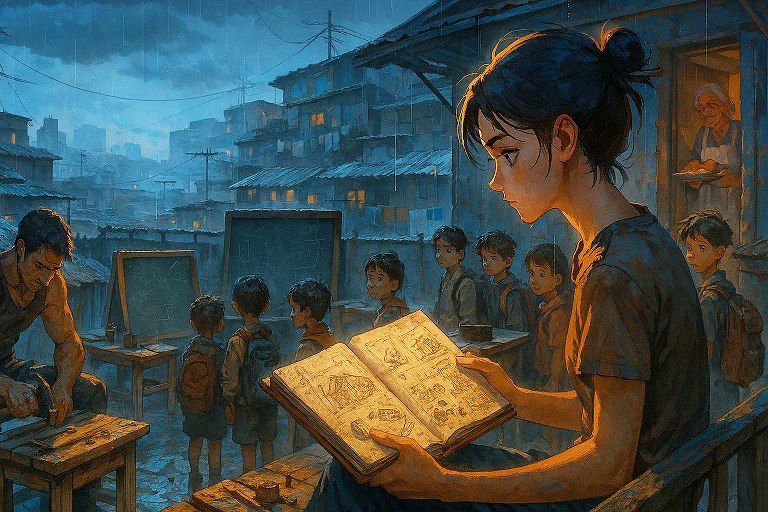
The rain over Caracas had a rhythm that knew the city by heart: a steady cadence that struck tiles, cardboard, and tin, seeming to wash the place without ever truly cleaning it. From the room she shared with her brother, Mariana listened to that distant drum like a metronome marking the measures of a life fraying at the edges. She was twenty years old, her hair tied back with a pencil, and she kept a worn sketchbook filled with drawings of facades, courtyards, and stairways that never came to be. She dreamed of studying Architecture, of giving her neighborhood dignified houses and plazas from which people could look out at the horizon without fear. But the public university, once a gateway of opportunity, had become a functional ruin: classrooms without maintenance, libraries with empty shelves, laboratories stripped of supplies, and a shortage of professors that rendered teaching sporadic, almost clandestine. That reality had struck Mariana deep. One afternoon, while she flipped through a faded faculty brochure with graphite-stained fingers, her friend Ana looked at her like someone resisting the acceptance of bad news. “Are you going to keep trying?” Ana asked, her voice tight, leafing through pages that came off the flyer like fragile fossils. “Yes,” Mariana replied without looking up. “I refuse to give up my plans out of fear. But it’s not the same; classes are a mirage. In Venezuela, if you decide to study, the universities are destroyed and there are no professors.” Those words were not an isolated complaint: they summarized conversations repeated at doors and in markets, phrases that circled the city like heavy flies. The universities no longer simply offered less; they were ceasing to function as hospitals of thought, places where young people could breathe different air. For Mariana, every absent professor was another blank page in her sketchbook. In the mornings, Luis, her older brother, left before dawn. He had worked in construction since he was sixteen: he learned to measure, to carry, to interpret a plan with his hands. Over time, precarity had hardened him: he was offered exploitative contracts disguised as opportunity. That week he came home with a sore back and eyes that had lost their shine. “They offered me another job,” he said, dropping his bag at the door and leaning against the wall. “Twelve hours a day, six days a week. One hundred dollars a month.” Mariana felt Luis’s voice braid with the voices of many others in the city. It was a number that repeated and hurt: “If you decide to work, they want to pay you $100 a month for working 12 hours a day, 6 days a week.” Working was no longer a guarantee of upward mobility; it was a way to survive in a circle that consumed strength and dignity. There were workdays that demanded constant presence and pay that did not compensate for the physical or emotional wear. Faced with that economic and social suffocation, Mariana thought about starting a business. She believed in small-scale projects: a cooperative for light repairs, skills workshops for young people, turning discarded materials into useful objects. She imagined managing, organizing, and teaching. But she soon hit a wall of paper: endless permits, fees, taxes that ate into profitability before the first result appeared. Many projects were born enthusiastic and fell exhausted before bureaucracy and fiscal pressure. “We could try to start something,” Mariana told Carmen, the neighbor, in one of those late-night conversations. “If we organize workshops we can generate income and train people.” Carmen looked at her with the gaze of someone who had learned to survive many blows. “I tried,” she answered. “They charged me taxes that didn’t make sense and I ended up losing money. If you decide to start a business, they want to charge you a ton of taxes and you end up bankrupt.” The word bankrupt hit like a sharp blow to the chest. Taxes were not just numbers; they were obstacles that could pulverize the desire to build independent futures. Entrepreneurship, which in other places is presented as a way out, was clouded here by the greed of rules that did not protect the social fabric. Saving, the basic practice of family security, had also ceased to be a real option. Inflation, voracious and unpredictable, ate the few bills that could be put aside. Mariana kept an old rusty tin under her mattress where she stacked coins and folded bills; every time she opened it, there was less inside than what she had left. “Look at the grocery list,” her grandmother said one day, showing receipts with prices that had risen week by week. “With what we used to spend we barely get by now.” “We can’t save,” Mariana murmured. “If you decide to save, you can’t because of inflation.” The words sounded like a verdict. Economic security stopped being an attainable horizon and became a fragile illusion—a promise time wore away mercilessly. The possibility of emigrating, using distance as a lifeline, appeared in conversations and dreams. Friends and cousins had left to build new lives and stability elsewhere. For many, leaving was the only alternative to a present that bit. Yet borders were not as permeable as need. Visas denied, administrative barriers, and the hostility of countries that closed their doors made exodus difficult. “My cousin made it out, but it cost him years, money, and the renunciation of many things,” Carmen said. “We’d love to leave,” Luis admitted, his tone wavering between anger and resignation. “But it seems no country wants Venezuelans. If you decide to leave the country, they aren’t giving visas and no country wants Venezuelans.” The house filled with silences that spoke: photos of cousins in other continents, delayed messages on apps, letters that took ages to arrive. Emigration was a small, sometimes invisible door that not everyone could pass through. One gray afternoon, on the rooftop where cables and half-finished hopes tangled, Mariana found a crumpled piece of paper with a sentence scrawled by hand: “Without a doubt, this is martyrdom.” She read it aloud and let the phrase hover over the city. The paper was neither elegant nor profound, but its truth hurt with its plainness. “Martyrdom,” she murmured. “Yes. But I don’t want it to be only that.” That small, stubborn determination drove her to act in the immediate. She began teaching informal classes to the neighborhood children in a borrowed parish room and a community space they had managed to prepare with effort. She had no fancy materials: she used sticks to teach angles, bottle caps to explain proportions, cardboard as chalkboards. Her voice became the most important tool; her patience, the glue that held wills together. Children came with patched backpacks and shoes that had known more asphalt than grass. Some had never opened a textbook; others had never seen a formal plan. Mariana turned scarcity into possibility: she taught how to measure with one’s own body and how to imagine space with a single line. “Why do you draw houses with caps instead of with plans?” a boy asked, with the candidness of childhood. “Because with what little we have, we learn to create,” Mariana replied. “Architecture is also imagination and desire.” Luis joined in with what he knew: hands for heavy work that also build futures. He turned discarded planks into tables and benches and organized workdays where neighbors contributed what they could, and the neighborhood started to take shape little by little. They couldn’t replace the formal infrastructure universities provide, but they planted a seed of training and dignity independent of the state. “If this works, at least the kids will have a place to learn,” Luis said, carefully hammering a plank. “It’s not a university, but it’s a start.” The community began to weave a network of mutual aid: barters, combined workshops, informal economies aimed at cushioning the lack of resources. Carmen opened a sewing workshop where she taught clothing repairs and how to make basic garments; the grandmother baked bread once a week to sell and contribute to a communal pot; young people improvised a small library from donated books. They exchanged services: lessons for materials, food for repairs, technical help for work hours. “Let’s exchange classes for materials,” Carmen proposed one day. “I teach sewing and you help me with upkeep and logistics.” “Done,” Mariana answered with a tired but determined smile. “That’s how we get by.” Despite sustained efforts, reality did not grow kinder. Official classrooms remained deficient; salaries were insufficient for basic needs; inflation devoured any savings; taxes threatened the survival of private initiatives; and the inability to emigrate persisted as a barrier. Still, amid this fabric of shortages, people found reasons not to give up: solidarity, creativity, the act of sharing what little was available. The grandmother, with wrinkled hands, held photos of family who had left and said that memory is also a form of resistance. “As long as we are here, let’s do something good,” she said one night. “Don’t let despair eat us.” Mariana returned to her sketchbook, folded corners, and added notes. Her drawings were no longer only exercises in aesthetics: they were plans for what could be built with what they had—community spaces to collect rainwater, workshops to teach trades, areas to learn how to care for the neighborhood. She knew good intentions were not enough; she understood the need to organize resources, reach out to broader networks, and document results to attract support and cooperation. The paper’s phrase—“Without a doubt, this is martyrdom”—stopped being only a verdict and became a record: the martyrdom of daily life, yes, but also a thread that wove resistance. It was not a contradiction: there was pain and courage at the same time. Their story did not promise a heroic ending nor a magical solution; it promised instead the daily narration of small struggles, ordinary decisions that outline the possibility of holding on. Over time, the workshops generated some movement: young people learned trades that allowed them to find work in construction, others joined recycling and social entrepreneurship projects. The tables Luis built began to appear in homes across the neighborhood; the improvised library supported students who could not find references at the university. These achievements were modest but real: shared bread, a class that opened a window to curiosity, a hand that helped nail a plank. The community learned that dignity is not only demanded; it is built, with patience and resolve. They did not ignore the tragedy nor diminish it; they faced it head-on and acted. In that blend of sorrow and work, of resignation and hope, the neighborhood found its own pulse. At nightfall, when the rain softened and the streetlights cast a warm glow over the worn facades, Mariana would pause to look at her sketchbook. The plans were no longer merely aesthetic exercises: they were lists of priorities and schemes for spaces that could improve quality of life. Each line carried echoes of the stories she had heard: Luis’s fatigue, her grandmother’s patience, the children’s laughter, Carmen’s resignation, and the neighbors’ solidarity. There was no sudden solution; the city did not transform overnight. But the actions of that small group were a testament: amid martyrdom, there are modes of resistance that preserve human dignity. That resistance did not present itself as a grand epic gesture, but as daily constancy: teach, repair, share, organize. These acts defied the logic of abandonment that many institutions had shown toward the people. Although the initial phrase seemed an irrevocable sentence, it became a title that encompassed everything: the martyrdom of living under adverse conditions and the resistance that, despite everything, springs up. Mariana did not forget what she had lost nor stop feeling the sadness that lived inside her. But she learned to multiply gestures, to see value in the small, and to believe that, step by step, shared dignity could open cracks through which to glimpse a future with less fear. Under the persistent rain, among cardboard chalkboards and repaired tables, the community continued its daily ritual: rise, work, teach, support one another. Martyrdom, yes; but also a tenacious insistence that, maintained over time, could end up transforming a part of the landscape. And so, with both sorrow and tenderness, life went on—rigorous and possible—in a city that had not lost its voice nor its way of resisting. Source of the images. Image created with Bing.
No comments yet