 @mc5punk
Short story: The Garden Where Questions Are Born
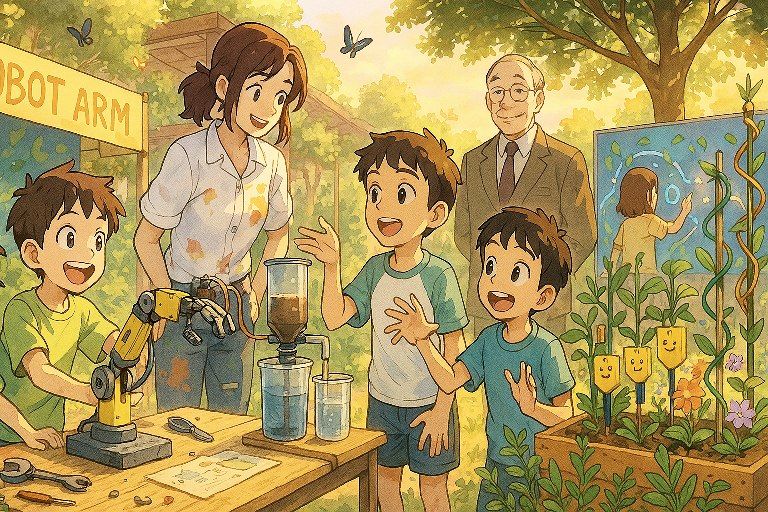
At Arboleda del Valle School, mornings had their own rhythm. They were not just bells and lined-up queues; they were the murmur of ideas, the creak of cardboard as prototypes were assembled, the smell of paint and soil mixed, and the whirr of small motors spinning eagerly. That day, the school was preparing for the course’s first big Science Festival, a day conceived not as a cold exhibition of knowledge but as a celebration of discovery where students were protagonists of their own learning. Teacher Amalia Santos walked among the booths with a notebook full of diagrams and notes. Her shirt bore paint stains—traces of recent projects—and her eyes showed the conviction of someone who had committed to a different way of teaching. As she moved through the stands, she watched the children adjust pieces, test connections, and correct code on small tablets. “Ready for the demonstration?” Amalia asked, with a clear, warm voice, and the students answered in unison with enthusiasm. Beside her, Principal Hugo Méndez, wearing round glasses and an attentive smile, watched everything with pride. He approached Amalia and, pointing to the robotic arm one group had built from recycled parts, remarked: “This is not just a show; I see physics and math concepts applied in every movement.” Amalia nodded and, remembering her early years as a teacher, recalled how science had once been a separate subject, often feared and full of rote formulas that disconnected many students. Since she adopted the integrated sciences approach, her classes had turned into discovery workshops. Lessons were no longer confined to a book or the four walls of the classroom; they arose in the garden, in the improvised lab, in the painting that explained a biological process, or in the sensor that measured soil moisture in the school garden. In one corner of the festival, Sofía and Mateo were finishing their water filtration project. They had designed a simple prototype with cloth, sand, and activated charcoal, and had prepared an explanatory poster full of drawings and notes that combined chemical concepts with a short theatrical dramatization. Sofía wore a mask representing a drop of water and Mateo held a small funnel that served as the stage. “Chemistry isn’t just formulas,” Sofía said as she played her part with enthusiastic gestures, “it’s also about caring for life.” The audience applauded and some parents approached, impressed by how clearly the kids explained the processes. One of them, Carmen, watched the booth closely and whispered to another mother: “I like how art gives meaning to all this. It’s not just pretty; now I understand why my son learned about ecosystems by creating an installation in the garden.” Sofía and Mateo’s booth was a fine example of how biology, chemistry, and physics complemented each other through the language of mathematics: data tables with filtration rates, graphs showing efficiency according to particle size, and simple equations explaining the relationships. But it was the artistic elements—the drawings, the performance, the aesthetic arrangement of the prototype—that emotionally connected with the audience and provided an ecological and functional purpose to their work. Meanwhile, in another area of the festival, a group installed an interactive mural representing a local food web. The mural had sensors that triggered sounds depending on visitors’ positions, and behind the installation was the work of a team that had used mathematics to model dependencies between species. The children explained how changes in one link affected the whole network and proposed creative solutions to restore balance in an urban ecosystem affected by pollution. That afternoon, after the festival’s bustle, Amalia moved to a room where teachers and school leaders from the region had been summoned for a training session. Among the attendees were Javier, a secondary science teacher, and Lucía, who was in charge of teacher training at a neighboring institution. Amalia had prepared a practical presentation that went beyond theory: she showed robotics activities with recycled materials, circuits to measure moisture in the garden, strategies to link real-world math problems with artistic projects, and methods to promote debate and research among students. “In neighboring countries teachers already work this way,” Amalia said with determination. “It’s not about copying a foreign model without context, but about adapting the best: integrating biology, chemistry, physics, and mathematics using technology and art to awaken curiosity from early education.” Javier, carrying the shadow of resistance to change from his institution, raised his hand with some nervousness. “But what if teachers don’t dare?” he asked. “Many prefer to stick to an evaluation plan repeated year after year. It’s comfortable, they know it and know how to measure it.” Amalia answered without hesitation: “That is the danger. Repeating patterns extinguishes curiosity. We must invite knowledge to be socialized, to build projects with students, not limit ourselves to assessing with routine tests. When teachers dare to step outside the script, they allow students to investigate, make mistakes, and learn from the process.” Lucía added from the second row: “We need to break the paradigm that science is unattainable. If this approach is incorporated from early education, we reduce the stigma and keep students close to scientific knowledge.” The training included hands-on activities: in one exercise, teachers designed a micro-robotics project with simple materials, programmed it with block code, and related it to a physics problem (force and motion). They also proposed formative evaluation structures that valued process, collaboration, and the ability to make adjustments based on experimental errors. At the end of the day, the group agreed to organize an inter-school festival and traveling workshops. Lucía suggested panels where students would defend different hypotheses about the same experiment, promoting debate and scientific argumentation. Hugo proposed including creative workshops where art had a functional role: sculptures that also functioned as environmental sensors, murals that incorporated calculations of plant growth based on simple equations, and sound pieces that conveyed climatic data. Back at the school, one of the projects that most attracted community attention was the sensory garden. Students built homemade sensors to measure soil moisture, used basic equations to calculate the volume of water needed per plant, and designed artistic supports and labels for the species. The project integrated biology (knowledge of plants and nutrient cycles), physics (fluid flow, pressure in irrigation systems), and mathematics (measurement, growth projection), all accompanied by an artistic component that turned each plot into a purposeful work. Every mistake in the garden became a learning opportunity: an incorrect measurement led to recalibrating the sensor; a misapplied formula sparked a discussion to revisit concepts; a structure that collapsed required thinking about alternative materials. Students learned to enjoy the process as much as the outcome and to value collaboration as a tool for solving complex problems. “Learning is making mistakes and trying again,” Mateo said one afternoon as he gathered pieces from the robotic arm that had fallen during a test. “And that’s okay, because that’s how we learn to think differently.” Over time, the school and its community began to notice tangible changes. Students who had previously avoided science subjects now actively participated in school debates, proposed environmental improvements for the neighborhood, and developed projects that sought local solutions. Logic and collaboration were cultivated simultaneously; critical thinking ceased to be an abstract skill and became visible in how young people questioned, proposed alternatives, and defended different conclusions about the same problem. Teachers realized that art was not an aesthetic add-on but an essential component that gave purpose to projects: art offered an ecological and functional perspective, helped communicate complex ideas, and emotionally connected the community with scientific content. Technology and digital resources, for their part, facilitated experimentation, data collection, and result presentation without replacing the need for critical thinking or teacher guidance. Amalia, looking at the garden where butterflies landed on a structure created by the students, felt certain that the effort was beginning to bear fruit. She remembered every resistance overcome, the meetings with leaders, the nights of preparation, and conversations with parents who had initially doubted. She thought about the conviction that moved her: breaking down the stigma that science is unattainable from early education, providing technological and artistic tools that turn learning into a dynamic process, and, above all, fostering curiosity. “The important thing,” Amalia murmured softly, more to herself than to others, “is that they keep asking, debating, and enjoying the journey. That way we will have generations capable of reaching multiple conclusions, engaging in dialogue, and building innovation.” In the months that followed, the Arboleda del Valle initiative multiplied: teachers from other schools adapted projects to their communities, inter-school gatherings were organized, and collaborations arose with institutions that provided resources and guidance. Science festivals became meeting spaces where research was conceived not only for its result but for the enjoyment of the process: children and adolescents learned to celebrate mistakes as necessary steps for learning, young people debated respectfully and proposed collective solutions, teachers dared to break schemes, and administrators supported educational innovation. At the end of another activity-filled day, the school rang with children’s laughter and the murmur of conversations that continued. The garden was no longer a simple playground: it had become an open-air laboratory, an extended classroom where science, mathematics, and art met to give meaning and purpose to knowledge. There, every experiment, mural, and debate fed a larger goal: forming students with critical thinking, capable of reaching multiple conclusions, engaging in dialogue, and contributing to their community’s innovation. And so, amid improvised sensors, functional artworks, and robotics projects that failed and rose again, Arboleda del Valle School cultivated more than plants: it cultivated questions. Questions that sprouted in curious minds and that, with the guidance of courageous teachers, grew into small but firm shoots of change. Source of the images. Image created with Bing.
No comments yet