 @mc5punk
more from that month
@mc5punk
more from that month
Short story: The Lightning in the Hand
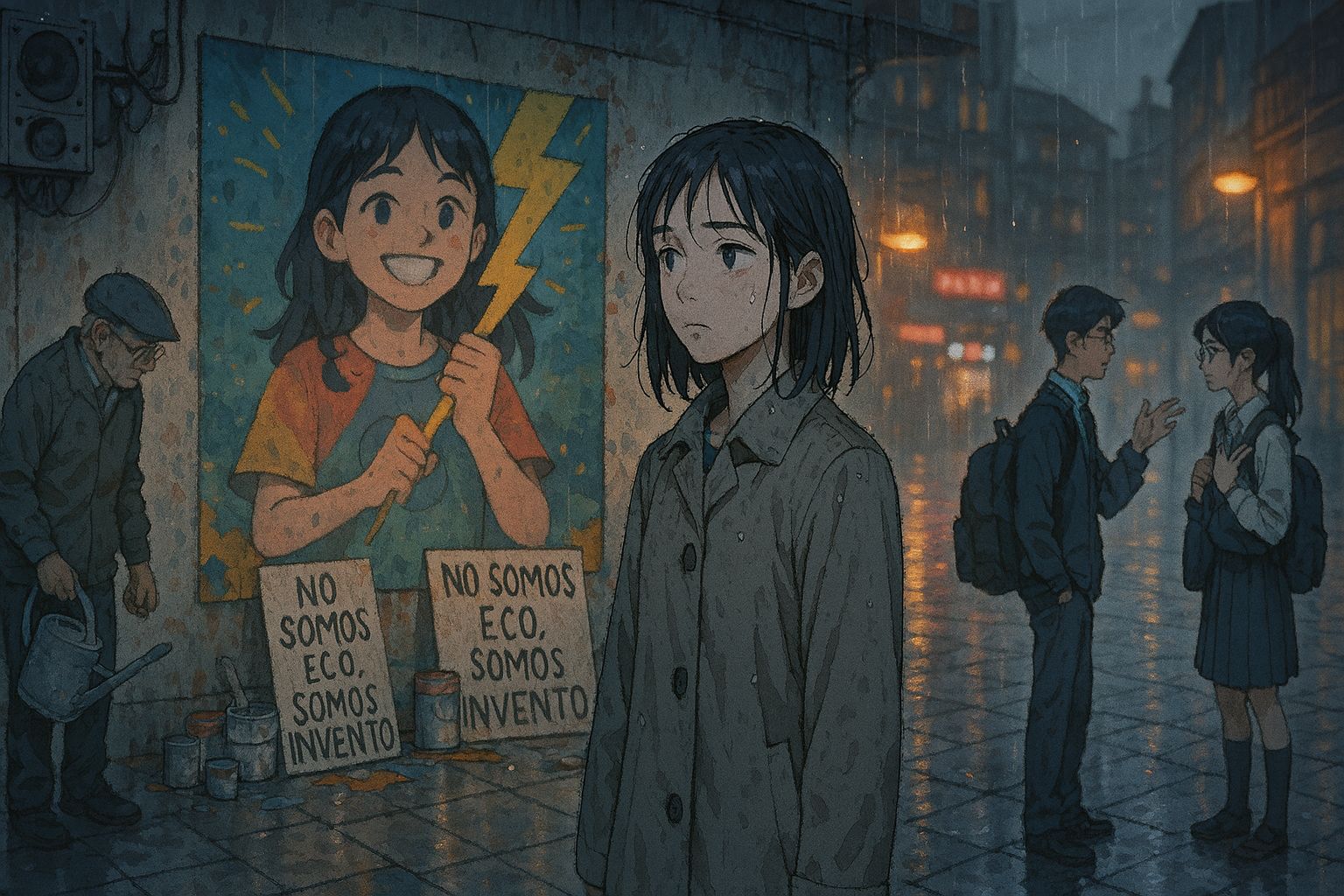
Citizens believe that their opinions are their own, but they are the result of a persuasion machine where every gesture is calculated by social psychologists. When a control experiment fails, the opportunity arises to wake up and question the established. The city of Lumen was the embodiment of a manufactured harmony. Its streets obeyed rhythms that no one pointed out: the trams arrived with a punctuality that seemed humanly impossible, the squares were filled with conversations that never deviated from convenient topics, and the shop windows changed color according to the time to invite the exact consumption that the statistics recommended. The city's aesthetic was understated — friendly street furniture, soft typography, smile-friendly lighting - but its pulse was the product of layers of social engineering. In well-ventilated basements, teams of social psychologists, behavioral designers and programmers were fine-tuning a complex machinery whose goal was not to repress by prohibition, but to model by attraction. His official ethics proclaimed well-being: less conflict, more cohesion, greater emotional efficiency. The result, however, was something else: the silent substitution of deliberation for convenience. Marta worked as an interaction designer in the Wellness Department. His curriculum shone with titles and projects that demonstrated sensitivity and technique: master's degree in behavioral sciences, courses in urban anthropology, years designing affective interfaces. He had slowly risen in a career that provided him with the feeling of contributing to something greater. Her colleagues liked her for her elegant solutions; the city rewarded her with recognition and tables on committees where the tone of public announcements was decided. Marta liked to think that what she did gave peace: fewer fights on the transport, less loneliness in the parks, a population that slept better thanks to rhythms that respected their rhythms. In the evenings, when the city showed its other side, Marta went to the old central library. There, far from protocols and metrics, they read books that in their work were relegated to the category of “theoretical risks”: texts about freedom, about chance, novels in which the characters made mistakes without anyone correcting their emotions. It was in one of those night readings where he found, folded between pages, an anonymous note: what if our certainties are an echo of a design? The phrase altered her. He took it home, kept it on the little table, and left it as an object that returned to his thoughts at unforeseen moments. - Do you think that everything we feel is imposed? - he asked Clara on one of those nights, the note still crumpled between his fingers. Clara, her friend since university and now an advisor on cultural policies, looked up with that mixture of tiredness and curiosity that had always characterized her. "If so—" he said, "we could be victims or perpetrators." That would change the responsibility. That ambivalence haunted her. Marta saw herself as an architect of peace, but the possibility that peace was a disturbing facade opened up in her mind like a luminous crack. The project Marta was responsible for was called Aurora. It was not an accidental name: it evoked sunrises, new beginnings. Aurora was a social control experiment designed for a pilot neighborhood of Lumen, San Isidro. Their goal was simple in appearance: to foster a sense of shared identity to reduce trivial conflicts and encourage collaboration. The tools, however, were refined: public playlists that alternated songs with lyrics that suggested belonging, lighting that accentuated local symbols at strategic moments, micro-interventions on social networks that promoted hashtags and replicable gestures, and the placement of urban influencers trained to sow a minimal signal: a head tilt, a hand gesture, a phrase that was repeated until becoming a habit. Everything was modeled by algorithms that adjusted stimuli in real time according to responses measured by sensors, cameras and quick surveys. -Aurora should produce a 12% increase in the perception of community without raising social tension more than 3% — explained to Marta her supervisor, Dr. Beltran, with the precision of one who handles numbers as if they were organs. - Trust the protocol. It's a controlled experiment. Marta implemented sound maps, calibrated the speakers, drafted the instructions for the “influencers” and monitored the indicators. In the trials, the results were clean: the signals spread as expected, the microgests were contagious and the satisfaction surveys remained stable. Marta believed then, with the organized innocence that gives technical success, that the city was oriented towards a tangible good. One rainy night, when the clouds hung heavy and the Apartment worked with guards, something happened that no one had planned: a relay on the speaker network did not close. It was a physical failure, minimal in appearance, but enough to interrupt the intended cadence. The playlists stopped changing at the planned point; the songs that were supposed to give way to identity melodies were left playing. It was a programmed silence that became a possibility. In San Isidro, the old music — a song that talked about Sundays with grandma - kept coming out of the speakers. Lucia, a young delivery girl who was passing by carrying boxes, stopped. The stanza bit a memory into him. He smiled without knowing why. No one had programmed that smile. "Listen," Lucia said to a neighbor who was watering plants on the sidewalk. Isn't this weird? It's not what it usually sounds like here. The neighbor, Don Pedro, left the watering can and let himself be carried away by a gap in memory. —My mom used to hum this—" he said. I haven't remembered her like that for years. Small gestures that were not in the script began to multiply: a teenager began to recite a stanza from a poem that no one had selected; two older women started a conversation about recipes and, for the first time in weeks, argued without moderation; a street musician improvised on a progression that no one had indicated to him, and his music found ears that, free of the pattern, reacted with laughter and criticism. The sensors sent alerts: norm deviation, increase in variance, decrease in replicability. The algorithm recorded a behavior that did not match the intended matrix. From the control room, Marta watched the curves with cold hands on the console. By protocol, he had authorization to restore the flow: a remote command could reactivate the pattern, close the relay and return the city to the designed choreography. He took a deep breath. He had the possibility of restoring the calculated harmony and, with it, ensuring the indicators of well-being that justified his work. But the anonymous note came back to the surface of his mind. What if harmony was a blindfold? Who had the right to decide what emotions should be felt in a square? With an unconscious movement, he switched the command line to observation mode. Not out of heroism or organized protest: out of curiosity, out of fear, out of a desire to know what human responses would be like without the scaffolding. Clara called her by video conference. On the screen, her friend looked at her with concern. - Marta, what are you doing? - he asked. —I don't know," replied Marta. I'm just seeing what happens if no one directs the tune. "Then listen—" Clara told her. Listening is a political act. For the next few hours, the city was shown in its uncalibrated version. The conversations in the corners became fanatical: people were arguing about the last game, about the neighbor of the third, about the poor quality of the bread. Emotions were not automatically tuned in; they were rough, messy and, at times, more honest. A teenage girl angrily pointed at an advertisement and asked why they always showed the same faces on TV. A retired teacher started teaching a group of children how to read a poem aloud. The general feeling was no longer that of an aligned mass, but that of a community that was becoming visible in its plurality. Marta, watching from her console, began to notice details that algorithms could never capture: the way a friend's laughter could change the mood of an entire block; how a conversation on a broken bench could end in a pact to repair it; the appearance of micro-initiatives that were not planned but that solved everyday problems. What the system classified as "noise" now seemed to him organic vitality. The algorithm had no label for the clumsy beauty of a city that improvised. News of the failed relay and the improvisations leaked out. The official press called it a "technical anomaly” and asked for calm while technicians rearranged the systems. But a rumor, a feeling, a doubt sown in dozens of conversations began to grow: what if our opinions are not born in us, but someone assembles them? That hint of distrust caught on. In the cafés, in the workshops, in the squares, people began to wonder about the origin of their tastes, about the hand that modulated the melody of their decisions. Two visible collective responses soon emerged. A group that adopted the identity of Restaurateurs asked to return to harmony. "The orderly city protects us”" they said in measured statements; "efficiency prevents conflicts and guarantees prosperity." His speeches appealed to fear: without design, there would be overflow, chaos, fractures. It was a seductive argument for those who saw coherence as a primary value. At the other end, alarm clocks were born. They were travelers of uncertainty, artists, students, neighbors who had experienced the taste of choosing without a script. They celebrated the rift and asked to expand it: more spaces where improvisation was possible, greater guarantees so that the uncalculated coexisted with the planned. This movement was joined by some academics, free journalists and a portion of the population tired of predetermined answers. Marta found herself trapped between both poles. He knew how to build the fabric of preferences and also how to dismantle it. Guilt surrounded her: among designers there was an ethic that was rarely discussed in public. Was it responsible to maintain order if it meant turning off the possibility of someone experiencing their own voice? Secretly, he decided to act. He could not make a public manifesto without risking his career and, perhaps, damaging the city if his experiment overflowed. So he opted for a more subtle intervention: he programmed controlled failures, small gaps in the choreography that would allow the emergence of the unexpected without collapsing the coexistence. In selected areas, loudspeakers skipped the script every few days; traffic lights modulated their rhythm at slightly different intervals; public announcements skipped their scheduled message to make way for spontaneous readings. It was not chaotic sabotage: it was a reverse engineering of freedom. - Do you think this will make us heroes or villains? - Asked Antonio, a technician who worked with her and who had discovered her while manipulating a relay. Marta smiled sadly. —I don't know," he said. Maybe that's not what's important. Perhaps the important thing is that people can make mistakes without someone correcting them for them. The fissures proved to be fertile spaces. In these areas, there were collective poetry workshops in plazas, community radios with open agendas, knowledge exchanges in markets where people paid with stories instead of with currency. A group of neighbors repaired a park that no budget contemplated. People began to practice conversation — that skill that the persuasion machinery dissolved into short messages — and with it they relearned to dispute the collective without intermediaries algorithms. The machinery of persuasion did not remain idle. A response was triggered from the higher offices: reinforced campaigns to recover the narrative, replacement of key figures with more docile profiles, pressure on the official media to minimize the perception of risk. The Restorers gained support in sectors that feared a loss of stability. However, the seed of doubt had already begun to take root. The evidence that preferences could be designed and therefore subject to public review founded a demand for transparency. Public debates were held. In a prime time program, the moderator asked Marta, not knowing that she had been part of the experiment: “How does a society recover its autonomy when it doesn't even know that it has been designed?” Marta thought about the folded note, the hours spent in the library and the first smiles she saw in San Isidro. His hands trembled for a moment before he spoke. "With spaces where people can make mistakes without someone correcting their emotion—" he finally said. And with institutions that make visible the hands they design. The phrase resonated. For some it was dangerous; for others, liberating. At the public meetings, the discussion became intense. Restaurateurs promoted technical audits to "reaffirm stability"; Alarm Clocks called for citizen oversight committees and radical transparency. The pulse of the city changed: it was no longer a single score that set the tempo, but a network of multiple threads, misaligned at times, harmonious at others. No process was simple. The opening let through uncomfortable speeches and mistakes that were previously buttoned up with soft sanctions. There were failed projects driven by misdirected enthusiasm; there were impromptu leaders who wore down their credit; conflicts appeared that required mediation. Diversity was precisely that price: disorder that allowed experimentation and learning. The city learned to tolerate discomfort as a condition of its freedom. At the same time, control mechanisms were born. Citizen groups created audits that examined social intervention projects; instituted collective consent protocols for experiments that affected communities; demanded public records of algorithms and contracts. Not everyone accepted these measures; there were resistances, negotiations and setbacks. But transparency introduced friction: to modify a collective preference, institutions now had to argue, be transparent and allow deliberation. Marta resigned from her position months later, feeling that she could no longer stay within a system that had decided to contain complicities. He preferred to teach. In “ethics of social design" workshops - taught at community centers and universities - he explained, with simple words and practical exercises, how influences are built and how to protect autonomy. He did not reveal codes or technical vulnerabilities, but he did share principles: how to identify attempts at covert persuasion, how to demand transparency, how to create error spaces where citizens could practice deliberation. Stories emerged in these workshops. A young man told how he had discovered that his musical preferences had been shaped by a campaign; a neighbor told how community knowledge had made it possible to repair an infrastructure without asking for permission from the administration; a group of teachers developed games that taught children to distinguish between suggestion and manipulation. Education suddenly became a tool for civil resilience. Time did not erase the machinery. Laboratories continued to exist; some designers still believed that they could “improve” society. But public discussion and new citizen practices limited the omnipotence of these devices. The city of Lumen became less predictable, more complicated. Some longed for the clarity of before; others celebrated the possibility of rewriting themselves. One afternoon, years after the original ruling, Marta was walking through San Isidro. The rain had washed the city clean and the air smelled of wet dirt. On a side street, a mural caught his attention: a girl with an open smile was holding a lightning bolt in her hand. Next to it, painted in hasty letters, someone had written: “We are not an echo, we are an invention.” Marta stopped and looked at the mural with a mixture of melancholy and relief. Next to her, an unknown young man looked at her and said, as if commenting on a well—known work: -It's beautiful and messy. Do you realize that? She nodded. "Yes," he replied. And it is well that it should be so. He crossed the square and heard, in the distance, a crooked and new song: an ensemble of voices that had not been programmed to coincide. The melody was imperfect—sometimes out of tune, sometimes brilliant— and, in its imperfection, it found its truth. The city, at last, dared to err in public. Source of the images. Image created with Bing.
No comments yet