 @mc5punk
more from that month
@mc5punk
more from that month
Short story: Mirrors of Ink
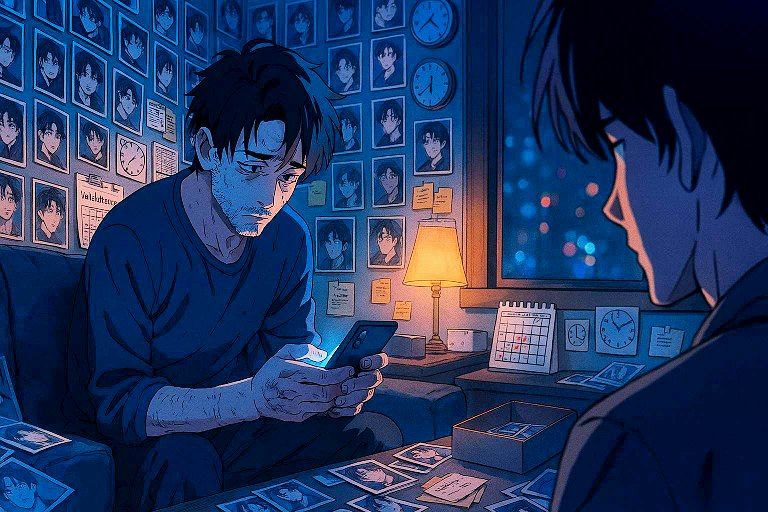
The photo appeared on my screen with the naturalness of something we had all accepted as routine: a measured smile, warm light sculpting cheekbones, an angle chosen to emphasize the jaw. The caption was brief and calculated — “Good morning ☀️” — like a coin tossed to check whether there were still hands willing to applaud. I didn’t think to open it; I had known that ritual for a long time. What I didn’t know was how far those images could open doors I had never imagined. In the stairwell, Marcos showed me the post with his thumb. “Did you see it?” he asked. “The same pose again.” “Yes,” I replied. “It’s monotonous.” “Monotonous, but it works,” he said, shrugging. “Look at those comments.” Alex lived on the fifth floor and was, to the building’s community, a convenient enigma: polite, always presentable, with a tidy line of speech and photos that radiated success. His posts spoke of scholarships, talks, dinners with people who seemed important; his digital life was a showroom without cracks. At first I took it as a professional curiosity: I wanted to see how someone built a narrative with such precision. But the curiosity turned into unease the night I found a private album that apparently had been left exposed by mistake. The images I found were not mere selfies; they came with instructions in the form of notes and tags. “Angle 12 — jaw.” “Flash 0.8 — softens.” “Suggested comment: ‘Thanks for so much love, friends.’” Each photograph had beside it a guideline: what to say, when to say it, how to react to certain kinds of comments. It was like entering the backstage of a show: the face was the stage and the words the script. As I moved through those folders, voyeurism mixed with alarm. This was not improvisation: it was identity engineering. Soon I found another folder with a name that left no doubt: “Validation — 03.” There were screenshots of private messages, lists of highlighted followers, engagement metrics, and a text file that began with a cold line: “Goal: maintain response rate 78%. If drop >5% — activate Protocol A.” My pulse quickened. I opened the file. “Item 1: intensify presence during peak hours. Item 2: provoke subtle envy through association. Item 3: eliminate negative interactions. Item 4: repeat until normalized.” Those were survival instructions for an ecosystem where survival was measured in numbers. The next day I found Alex in his doorway. His smile was identical to the one he showed on screen. “Hi,” he said politely. “How are you?” There was something different about his look: a disturbing glint, a shine that did not belong to the gesture but to the device that always inhabited his hand. When I offered him coffee, his fingers trembled slightly, as if responding to notifications that didn’t exist. “Is something wrong?” I asked. “No,” he lied. “I’m just tired of posting so much.” His tiredness sounded contradictory. At first his messages were innocuous requests for help: “Which headline seems better?” “What do you think of this caption?” But they rose in frequency and anxiety: chained screenshots, missed calls, stories appearing up to seven times a day. Once he wrote me: “Do you notice how X writes to me? Tell me what I can say so it sounds authentic.” The request came from someone who had turned spontaneity into a lost art and needed instructions to fake it. The peaks of approval Alex obtained were not eternal. People who had once praised him stopped; the usual comments became lukewarm. When I pointed out the drop in interaction, he answered with the calm of someone who had foreseen every contingency. “Don’t worry,” he told me. “If the average falls, I’ll launch something big.” His “something big” arrived in three days: a polished photoshoot, a text about personal growth, and a flood of new followers that smelled of promise. The numbers rose and, for an instant, his face softened. He celebrated with a grateful post: “Thanks for so much support.” The victory, however, was a bandage over a wound that bled internally. Reaching new peaks only increased the vertigo of a potential fall. Each new climb required creativity and risk. The posts ceased to be purely aesthetic and began to weave narratives that provoked: insinuations, half-confessions, scenes designed to spark controversy. He offered his followers carefully dosed scraps of intimacy, enough to trigger curiosity but never so much as to truly expose himself. People liked the mystery; the metrics rose. Alex, however, found no solace in the effects. His anxiety grew more primitive and his patience shorter. One night, after a week of growing silence from some key followers, I got a message from him: “Come now. I can’t take it.” The fifth-floor door was ajar. I entered and the apartment looked like a nighttime operations center: screens lit in a cascade, printers spitting out glossy photos, stacks of selfies cut to size. On the wall, taped, hundreds of prints reproduced his face until the features merged into a repetitive pattern. On a table there were lists with names and percentages, clocks with marked times, and a calendar full of mechanical reminders: “Post 09:00,” “Engage 12:00,” “Upload story 18:30.” “I can’t anymore,” Alex said. “Stay, please. Just stay until I post something.” His hands were stained with printer ink. He looked at me as if I were the last lifeline, as if my attention were the anchor that would keep him from evaporating. He uploaded a photo — an image crafted to wound and move at once — and within minutes the screen began to vibrate with notifications. Relief smoothed his face, and for a moment he seemed human again. But the calm lasted little; when the wave passed, his expression contracted with the anguish of someone abandoned by the very construction he inhabited. That was the start of a ritual: post, verify, despair at the drop, implement extreme measures to recover. The escalation grew more methodical and sinister. He began to execute “Protocol A” and other plans I had seen in files: buying followers, orchestrating support campaigns with fake accounts, filing anonymous reports against critical profiles. In his home he practiced dramatic appearances for stories and small controlled fires of rumor and tension that reached his followers as if they were accidents. One night, digging through his files, I stumbled on a document whose name chilled my blood: “Protocol E — Extinction.” It was not a roadmap to regain likes: it was a list of names. Beside each name, the word “Recover” and a set of cold instructions: calls at exact hours, messages that recreated closeness, strategic leaks and, on the last line, a note that made no room for doubt: “If it fails — isolate.” The idea of “isolate” did not speak of gentle cuts; it spoke of expulsion, of methodical erasure. “What is this?” I asked, breath tight. “Plan B,” Alex answered in a low, steady voice—the voice of someone who believed he had found the solution to a problem bigger than himself. “If they don’t respond, I remove them.” I couldn’t take it any longer. I grabbed the file and confronted him. I told him this whole thing was sick, that he needed help. “This is killing you,” I said plainly. “It’s not sick,” he replied. “It’s survival.” That word—survival—had the force of a confession and the lightness of an excuse. In his logic, in a world where visibility was the currency, appearance was not an accessory: it was existence itself. If no one looked at you, you did not exist. That reflection was not just his; it was the diagnosis of an era. But in Alex the consequence had reached the extreme: he had turned his life into a function of others’ reactions, and that reaction had become judge, executioner and deity. From that moment his life became a stage with no curtain. He rehearsed breakups, faked reconciliations, invented confrontations and clung to any gesture that promised noise. His home ceased to be a dwelling and transformed into a set, a storage room and a torture chamber. He slept in fragments, scattered among notifications and programmed alarms. The line between what was authentic and what he staged erased. The downfall reached its climax when a woman who had smiled alongside him in earlier photos stopped following him publicly. The absence of her name had the force of a verdict. Alex pursued her with messages, calls, measured displays of contrition, but she remained silent. The absence became a hole that devoured him. He began tearing his photos off the walls, ripping prints with reddened hands, cutting his work as if trying to evict an unbearable presence. “What did I do wrong?” he muttered one afternoon as he tore a photo. “How did they leave me?” “You don’t know,” I said. “No one knows.” In the darkness of his apartment there was something that no longer belonged only to him: a collection of masks that were worn and discarded, a logistics of lies he could no longer sustain. Desperation sought a gesture that could not be neutralized by algorithms, a climax that would break the calculus and force people to look not out of fleeting curiosity but out of shock. He prepared a scene he wanted total and irreversible. The night everything overflowed, the building smelled of ink and coffee. He had plastered Post-its on the walls with slogans that promised intrigue; he had printed paper even in the elevator. I ran down when I heard the dull sound of glass breaking. In the lobby, Alex was standing in the flow of people, a box of photographs open in his hands. He had a lost look and a scream lodged at the back of his throat. “Look,” he cried, lifting the box. “Look what I am.” People gathered, first curious and then with the distance we keep for what we suspect isn’t right. For a moment there were whispers, then phones raised in the reflex to turn pain into content. For a few minutes validation was massive: stares, cameras, comments. What Alex had sought so desperately—being seen—arrived in waves. But the crowd exercised its subtle cruelty: they were not seeking understanding; they were seeking spectacle. When the photos hit the floor, people trampled them; his face was dragged and denatured by careless steps. “Don’t step on them!” he screamed, torn. “They’re mine!” A neighbor snapped at him in a sharp voice. “Enough.” “Please,” Alex stammered. “Tell me I exist.” Some called for more spectacle; others filmed and shared. From phones came calls for escalation: “Do something bigger.” The pressure of that anonymous demand was lethal. The man who had built a maze of mirrors could not bear that everyone had, in the end, stopped recognizing in his figure something human and not a consumable object. The night ended with ambulances, news cameras and headlines that reduced the tragedy to a viral anecdote: “Man spreads photographs in the street.” On social media reactions ranged from swift condemnation to shallow empathy; for many it was entertainment, for others a warning. He was admitted to a clinic. They told me staff described him as someone who had lost the ability to distinguish acting from living, and who reacted to the lack of applause as if to extreme cold. They said he repeated numbers, percentages and schedules; that he begged to be told how many likes had arrived and tormented himself with the idea of being invisible. After his admission, the building’s routine returned but with something changed: the light curiosity that had once been easy was now tinged with caution. Weeks later, in the stairwell, Marcos asked me if I thought Alex could recover. “Do you think he’ll get better?” he asked. “I don’t know,” I answered. “But I choose to believe he can.” I left with the sense that Alex’s story was not simply that of a man broken by his own ambition. It was an illustrative consequence of a social architecture where interactions are commodified and admiration becomes metrics. In that design, the person who turns their face into merchandise and their affection into numbers is exposed to a dark risk: the inability to lose without collapsing. Alex was perhaps the most brutal version of a trend: his ruin was not caused by a single factor but by the convergence of that design and his own fragility. At home I keep a copy of one of his photos. On the back there is a handwritten note, barely legible: “If there are no eyes, there is no me.” Sometimes, when I turn off the lights, I leave it on the table and look at it. I wonder how much of ourselves we sell in microdoses for a gesture that lasts the time it takes for a thumb to swipe. The phone vibrates often; I look, count notifications, give a tiny approving gesture and turn it off again. There are nights when the gloom and the screen’s glow make me feel a borrowed identity, and I wonder whether I’ll ever get back the habit of looking at myself without asking the world for permission. For many, Alex’s photos became a moral lesson; for me, they were a warning in living flesh: when you reduce your being to merchandise and your affection to metrics, you lose the possibility of losing without dying. And when the fall comes, what awaits is not compassion, but entertainment. Source of the images. Image created with Bing.
No comments yet