 @mc5punk
more from that month
@mc5punk
more from that month
Short story: The Gray Pack
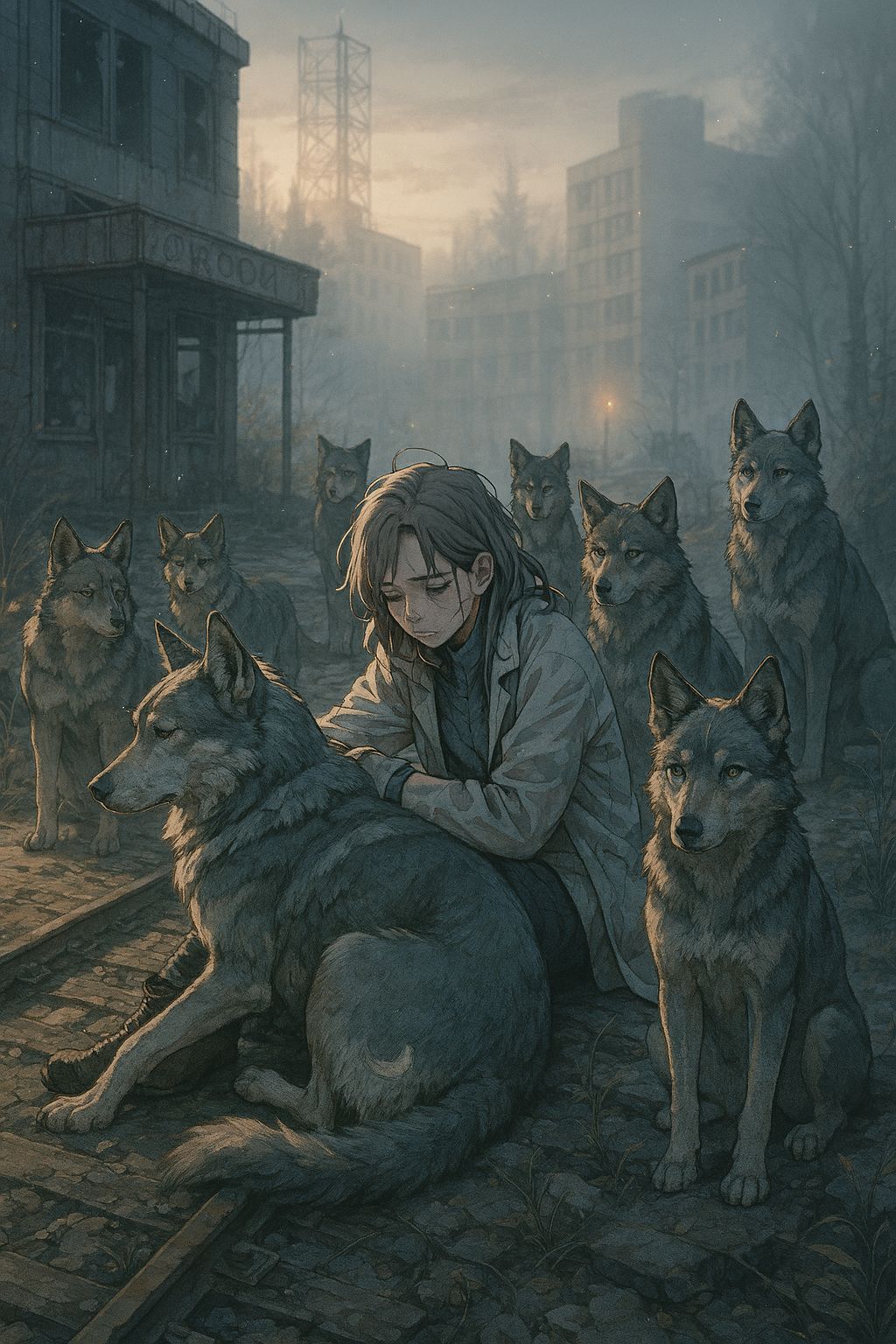
The fog did more than descend; it seeped like an old thought, like a letter never sent, filling the gaps where voices and footsteps once lived. In the exclusion zone time had stretched until it became tangible: broken windows, trees growing through sidewalks, signs still bearing names no one spoke. There, in that paused landscape, the dogs had learned to measure the world with the slowness of those who know waiting is a way of existing. Vera arrived at dawn, when the light was a wash of gray and distant smoke seemed like unmade promises. The SUV creaked as it stopped in front of the station. Yuri, the guard, stepped out beside her; his face was a map of all the nights he’d spent watching over what remained. They walked with ceremonial steps, as if each movement required the place’s permission. “Look how they move,” Vera whispered, the camera hanging from her neck like a reliquary. “They aren’t city dogs.” Yuri tilted his head and pointed to an old dog dozing beside the skeleton of a car. “That’s Kolya,” he said. “The leg was patched by hands that are gone now. He survived when no one else could hold on.” The dogs gathered around a rusted kiosk; some crossed the tracks with the indifference of animals that had made the territory their own. Their coats defied common memory: ashy streaks of silver, blotches that traced contours where light seemed to pause, dark bands that resembled maps. These were not merely ornamental mutations; for those who watched them with scientific eyes and with affection, they were the writing of years spent living with a poisoned world. Vera’s discipline compelled her to convert fascination into method. She spread out maps, marked routes, set cameras in trees and in the mouths of disused tunnels. Hour after hour, day after day, she accumulated records: passage times, interactions, resting places. At the same time she collected samples with the care one reserves for relics. Her notes, written in ink and in digital files, spoke in two languages: one of the lab, the other of intimacy. “What are you looking for in their DNA?” Oksana asked her one morning. The volunteer’s hands were steady and her gaze weary; she arrived daily with a thermos and two cans of food. “Signs of adaptation,” Vera answered. “Variants that might indicate DNA repair, tolerance to oxidative stress, changes in metabolic pathways. But not only that: I want to understand how biology is articulated with behavior. Science can explain the ‘what’; I also want to know the ‘how’ and the ‘why.’” Oksana exhaled a sigh that carried too many winters. “They’ll teach you more by how they live than by any sequence,” she said. “We give them food; they show us how to stay.” Months became seasons of observation: springs of sparse grass, summers of still days, autumns with fog that drew tight circles, winters that hardened everything. Vera documented 302 animals whose genetics would be analyzed with fingernails and patience in distant laboratories. The tests revealed the unexpected and the inevitable: marked genetic differences compared to other canine populations, signs of selective pressure, variants suggesting biochemical adaptations. The publication in Canine Medicine and Genetics was clinical in its language—tables, p-values, phylogenetic trees. But behind those numbers a far larger story was being woven. Mila, with her crescent-shaped mark, became a living epigraph. She was born in a shack among scrap and loose bricks, and eventually became the mother of litters that learned not only where to find food but also which paths to take, which shelters to trust, who to approach. Her offspring took on variations of the curious coat patterns that drew the researchers’ attention: blends of tones, seasonally shifting patterns. Mila led, taught, corrected. There was no human pedagogy in her acts; there was instinct and a cumulative series of small choices that, together, kept her kin safe. “See the crescent?” Lev asked, a thin volunteer who always brought worn blankets, pointing at the dog. “They say it brings luck.” “Luck here,” Vera replied, “is finding a bowl by morning. The rest is superstition for those who don’t wake up early.” The dogs’ coexistence included soft hierarchies: watch shifts, mothers sharing shelters, elders who taught how to avoid dangerous zones. Kolya, with his repaired leg, functioned as a tacit patriarch. His growls and nudges were practical lessons—how to cross a field sown with unseen traps, which street to avoid on windy nights. He steered the pups with the granite patience of those who know survival is a craft taught by repetition. Scientists debated in conferences, often amid cigarette smoke and reheated coffee, about the extent of mutations, the possible reuse of those genetic pathways in other species or humans under similar stress. Alexander, a veteran researcher, argued with scholarly zeal that sometimes smelled of control. “We don’t extrapolate humans from dogs,” he would say. “But understanding DNA repair mechanisms can open useful questions.” “We can’t reduce everything to mechanisms,” Vera responded. “There are social fabrics, microbiotas, behaviors that alter selective pressure. Life here is an integrated system.” Irina, the microbiologist, added another layer: the dogs’ gut microbiota shifted with seasons, diet, and environmental conditions. That microbial community could help break down unusual foods or neutralize toxic compounds. It was another link in the web allowing the dogs not only to survive but to thrive in an ecology that forced them to reinvent themselves. Scientific literature spoke of “biological resilience.” The media sought emotional headlines: “Dogs That Defy Radiation.” Between coverage and coverage, the hands leaving food at night remained the same, and the whispered names around the kiosk—Mila, Kolya, Lev, Oksana—wove stories that did not fit into abstracts. The human-dog relationship was ambivalent and profound. Some volunteers came for the certainty of not feeling alone; others came from guilt; others from a desire to contribute. Vera observed these interactions with distance and tenderness. On long nights she would ask herself how many of those people saw the pack as a mirror—animals that inherited human absence and yet still rummaged the ruins for the possibility of companionship. One afternoon, while dry leaves bit at the SUV’s wheels, Yuri found her sitting on the cold ground, her hands on Mila’s flank. Silence between them did not need translation. “What are you looking for now?” Yuri finally asked. Vera closed her eyes and let the wind answer. “Answers that don’t fit in papers,” she said. “I want to know why they keep coming back to us. Does it remind them of what we used to be? Is it habit, or the last thread of trust?” “They remember hands,” Yuri murmured. “They force us to look at what we’d rather forget.” The question resisted precise terms because the word “abandonment” carried the imprint of 1986: the hurried escape, doors shut, owners who left with the promise to return and the inability to do so. The dogs had been innocent witnesses and victims of that rupture. The memory of human contact—food, warmth, strokes—was embedded in their behavior patterns. Yet their adaptation was not merely an individual endeavor; it was collective, built on networks of canine support that mimicked, within limits, family bonds. With publication and notoriety came visitors: students, journalists, film crews. Equipment, questions, and sometimes intrusions arrived. Vera learned to shield the animals from curiosity that crossed lines. She did not want the pack turned into spectacle. So she enforced protocols: minimize contact, let animals keep their routes, ensure human presence did not become an added disturbance. Scientific literature began to accumulate: papers on DNA repair, elevated antioxidant mechanisms, changes in genes associated with stress response. Other studies pointed to behavioral modifications: increased sociability, a tendency toward cooperation, more communal care of pups. Each study added a piece, but the puzzle remained immense. At a conference, Alexander posed a grave question aloud. “Is it ethical to observe without intervening? How much can science allow nature to pay while we watch?” The question hovered like a breath over the room. Vera—fatigued by too much seeing—looked at him. “The line is thin,” she replied. “We can’t cure everything, nor should we mortgage lives for curiosity. But we have a duty to understand, to prevent future harm that could affect us as well.” The following winter was long. Snow covered scars no one would erase. The pack learned to find tunnels among debris, shelters that barely warmed. One particularly brutal night a storm trapped newborn pups. Vera, Oksana, and Lev worked until dawn, laying blankets and carrying food with hands that shook from cold and something like fear. In those hours science appeared to assume a human value: not merely measuring, but helping. With spring came new questions: what long-term effects would the adaptations have? Would selection alter future behaviors? Could the dogs’ genetics reveal risks for other species? Answers remained hypotheses scribbled in journals and discussed in university cafés. Over the years Vera reconciled with the idea she would not find a single truth. She learned to live with the place’s contradictory wealth: bitter beauty, resilience composed of wounds, tenderness that did not deny harshness. Her hands—stained by lab work and by animal caresses—mirrored the blend of science and affection that defined her calling. On a final long visit, seated beside Mila, who now showed more gray than anything else, Vera received Alexander and the team. A small ceremony followed: exchange of observations, a reading of results, words intending conclusions. But at dusk, when the scientific lights went out and only the wind whispered, Vera sat again on the ground and let the pack circle her. “Sometime,” Alexander said, with a hard edge, “we’ll understand all the mechanisms.” “Maybe,” Vera answered, “but understanding isn’t absolution. There is memory and guilt here. And, surprisingly, there is affection.” Oksana appeared with a shared thermos. Lev brought a blanket. Yuri watched from a distance, carrying a mix of duty and remorse that never fully heals. The dogs, with their everyday wisdom, settled as always: in shifts, curled, keeping watch. Vera rested her forehead on Mila’s side and thought of the layers of meaning that overlapped: genetics, microbiota, behavior, social history. But she also thought of the most human question of all: what remains when people leave? The animals left behind are not only survivors; they are involuntary narrators, persistent. Their bodies bear the imprint of what happened and, at the same time, the capacity to invent new routines. The story of Chernobyl’s dogs became many things: a basis for research, a subject for documentaries, a matter for ethical debate. But above all, it remained a murmur across the zone: the rumor of footsteps that do not stop, the rumor of those who keep on existing after the fracture. Scientists would keep studying. Volunteers would keep bringing food and blankets. The dogs would keep traversing ruins with the dignity of those who learned to turn absence into continuity. Vera knew that no paper or photo could encapsulate the whole of that experience. The pack was not a discovery one could possess; it was rather a lesson that obliges looking and responsibility. And so, under a sky that changes hue and towers that rust with patience, the pack remained—not as a triumph over disaster, but as a living testimony that life, even wounded and changed, knows how to find ways to go on. In their eyes one could read the story of those who left and the promise in every bark: the possibility of persisting amid abandonment, the evidence that fragility can become resistance, and the warning that when human memory fades, others must carry its traces. Source of the images. Image created with Bing.
No comments yet