 @mc5punk
more from that month
@mc5punk
more from that month
Short story: The Deluge of Lost Days
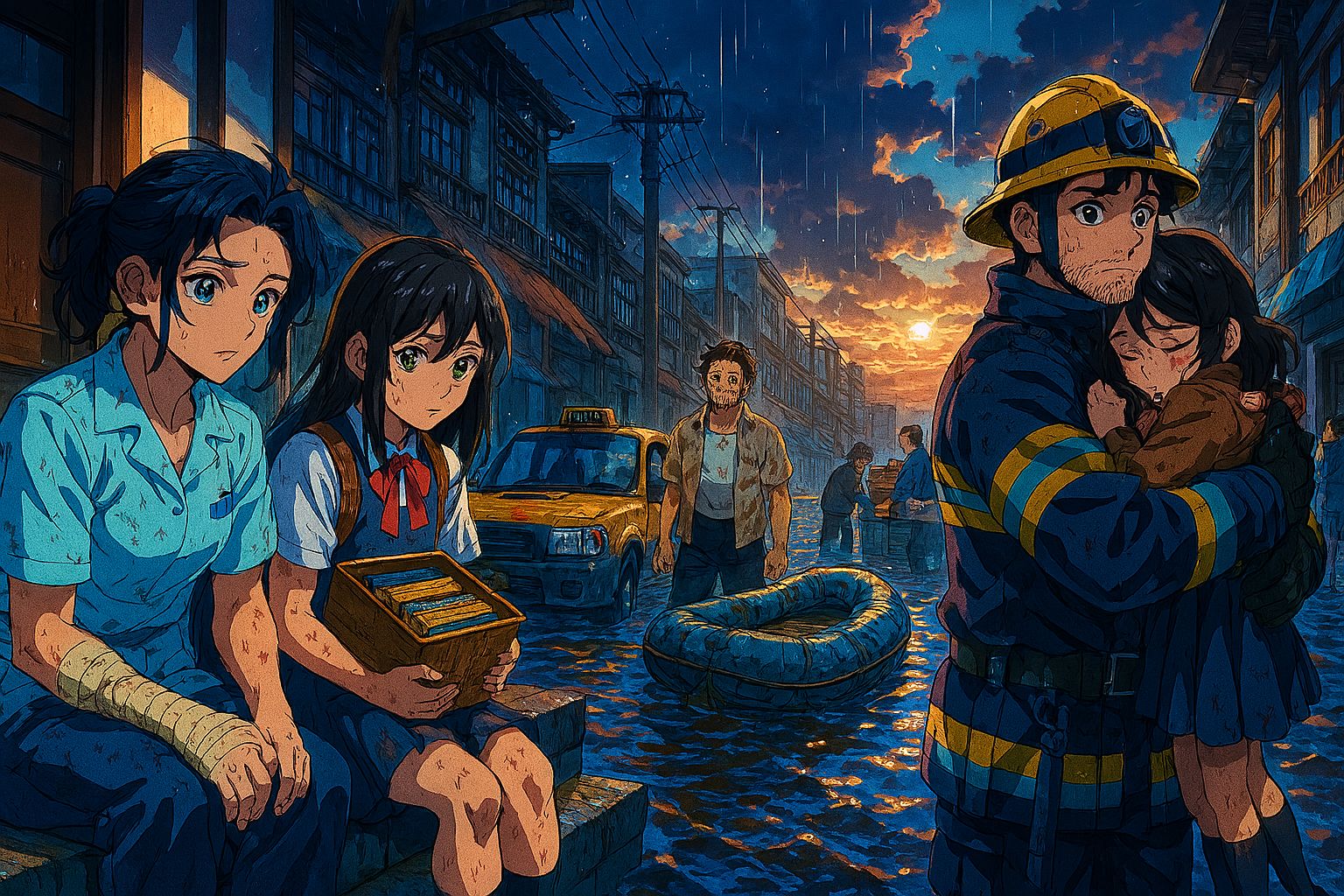
The rain did not warn. It arrived without prior signs, like a radical interruption in a calendar the city believed secure. It fell with the violence of a broken vow, and over the course of seven days it turned avenues into rivers, plazas into dark mirrors, and schedules into useless memories. What began as a downpour became a constant presence, a force that unraveled routines and tested the patience and endurance of those who lived beneath its roofs. Mariana saw it first from her window: the soaked curtain, the street transformed into a gray ribbon carrying trash, papers, and torn posters. She was a nurse, and still the vertigo of it penetrated her to the core. She packed syringes into waterproof bags, filled backpacks with saline and bandages, and descended the building stairs with the feeling that each step was a decision. When she reached the school that, within hours, had become an emergency center, the place smelled of damp, bleach, and tension. Mariana arranged cots between desks, lined up first-aid kits as if ordering pieces in a puzzle that admitted no mistakes. Fatigue read across her face — a weariness born not only of the body but of sustained responsibility. Diego stood in the street, breathing the scent of asphalt churned by water. A taxi driver by trade and neighbor by necessity, he adapted his old pickup with what he could: ropes, life vests, a small inflatable boat he tied to the roof like a talisman. He answered each call on the radio: “Second floor on Lavalle, an elderly woman is stuck.” “A car overturned on 9 de Julio avenue.” With a rough calm and the manner of someone who had spent long nights working, Diego responded to every plea. He knew that when a city breaks, it demands hands that keep working without pause. In his vehicle he carried blankets, a large flashlight, and the habit of offering time without asking for rewards. Sofía, twenty-one and carrying the vertigo of someone who still keeps dreams in her backpack, crossed the campus with a box of books held high. Mud squelched in her boots and the wind slapped the box against her chest. She was a student and a volunteer: she had chosen memory as her cause. In the library she improvised shelves on top of tables, moved volumes to higher floors, and sealed the oldest editions in boxes with tape and care. For her, books were a form of continuity; losing them would mean losing a shared story. People spoke little on campus, but when someone smiled in approval, Sofía felt she was not alone in the task. By the third day, the city had ceased to resemble itself. Public transport had given up: subway stations flooded, cables sagged, traffic lights blinked with the expression of an injured animal. Héctor, a veteran firefighter, stood at the center of operations with soaked boots and numb hands. He commanded from the bow of a raft with the gruff voice that demands obedience and trust. He had trained for fires, collapses, and high-altitude rescues, but nothing had taught him to face a patient, wet enemy. Rescuing Luca, an eight-year-old boy who shivered under blankets and sobs, was an operation that blended technique and tenderness. “Calm down, little one,” Héctor told him, taking his hand. “We’re going to bring you to your mother.” That promise, plain and concrete, became an island of truth amid the chaos. Doña Carmen was another presence the city needed. Seventy-two years old, carrier of memory and custom, she opened her building’s door and let anyone who knocked step inside. She prepared broth in jars, spread borrowed blankets, and spoke with the authority granted by experience: “Let them in, they need warmth,” she said, her voice leaving no room for apologies. In the school-center, alongside Mariana, she organized shifts to serve food and give tired hands a rest. Her certainty was a compass: in a flooded city, humble gestures kept people standing. Merchants reacted with professional improvisation. Raúl, owner of a market stall, turned crates into tables and planks into shelves. From the first day he issued orders like a captain: “Eggs in boxes inside, canned goods on the back table.” His customers, now queuing through water-filled gullies, stopped being buyers and became companions in waiting. Bread, stories, and blankets were shared; recipes and small comforts passed from hand to hand. Among conversations and heavy silences, an invisible network formed — the fabric of future reconstruction. Nights brought a persistence of shadows. The city endured power outages and windows revealed silhouettes lit by candlelight. Old fears surfaced in hushed voices: parents calling unanswered numbers, neighbors who did not return, family portraits floating away and vanishing. Mariana, amid stacked cots and pleading faces, listened to confessions, soothed cries, and administered medicines with ritual precision. Her work extended beyond treating bodies; she gathered words and wove narratives so no one felt lost. “Tell me your name,” she would ask, as if naming restored dignity. By the fifth day the city began showing deeper wounds. Parks that were lungs had become lagoons; public sculptures leaned with sorrow; facades exposed the rot beneath. Father Samuel opened the church’s arms and welcomed those seeking shelter and rice. The parish ceased to be merely symbolic; it was a lifeline. Raúl coordinated the distribution of supplies as if conducting an orchestra: raised hands, clear instructions, human order. Doña Carmen knitted blankets beside mothers who could not find the words to describe their losses. These small tasks, accumulated, formed the backbone of resistance. Sofía spoke with Mariana one afternoon in a corridor turned dormitory. “I stored the most valuable books in a safe in the basement,” she said softly, as if fearful the box was a fragile talisman. Mariana, eyes marked by exhaustion, nodded. “Good. We will preserve memory.” Both understood that memory would be indispensable to rebuild more than bricks. The sequence of rescues had the density of a novel of small heroics. Firefighters hoisted families from rooftops that served as refuges; volunteers improvised ropes and planks to bridge gaps where sidewalks once were; Diego towed cars, pushed rafts, and ferried people to safety. Some acted without witnesses: a young man saving his grandmother, a couple offering their roof to five strangers, a neighbor bringing generators to the emergency ward. The city did not expect medal-bearing heroes; it expected hands that knew how to respond to the rain. When the rain finally relinquished its monopoly on the sky, the silence that followed carried the weight of the irretrievable. Seven days of water had left marks: sticky mud clung to streets, facades showed their bones, ruined trees demanded patience. The sun peered out timidly, as if asking permission to enter. Mariana sat on the school steps and let everyday life reach her in the form of exhaustion. “I didn’t think we would hold on that long,” she said in a low voice, as if speaking to the city itself. Sofía, clothes splashed with mud, looked at her and answered, “We did it together.” The phrase sealed a provisional chapter — a pause before the next task. Reconstruction began the next morning. Cleanup brigades organized into teams that worked without schedules; psychological support centers opened for those who carried the rain in their memories; donation networks multiplied to supply food, clothing, and medicine. Héctor embraced Diego upon reuniting a child with his mother; Raúl and Doña Carmen organized community ovens for those who had lost their kitchens; Father Samuel drew up priority lists to repair the church and serve as a beacon. Daily life became a mixture of logistics and consolation. The city, battered, stood thanks to minimal gestures that proved essential. Facades demanded repair, streets would need to be relaid, trees might take time to offer shade again; but the experience left an intangible imprint: a network of small fulfilled promises. Those who walked among the ruins returned home with more than mud on their boots: they carried the understanding that a city is, before its buildings, the sum of shared acts. In the days that followed, newspapers recorded not only losses but stories of quotidian courage: Héctor returning a child to his parents, Diego towing a couple from a terrace, Mariana caring for a wounded person until their pulse steadied. Sofía organized collections to replace lost books; Doña Carmen continued to distribute soup to anyone who knocked on her door. Collective memory began to name those on the front lines, but above all it remembered nameless gestures. The deluge left a city with a changed face and a community more aware of its fragility and its capacity to respond. It was a week of simultaneous loss and discovery: loss of objects and certainties; discovery of the power of solidarity. Amid the mud and debris, in that landscape that would take time to regain its polish, a lesson glimmered: a city is rebuilt not only with cement but with the clasp of hands offered, with the repetition of small acts that, sum after sum, restore the common. Source of the images. Image created with Bing.
No comments yet