 @mc5punk
Short story: Shadows over Los Álamos
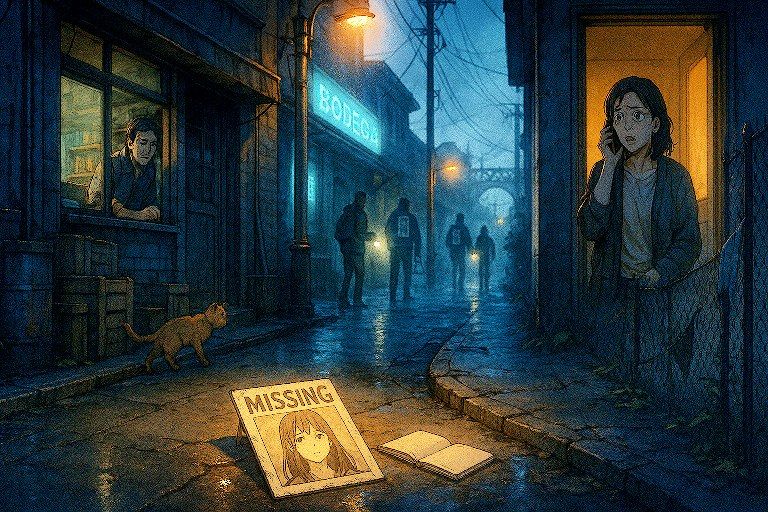
May 7 began like any other day in the Los Álamos neighborhood. Clouds promised rain and the wind moved the trees’ leaves in a dry rhythm. Mariana got up with her notebook under her arm, checked that the poster board she needed for her school project was ready, and left the house with the calm of someone taking a familiar route. —Mom, I’ll be right back, —Mariana said as she crossed the threshold, the poster board folded under her arm, her voice light. —Don’t take too long, sweetheart, —Ángela replied without taking her eyes off the pot boiling on the stove— and don’t get your hair tangled with everything. She split the routine into two blocks: the corner with the newsstand where she always paused to look at the covers, the concrete bench under the old tree, the short step over the cracked sidewalk. The tawny cat, lord of many afternoons, watched her pass and disappeared behind some boxes. No one imagined that that short walk would be the thread that unraveled. She never reached the bodega. She never returned home. At six in the afternoon, when the sun began to fall and the shadows lengthened, the poster board did not appear on the table. Ángela noticed the absence first in small details: the untouched cup, the open notebook where Mariana had left a half-finished drawing, the house door left ajar when it should not have been. The mother went out into the street with short, shallow breaths, asking before she could fully name the fear. “Did Mariana come by?” Ángela asked the bodega owner in a low voice, eyes fixed on the counter. “No, ma’am. She hasn’t been by here,” the shopkeeper said, shaking his head. “If she does, I’ll let you know.” That denial hit like a stone. Ángela returned home to check if, in the midst of some adolescent mess, her daughter had been delayed. She searched rooms, the rooftop, called her phone until the ringing grew weary. Minutes stretched into hours and calm shattered into a thousand pieces. That night the family lived between disbelief and waiting. Calls came from distant relatives offering practical comforts and promises. In the living room they tried to hold normal conversation, but words tripped over one another. Around them life went on: a neighbor hung laundry, the corner radio talked about soccer, and yet the house felt suspended in a time that would not return. “Maybe she went with a friend,” Aunt Rosa murmured, trying to mend the anguish with plausible explanations. “She’ll probably show up in a bit.” “I don’t know,” cousin Javier replied, clenching his fists. “She’s not the type to disappear like this.” The community soon noticed the movement: neighbors watching from balconies, children stopping play at the sound of a woman calling a name in the night. When darkness enveloped the streets, Mariana’s absence became more tangible. Streetlights sketched islands of light and footsteps echoed urgently through the square. Door-to-door searches began. A small group traced the route Mariana should have taken: the bodega, the bus stop, the corner where teenagers gathered to smoke. They combed parks and the corners where the girl used to draw. They asked at schools, the barber shop and the town hairdresser. Answers were mostly negative until voices with conflicting accounts appeared. “I saw her passing with a man I didn’t recognize,” a man at the square said in a rough voice. “They were talking.” “I heard her arguing with someone on the avenue,” another witness insisted. “It was a man’s voice, loud.” Each statement opened a new labyrinth. Rumors began to spread like oil: that she had left with someone older, that she had been forced, that she had been deceived. The murmur that had once concerned markets and parties now revolved around a question no one could answer: where was Mariana? Ángela wanted to file a report immediately, but bureaucracy halted her with its coldness. “We can’t formalize it yet,” an official told her, his voice grave. “There are certain hours that must pass before we proceed.” “Hours?” she exclaimed in disbelief. “My daughter is missing!” The response left her reeling. The need for action collided with procedures and delays. Finally, after two days that felt endless, the family managed to file the complaint. Agents from the Anti-Extortion and Kidnapping Group (GAES) arrived with professional rigidity and technical language. They collected testimonies, requested phone records and reviewed the municipality’s security cameras. Their presence gave the illusion that something was moving, but also revealed how limited the certainties were. “Did she have enemies? Was anyone following her?” the lead investigator asked, notebook in hand and a beard of stubble on his face. “Not that we know of,” Ángela answered. “She was a quiet girl. She only wanted the poster board.” The agents cross-checked data, consulted lists, and began to map the case’s relentless questions. In the station a deleted message from Mariana’s phone surfaced like a shadow: a fragment of a conversation about “help” and “discretion.” No one could explain its meaning. Desperate to amplify the call to the community, the family turned to regional media. Ángela went to the local newspaper with a photo of her daughter: the image showed a teenager with an intense gaze and tied-back hair, a smile that seemed to hold a promise. They placed the family’s phone number next to the photo and waited for a call that might change everything. “If someone has her, speak up,” the mother said on the local radio, searching for firmness in her voice. “I beg you to return her.” The plea’s echo spread through streets and social networks. What had been a private concern became a story that crossed boundaries: neighbors from other blocks asked questions, bus drivers mentioned the disappearance at stops, and the tale reached regional press. The town split between those offering help and those fearful that speaking up brought risks. The community organized vigils and search groups. Ramiro, a merchant known for his decisive nature, took the initiative. “We can’t just wait with our arms crossed,” he said at a neighborhood meeting. “I’m organizing a search party right now.” “I’ll go with you,” Marta, the schoolteacher, replied. “Mariana is like one of my students.” Nights in Los Álamos filled with flashlights, hushed conversations and improvised maps. Shifts were formed to patrol surrounding areas, posters were stapled to posts and flyers distributed in the central square. Still, uncertainty persisted like a fog that would not lift. Police work had ups and downs: anonymous calls turned out to be cruel pranks, testimonies contradicted one another, and leads petered out. One dawn a partial footprint was found in the damp earth behind the bicycle shop; to the family it was a glimmer, but the print led to no clear culprit. On another occasion they recovered a recorded conversation in which an unknown number requested “discretion,” but its origin could not be traced. “Who wrote that?” one investigator asked, showing the fragment. “Did anyone else have access to her phone?” “Only her,” the best friend said in a trembling voice. “I don’t know who could have.” The search was also an exercise in exposing collective secrets. In cafés whispers circulated about hidden relationships, debts paid with silence, and how easily daily life could conceal danger. Suspicion sank in deeply; some began to regard those they once greeted casually with distrust. “What if someone in town knows more?” neighbor Dolores whispered to Ángela one dawn. “There are things people don’t tell.” “If they knew, they’d say,” Ángela replied in a broken voice. “I wish they had the courage.” Media and police pressure attracted outside attention. A regional reporter wrote a feature combining official data and local testimony; his piece not only recounted Mariana’s disappearance but also posed uncomfortable questions: who benefits from silence? What pacts sustain routine? The exposure forced some documents, formerly kept in drawers, into the light. A month after the disappearance, a nighttime phone call shook the family. The voice on the line was formal, almost mechanical. “We have found indications that require an investigation outside the municipality,” the agent said. “We must proceed discreetly.” The news ignited hope and fear in equal parts. Agents expanded the search radius: neighboring routes, settlements reached by passing trucks and stops far from common sight. Suspicions moved toward directions no one wanted to admit: trafficking networks, people with influence, agreements crossing town borders. The following weeks brought brief arrests and contradictory testimonies. Some neighbors stayed silent out of fear, others out of unconfessed interests. The community fractured: families who once shared flour and mate now looked at each other warily. On a rainy night a resident reported seeing a figure near the old bridge. “She was walking upright, with a bag,” he said. “It looked like she was carrying something.” Items recovered along the riverbank—a scrap of fabric, a buckle—fed hopes that mixed with suspicion that answers were closer than they seemed. The ambivalence between certainty and doubt set the town’s pulse. At a rally in front of city hall, Ángela voiced a demand that many remembered. “We want justice,” she shouted. “I will not be satisfied with words.” “Justice will come,” the mayor replied in a rehearsed tone. “We are working with the pertinent authorities.” The mayor’s words were convenient and brief. For Ángela, promises were not enough; she needed certainties that would bring her daughter back. The mother continued to organize pre-dawn searches and plaster Mariana’s photo across the streets. She answered the phone with a worn voice, taking calls that often offered nothing but false hope. Over time fragments of the truth surfaced. It was confirmed that someone had contacted Mariana promising help for a school project; the offer, harmless in appearance, was the trap. The figure who approached with kind words and assurances became the thread that led to places from which the girl could not return. Between lies, omissions and silences, consequences were woven that would be difficult to unpick. The investigation forced uncomfortable realities into view. Someone with access to the town’s routes was implicated, and the network surrounding the disappearance revealed connections beyond the village boundaries. Arrests and judicial proceedings began to take shape, though progress was irregular and full of legal turns. Mariana’s case left a deep wound in Los Álamos. The town that had once lived on small certainties—the market price, the date of the fair, church meetings—was marked by the feeling that calm could be easily shattered. Daily life changed: mothers stopped trusting evenings without supervision, young people walked in groups and windows were shuttered early. The search was not in vain: part of the truth came to light, but there remained gaps demanding justice and memory. The process exposed complicities and cover-ups that no one wanted to admit easily. The wounded community also began to demand structural changes: better police coordination, prevention programs and more support for affected families. In Ángela’s kitchen, Mariana’s photo hung beside a flickering lamp. Each night the mother spoke softly to it as one who keeps a fire alive with breath. “I swear I will find you,” she whispered to the photo, a promise that was equal parts threat and solace. The story of the poster board that never made it home left harsh lessons: the banality of an errand can hide traps; communal trust can crack; and the disappearance of a teenager can reveal secrets that turn a town into a different place. Los Álamos changed names in many memories: it ceased to be the neighborhood where everything was known and became instead a map of shadows and half-certainties. Even as investigations advanced and some responsible parties faced proceedings, the echo of absence remained on every corner, on each poster ripped by the wind, in the whispers of those still waiting. Mariana’s story became a warning, an indelible trace that reminded everyone of the fragility of social pacts and the urgency of refusing to remain silent. The End. Source of the images. Image created with Bing.
No comments yet