 @mc5punk
more from that month
@mc5punk
more from that month
Short story: The Bread That Returned the City
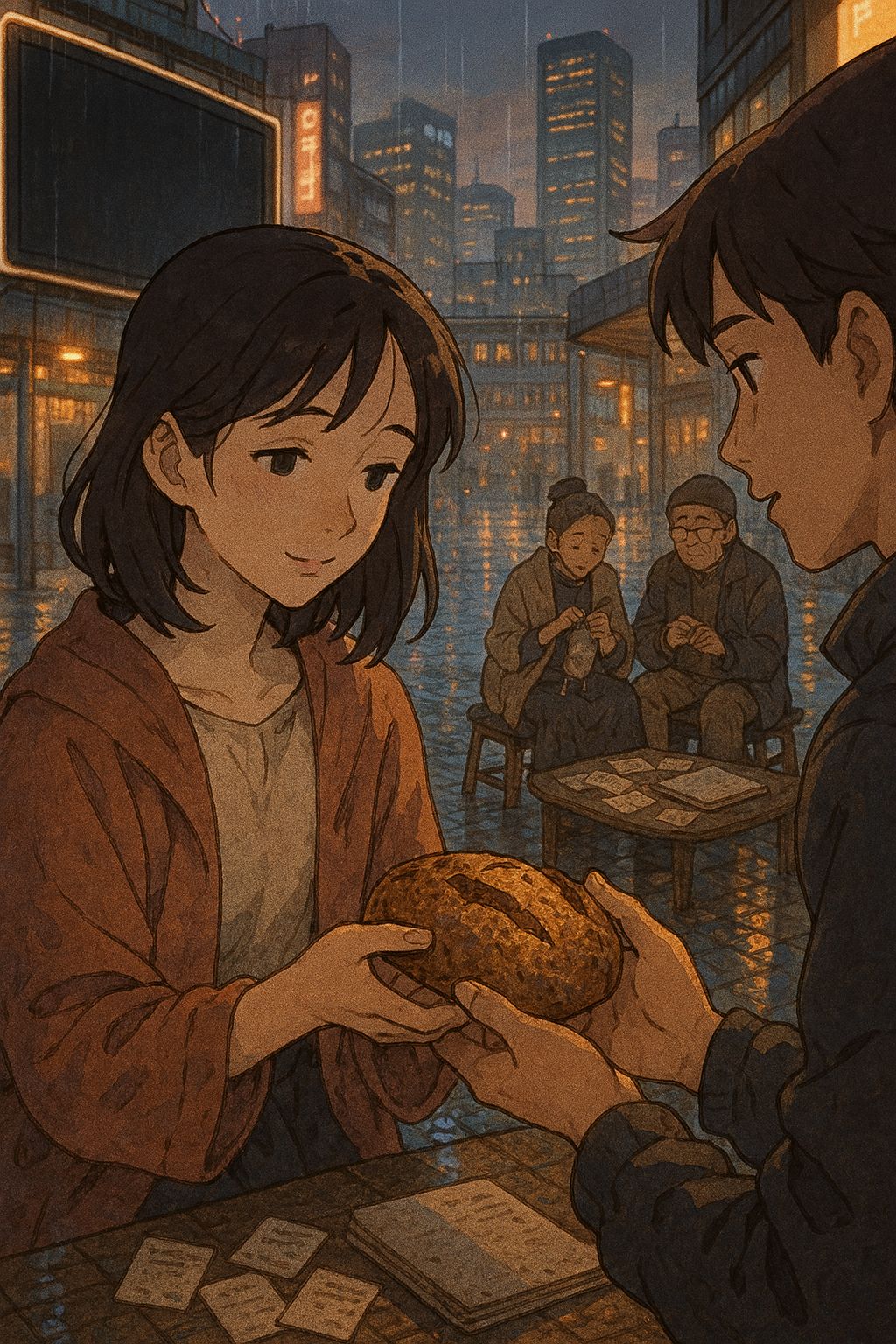
The city smelled of rain and screens. On every corner, smart banners changed their message depending on the face that looked at them; streetlights projected ads that adapted to whoever passed; bus speakers murmured slogans designed to calm morning crowds. From the glass offices of the Central District, an elite had learned to pull invisible strings: not with guns or decrees, but with words, images and gestures packaged by professionals who knew exactly how people respond. They had turned communication into an architecture of behavior. María had been one of those professionals. She had studied social psychology, trained in behavioral labs, and spent years decoding patterns of attention. Her record was full of successful campaigns: reductions in disturbances in public squares, increases in trust toward institutions, decreases in substance use in specific districts. Her reports were maps: population segments, emotional triggers, ideal time windows for dissemination. To the District, María was a craftswoman of collective calm. "Do you think what we do is ethical?" Ana asked her one morning in the break room, leaning against the coffee machine and watching her reflection in the polished steel. María put down her cup and ran a slide through her mind. "It's not simple," she replied. "When protests drop, violence decreases, people sleep better. What would change if people were less anxious?" Ana shook her head. "Truth, maybe. Responsibility. Not everything should go through an algorithm that decides what to remember." María knew what Ana meant. At work there were no bushes of conspiracy: there were models, metrics and an instrumental logic. The influencers who collaborated with the District were not only celebrities: they were calibrated profiles, human pieces in a machine designed to modulate emotions. They received training in persuasion techniques, nonverbal language, microexpression and narratives constructed to resonate with specific segments. What they did wasn't direct lying; it was narrowing, highlighting and attenuating. In internal jargon they called that procedure "reality management": selecting and amplifying narratives that would feel more real than subjective experience. The system worked with precision until, one day, a tiny deviation opened a fissure. María was working on a campaign to calm financial panic: the algorithm recommended warm tones, images of domestic routine and micro-stories of resilience. To soften the transmission, María proposed a variation: at the end of each block, a brief human anecdote to give texture to the message. "Keep it short," Javier, the unit director, instructed. "We don't want deviations. Three lines, empathetic, closed." María complied and, in one of the versions, quietly included a personal detail: the mention of her grandmother and a bread recipe she had found in a notebook. She didn't see it as disruptive; she saw it as emotional glue that would attach the message to the everyday. The broadcast went live. One of the influencers, Lucas, read the script and at the end, driven by something he couldn't explain later, improvised. "My grandmother used to say that bread brings people together even when words are missing," Lucas told the camera. "Yesterday I found her recipe in a notebook and I brought it with me. Sometimes remembering is a way of healing." The control room recorded atypical spikes in interaction. It wasn't just the numbers: it was the tone of the comments, the density of personal stories that emerged like lava through old cracks. Users recounted losses, forgotten things, wounds they hadn't known how to put into words. A thread on a local forum filled with pending bread recipes, unread letters and faded photographs. María's anecdote had become a trigger. At the District it was first perceived as noise. The analysts who seemed to see the world in graphs recoiled at a phenomenon their model couldn't capture: an emotional pulse that arose without predictable coordinates. The metrics that had once been infallible began to fail. Behavioral models showed noise where there had been clean signals. It was an anomaly that did not fit the equation: it wasn't the technical system that failed, it was the assumption that people could be reduced to profiles and predictable reactions. "Cut it off," Javier ordered in a closed meeting, his voice controlled, the projection screen showing waves of unexpected interaction. "Increase the frequency of neutral content. Isolate the testimonials." Others, however, suggested caution. "If we shut it down abruptly," warned Sofía from Ethics, "we'll provoke resistance. We could observe, collect qualitative data and let the fissure reveal itself." "We can't risk this scaling," replied a technologist. "Stability is the priority." While teams argued, the anomaly moved independently of the District's circuits. It appeared in cafés where an old song unleashed conversations about absent mothers; in neighborhood collectives where people began bringing recipes kept in drawers; in a bar where a patron told the story of his missing brother and, for the first time in years, others dared to tell theirs. It wasn't an organized wave but a network of small outbreaks of memory connected by association and empathy. In a popular café, an older man named Ernesto set his cup on the table and, addressing those around him, said aloud: "My wife used to make bread with hands that seemed to speak. I stopped making it when she left. The last time I tried, the dough refused to rise." A young woman, Marta, replied with a tone that mixed laughter and tears: "My mother stopped kneading when we moved. I thought the recipe had gone with the house. Trying again was like seeing her again, understanding her." Those exchanges turned private practices into public acts of memory. People began meeting on rooftops to tend small gardens, exchanging books that platforms had de-listed, projecting films on improvised screens where they discussed scenes aloud. It wasn't armed insurrection; it was a mass, silent renunciation of constant intermediation. Many disconnected their devices or turned them off when they were in groups. Others used the same platforms to coordinate gatherings, share recipes and read old letters. The District responded with tools: playlists designed to induce general calm, broadcasts on public screens with neutral landscapes, micro-campaigns intended to reinstitutionalize attention. The technical team deployed a large-scale experiment: synchronized broadcasts meant to "recalibrate" the city's affective response over 72 hours. "If we balance the signal," Javier said, "we can regain control of the narrative." However, the experiment produced unexpected reactions. In several neighborhoods, the mere presence of screens trying to "normalize" generated rejection. People who previously didn't question the information flow now chose to look around and talk. In some cases, the broadcasts became catalysts for mobilizing memories: a segment projected with local residents recounting childhood stories was filmed by attendees who uploaded the footage to alternative networks with personal comments. Within the District teams, the rift between those advocating a technical response and those proposing to allow the fissure for study deepened. Sofía, the Ethics officer, pushed for gathering uncensored testimonies and using that information to understand the emergency from human vulnerability. "We need to understand what's coming out," she said in a meeting. "What appears is not irrationality; it's a kind of knowledge that doesn't fit our models." "And if it's contagious?" asked an analyst. "If it spreads to areas we control less?" "Then we'll have to accept that control is partial," Sofía replied. "Or learn to live with that." Haunted by her role in the trigger, María began to feel the weight of responsibility. She remembered her grandmother's notebook, the flour stains and the instructions written by hands that were no longer there. She started visiting community projects without the District knowing: she would go into cafés, sit in memory workshops and listen. At one of those gatherings, Marta recognized her voice and confronted her with a mixture of curiosity and reproach. "You were on television," Marta said. "Did you manipulate us into remembering?" María breathed deeply before answering. "I didn't want to manipulate. Not like that. I only thought a small story could soften a hard message. I didn't think about everything it could open." Marta looked at her for a long time and finally said, "Now that I know, I prefer that you opened it. I don't know if this is a cure, but we need to talk." The conversation was both relief and condemnation. For María, the experience was a lesson in the fragility of technical solutions in the face of the unpredictable fabric of human life. Meanwhile, in some corners of the city spontaneous initiatives consolidated that did not obey the logic of centralized moderation. A network of book-exchange libraries sprang up in alleys where platforms had little advertising reach; rooftop gardens began supplying vegetables to people who had previously relied on algorithm-driven delivery services; neighborhood groups organized film nights where the chosen movies came from collective memories. All these acts shared one characteristic: they reinstated direct experience above mediated experience. The District demanded more aggressive measures. They proposed reinforcing influencer profiles with tougher messages and saturating the public with neutralizing content. Some legislators pushed to regulate the circulation of "disruptive content." Sanctions for accounts that promoted unauthorized gatherings were discussed. "We control the infrastructure," Javier said in a meeting with officials. "We can limit amplification." But politics showed limits. The feeling that something had changed was already installed: people had found ways to create their own spaces where attention was not automatically commodified. Although control didn't vanish, the city's dynamic shifted. Campaigns no longer worked with the same effectiveness in sectors where community practices had taken root; metrics that had been the compass were now partial indicators. María resigned from her position at the District with a mixture of helplessness and relief. She made no dramatic speech; she handed over her badge, packed three books and moved to a working-class neighborhood where the streets still carried market noises and unscripted conversations. There she opened a collective memory workshop: free sessions where people practiced the art of telling stories without editing pain, active listening exercises and gatherings to sew letters and recipes into communal notebooks. "Are you going to disappear?" Ana asked at her farewell, her eyes glassy. "I won't disappear," María answered. "I just want to listen more than I design responses." In those sessions people brought objects that worked as memory triggers: a small spoon, a blurry photo, a napkin with a recipe. The workshop became an exchange center where bread was baked, books were repaired and stories were recorded with a camera that didn't publish anything without permission. Little by little, the collective memory took shape in small shared archives, in printed recipes pasted on neighborhood walls, in nights where neighbors recited poems that had never been published. Not everything was harmony. Tensions persisted: some demanded stronger measures against disinformation, others feared memory could be exploited by political actors with their own agendas. The city didn't become a utopia; it became an unstable territory where certainties had shifted. But that instability brought a richness that dashboards couldn't contain: the possibility that emotions, memories and collective stories had space of their own, not mediated by the logic of performance. On a rainy afternoon, María crossed a plaza where the giant screen, for once, was turned off. A group of neighbors sat in a circle; some knitted, others told anecdotes aloud. When a young woman offered María a piece of bread she said, "It's from my mother's recipe. We share it so we don't forget." María accepted the bread and, upon taking a bite, felt a mix of relief and a hard-to-quantify certainty: that something had changed in the way the city looked at itself. It wasn't the fall of a power machine, nor the building of a new hegemony; it was the opening of cracks where human fragility could exist without passing through optimization filters. Control continued to operate: elites kept refining persuasion tools and platforms maintained their influence. However, the event had proven that humanity keeps resources of resistance in the everyday: recipes, songs, hands that knead, gestures that aren't merchandise. Campaigns no longer automatically aligned attention because in many neighborhoods constellations of memory had emerged to compete with institutional messages—constellations that algorithms didn't know how to consume. The city became, in certain sectors, more unpredictable. Someone could fill a plaza without permission and read old letters; another could start a communal cooking session that ended in debates about memories. Platforms carried on their work, but now in tension with realities that had decided not to accept a single narrative. Ultimately, what changed wasn't the technology but social practice: small individual renunciations that, gathered together, altered how attention was distributed. María, who had begun as a designer of calm, ended up as a curator of memory. Her work stopped being about optimizing responses and became facilitating spaces where people could remember without a single elite deciding what should be remembered. On a wet street, under a shared umbrella, Ana once said to María, "I don't know if this is reversible." "Maybe it isn't," María replied. "But it doesn't have to be worse." The bread had returned the city to its people—not as a total solution, but as a reminder that small things can open unexpected paths. The metropolis remained a field of power and technology, but now with cracks where memory and emotion could slip in and, from time to time, change the way it looked at itself. Source of the images. Image created with Bing.
No comments yet