 @mc5punk
Short story: The Five-Kilometre Distance
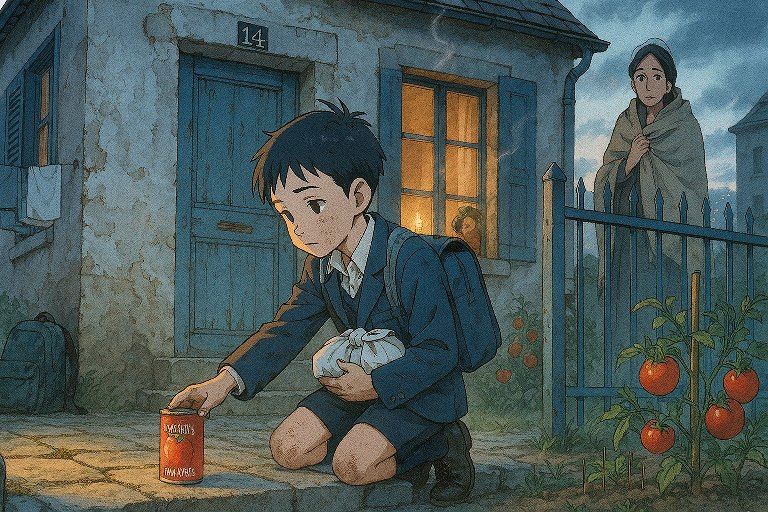
The house at number 14 cut against the grey sky like an incomplete sentence. Semi-detached to others, its paint peeling and gate bent, it harboured a secret inside that no one, apparently, could or would see. From the outside the façade suggested an ordinary life; inside, an existence contained, silent and strictly administered by childish hands. 1. The boy and the routine that protected him Théo was nine years old. His body was small but firm; his face, still childlike, had already learned the serenity of one who assumes responsibilities too soon. His hands, despite his age, were calloused from the soil of the garden he tended with devotion. Each morning he rose before dawn, when the house still smelled of candle wax and a cold that would not lift. He would carefully light a candle to avoid spilling wax on the kitchen table, wash his face with cold water in a basin heated slowly for the day, and put on the clean shirt he had folded and hung the night before with the precision of a small ritual. He packed his backpack with the same meticulousness: books arranged by subject and notebooks with straight margins, the snack wrapped in a cloth — bread, a can of preserves and, if the harvest allowed, a tomato he had grown in his little garden. He walked to school with his backpack zipped and an expression that revealed neither the weight of loneliness nor the dryness of water that rarely arrived hot. “Bonjour, monsieur Durand,” he would say in a clear, punctual voice to the school caretaker, greeting him politely. “Do you have the math report?” “Here you go, champion. You’re still the best,” Durand would reply, handing him a paper with his grade. “How do you do it?” Théo smiled, accepted the compliment with learned humility and kept the report as if it were not about him: excellence had become a practical shield. At school Théo was the model student: punctual, obedient, always prepared. His teachers remarked among themselves on the odd and admirable discipline and neatness; his notebooks displayed tidy exercises and almost adult handwriting. No one looked beyond the shine of his shoes and the spotless shirt. That appearance was the fruit of a strict routine he imposed on himself. Each night, before going to bed in a bed he had learned to make precisely, he rehearsed the list of tasks for the next day: water the tomatoes, close the windows tightly to keep heat in, check that the candle had enough wax for the night. These small duties, accumulated, gave him a feeling of control in a house where the grand gestures of care had ceased to exist. 2. The house and the methods of survival In the afternoons, after the last bell, Théo returned to his silent house. No doorbell rang, no voice awaited him. The only familiar presence was the neighbour’s cat that sometimes slipped through a hole in the fence and curled on the boy’s knees. The house, at first glance, showed no wild signs of neglect: the dishes were washed, clothes hung out, the bed made. But a layer of cold permeated the rooms, and in the kitchen cans and preserves were lined up like an army of provisions that Théo administered with military rigour. He lit a candle in the kitchen to see; the flame cast trembling shadows on the walls. He prepared dinner patiently: opened cans with effort, rationed bread, peeled a tomato with the skill of someone who knew every seed. In winter the house was a capsule of cold. There was no heating or hot water; electricity had been cut for non-payment and the appliances slept in silence. To bathe, Théo heated water in a pot over low heat and washed by the candlelight, shaking off guilt as if it were dust. He relied on simple materials to maintain the illusion of normality: a candle, a basin, a cloth to wrap a snack. He learned to sew buttons that came loose, to fix small faults, to sweep the house with hands that already knew how to distinguish the urgent from the necessary. His inner life adjusted to that frame of scarcity with painful precision; he had accepted that asking for help might bring less than it took away: the possibility of losing the little he had. “Are you not afraid?” asked Leïla, the neighbour from the second floor, once when she offered him a blanket and two apples. “Not much,” Théo replied, with the calm of someone who has made routine a shield. “If I do everything right, no one asks questions.” Leïla looked at him with misty eyes. She knew something didn’t add up: a house without light kept immaculate; a child speaking with maturity but evidently too alone. That answer seemed both innocent and terrifying: a child rebuilding uncertainty through obedience. 3. The mother and life five kilometres away Théo’s mother, Camille, lived five kilometres away in a modern apartment with her partner. She was a woman of neat appearance, busy schedules and conversations that rarely descended into domestic substance. She left in the morning with her coat buttoned and phone vibrating in her bag, and returned at night to a home where company and routine were different. Visits to Théo were sporadic and always brief: a loaf of bread here, a tin there. She never stayed, never truly took charge of the day-to-day. Over time, she stopped coming altogether. The excuse of physical distance — five kilometres — became a moral excuse: geographical proximity did not correspond to any effective responsibility. Camille justified her absences with work, fatigue, and the instability of her relationship. The partner she lived with was not indifferent but not fully engaged in the domestic sphere either, and seemed to accept that the family life had become fragmented. “I don’t understand why you’re asking me to do this,” Camille once said in a cold voice and evasive gaze to the partner who urged her to be with their son. “He is his child, yes, but… it’s not the same.” “Sit with him, talk to him,” the partner insisted, weary. “He’s nine. How can you…?” “I can’t,” Camille replied. “My life is different now.” Those words, said with the certainty of one who normalises their own absence, rang hollow. The abandonment was not an explosive act of violence but a gradual withdrawal: unpaid bills, missed calls, visits that became rarer until they disappeared. Neglect settled into the form of an everyday and silent decision. The cradle of care lay empty. 4. Ignored signs and collective complicity Some neighbours noticed things: odd noises at night, mornings when Théo watered his tomatoes at nine in hands that the gloves swallowed, clothing always hung with such order as if someone had taught him to present himself to the world with dignity. Others assumed the family was troubled, that social services would have intervened, or that the mother had reasons. The school, reassured by the child’s impeccable appearance, asked no questions: neatness and grades functioned as passwords that shut down suspicion. “Why did no one see him?” Leïla murmured as she passed the building’s mailbox, hands shaking. “I brought him bread, saw him in the afternoon, but no one called!” “Maybe no one imagined a mother could…” another neighbour said softly, finishing the sentence with the usual incredulity. The community, busy with its own problems and resting in the faith of appearances, let pass signals that, in hindsight, were muffled screams. There was a confusing mixture of moral laziness, bureaucratic distrust and the comfortable belief that someone else, somewhere, would handle it. Institutions meanwhile relied on protocols that worked better for obvious cases than for those that disguise themselves as normal. Théo did not ask for help. His pride and fear of losing what little he had kept him silent. Asking could mean being separated from his house, his tomatoes, the independence he had won out of necessity. So he preferred order and appearance; thus, no one in school or the community noticed the hunger that was more emotional than physical. 5. The incident that cracked the crust One autumn afternoon, a strange smell in the stairwell alerted neighbours: Théo had tried to heat something in the kitchen and the flame had flared up unexpectedly. Perhaps a pot slipped or the candle ignited something; in any case, smoke filtered down the stairwell and ruptured the routine of indifference. The smoke raised alarm; someone called the emergency services. The community’s ambivalence broke: a volunteer saw the child peering from the window, pale, hands trembling. Police arrived. Firefighters extinguished the flame that threatened to consume more than the kitchen. Social workers, notified by the intervention, also attended. “Where is your mother?” a social worker asked, kneeling to look him in the eyes with a soft but firm voice. “She lives nearby,” Théo answered. “Sometimes she comes for bread.” The reply landed like a slap of reality. The neighbourhood complaint and the evidence gathered by neighbours and professionals brought to light what routine had hidden for so long: abandonment, lack of basic utilities, negligence. Camille was called to testify. At first she denied things, then she buckled under the weight of evidence: unpaid bills, witnesses who had seen little or no maternal presence, and the child’s own vulnerable but frank testimony. “I didn’t know…” Camille stammered. “I thought he was fine. I did what I could.” But the law does not accept excuses when a child is left to cold and loneliness. Justice, with its own pace, followed procedure; the mother was convicted. The case, disturbing in nature, did not remain within the neighbourhood’s intimacy: it spread to newspapers and the public agenda. 6. The country faced with its reflection: debate and consequences France was shaken. On television and in cafés, on social networks and in official committees, the issue was debated intensely. How could a nine-year-old sustain a façade of normality for almost two years without anyone detecting the severity of his situation? Where had child protection services, schools, neighbours and administrative procedures failed? Was it possible that trust in appearance and bureaucracy had in some way been complicit in negligence? At school, teachers reflected with anguish and remorse. The impeccable grades and neat presentation had been interpreted as resilience, when in reality they were survival strategies. Interviews with specialists revealed that many children in abandonment situations develop this “performative normality” to avoid questions that could lead to losing what remains. Officials reviewed protocols; new measures of early detection, teacher training and improved coordination between social services and health were proposed. Neighbours, whose complaint finally enabled intervention, felt a mix of relief and guilt. Relief for having acted at the decisive moment; guilt for not having done so sooner. They started organising support groups and neighbour-watch networks with a preventive focus: not to spy, they said, but to learn to see. Institutions discussed the need to move from a reactive logic to a proactive one, but debates also arose about privacy, intrusion and the limits of intervention. 7. Recovery, wounds and care After intervention, Théo went to foster care. The change was deep and slow. At first he clung to his routine as someone who cannot allow themselves to lose their story: he arranged his books by size, placed his tomatoes in a box carefully, stored the cans in a new cupboard and labelled each as if preparing a reserve against uncertainty. He did not speak much about his mother; when he did, his words were short, without rancour but with a distance that hurt. The foster environment offered him things he had not known with certainty: hot water without effort, heating that turned on with the press of a button, shared meals and adults who sat beside him without expecting perfect rectitude in return. Gradually, with professional help, Théo let others care for him. He was taught to accept affection without feeling he was losing it, to trust that care is not a contract that can be rescinded at the first mistake. Leïla, the neighbour who had watched him for years, became a constant presence. She visited, brought apples, took him to the park and, above all, listened. In those meetings the boy who had learned not to show weakness learned to name fear and abandonment with less shame. One bright afternoon, while sharing a snack, Théo offered her a red tomato as an offering. “Thank you,” he said, shyly, as if relieved. “If it weren’t for you, I don’t know what would have happened.” “You did it yourself, little one,” she replied, squeezing his hand tenderly. “You were brave.” Those simple words acted like a balm. They did not erase what he had lived, but they gave Théo permission to recognise himself as the subject of his own story, not only as a passive victim. 8. Memory and hard lessons Camille’s conviction was just a legal episode. What followed was a wider process: public policy revisions, awareness campaigns in schools, mandatory training for teachers and communication protocols between social services, education and health. There were debates about collective responsibility and about teaching a community not to turn its gaze into indifference. Years later, when Théo was a teenager, he walked past number 14. The house still had peeling paint, but the gate had been freshly painted. He paused, stood for a moment on the pavement observing the door that had been both refuge and prison. Finally he touched the wood with his fingers, felt the grain and left, quietly, a can of tomatoes on the step as though placing a small symbolic offering: a closure without sterile drama. He did not need to open the door to understand that life is a weave of absences and presences; some wounds heal and others remain as tempered memory. Around him, the city had learned, painfully, that appearance is not sufficient proof. Théo, who had learned to grow tomatoes and to hold small dignities, continued growing with the calm certainty that, at last, someone would see him. The five-kilometre distance ceased to be merely a geographic measure and became the metaphor of a community that had to examine its own moral closeness. And though the wounds were not entirely erased, Théo’s story opened a window that forced people to look: toward prevention, early detection and the urgency of turning indifference into care. Source of the images. Image created with Bing.
No comments yet