 @mc5punk
Short story: Friends 5,000 Miles Apart
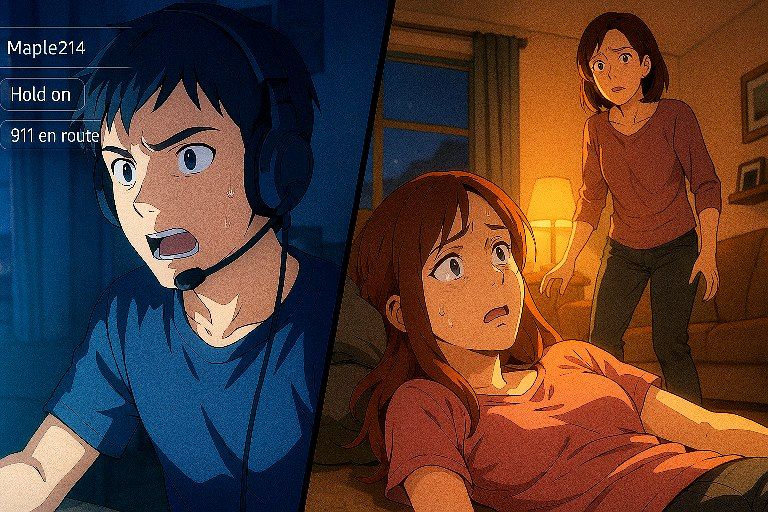
Night had fallen over Mexico City and Riverside, California, though the clocks in each place marked different hours and the windows framed similar skies. Mateo, a sixteen-year-old boy, had logged into his computer as he did many nights to play with his online squad. His room smelled of clean sweatshirts and cold pizza; the screen lit his face with a blue glow that seemed to belong to another hour of the world. Between jokes and strategies, his voice mingled with Alex’s, a teammate, and Lena’s, a seventeen-year-old living in Riverside who had become a close friend through the game and long late-night conversations. For them, the match was both refuge and bond: shared hours, secrets exchanged between rounds, and the familiarity of someone who knew when to crack a joke to relieve tension. Lena was charismatic, with a contagious laugh and a mischievous tone when she teased Mateo about his bold maneuvers. That night, however, her voice began to crack on the microphone. At first the breaks were slight: heavier breathing, a word cut off. Mateo, accustomed to reading small changes in his friends’ moods, realized immediately that something was wrong. What followed was a sequence of moments that widened with the gravity of a real emergency. Lena spoke with difficulty; words came out dragged. Then a dull sound, like an internal crash; then silence. It was not the silence of a technical disconnection but the silence that occurs when the body signals an emergency: disordered breath, moans, noises the voice chat left raw in the night. Alex, nervous, asked if the others heard what he heard. Mateo didn’t hesitate: pieces of knowledge from first-aid guides and documentaries flickered in his mind. Everything pointed to a seizure. Mateo didn’t know Lena’s exact address, but he knew what had to be done. He asked, with as steady a voice as he could manage, that she give her full address. Between gasps and fragmented phrases, Lena managed to say “Maple… 214… Riverside… California…”. The number and street blurred in the murmur; she couldn’t recall clearly. Mateo asked if anyone in the house could answer, but all that reached the mic was the echo of a mother calling for her daughter, a stricken voice from inside. The situation grew more urgent with each second the silence filled the virtual room. Without hesitation, Mateo picked up the phone and called 911. It was not an impulsive choice: it was the concrete expression of the responsibility he felt in that instant. From more than 3,000 miles away, he described the scene—the seizure, the irregular breathing, the incomplete address—and stayed on the line as the dispatcher requested confirmations and details. The dispatcher, professional and calm, coordinated the sending of an ambulance and asked that someone in the house keep Lena in a safe position: loosen tight clothing, place something soft under her head, do not move her roughly. Mateo relayed the instructions to whoever could hear, attempting to bring calm where uncertainty raged. Inside the house, Lena’s mother, Sofía, was panicked. She ran down the hall, found her daughter on the floor, and called to her with no response. Her hands trembled; sobs shook her breath; the call with Mateo became a thread of consolation amid the storm. Mateo, from his blue-lit room in Mexico City, spoke with the calm the situation required though his whole body shook. He told Sofía how to place Lena’s head, how to loosen clothing that might restrict her airway, and asked her to monitor Lena’s breathing. In the background they heard distant sirens: the dispatcher and emergency services were taking action. The following minutes seemed to stretch. The wait was a wide sea of terrifying possibilities: what if help didn’t arrive in time, if the seizure didn’t stop, if the silence on the mic meant the worst. Mateo had to hold hope and terror in his chest; Alex remained on the line, recording and offering additional information, sustaining the virtual bond that now bore a heavier weight. Finally, the dispatcher’s voice confirmed what they needed to hear: emergency units were en route to 214 Maple Street. As if knowing it made the uncertainty slightly more bearable, the three youths clung to the possibility that someone on the other end could still be saved. When the paramedics arrived, they found a distraught mother and a daughter beginning to regain breath. The seizures had stopped, but the postictal state—those moments of confusion and weakness afterward—left Lena disoriented, breathing with effort and pale. The paramedics worked efficiently: their movements were precise, their words short and direct. After a quick assessment, they transported her to the hospital for observation; Sofía, trembling and tearful, stayed by her side. Mateo, still attached to his microphone, followed the chain of messages: the dispatcher assured him the ambulance had been dispatched; later he received confirmation from the hospital. He could not travel—he was thousands of miles away with no immediate way to cross an ocean. All he had was his voice, his information, and the conviction that doing something, even from afar, could make a difference. And it did. At the hospital, Lena woke hours later, confused and weak. When she opened her eyes she saw her mother, the vital-sign monitor, and a small chat message glowing on a screen: Mateo’s username and his words, simple but laden with meaning. “Don’t go through this alone again,” he had written once the situation stabilized; “I need you here in the game.” For Lena, the impact was profound: she understood that the line dividing the virtual from the real wasn’t as rigid as people often believed. That friend on the other side of the world had been the difference between life and death. Sofía, grateful and still trembling with tears, tried to thank the young person whose real identity they didn’t fully know but who had, from a screen, given calm and concrete actions at the moment of greatest terror. Hospital staff later confirmed that the timely intervention—the call, the coordination with emergency services, and the basic support given at home—had prevented more serious complications. The seizure had been severe, but help arrived just in time. In the days that followed, Lena recovered. Conversations with Mateo returned to their routine but were transformed by what had happened: they were no longer solely about matches and jokes; they became reaffirmations of a friendship that had passed the most demanding test. Mateo carried both relief and a new sense of responsibility. He had learned that distance does not nullify the capacity to act and that empathy, coupled with information and technology, can save a life. Alex and the rest of the team remained connected, processing the event in their own ways: messages of congratulations, a few jokes to dispel tension, and the shared sense that they had been part of something far larger than a win on screen. Sofía kept every message and instruction Mateo had given as a reminder that the hand that reached for her daughter is not always visible. The weeks that followed brought introspection for all of them. Lena gradually regained her energy and smile; Mateo returned to the matches with a new calm, aware of the human fragility he had witnessed. In their conversations they spoke less about scores and more about everyday things: a song they heard in the morning, study tips, household routines. In a way, the crisis had forged a deeper intimacy. That night remained a scar in their collective memory but also a testament: technology had been the bridge, and empathy the tool that crossed it. Thousands of miles apart, two teenagers and a family had experienced what it means for friendship to be an act of care. In that night of sirens, calls, and recovered breaths, distance became a number that no longer mattered. The end. Source of the images. Image created with Bing.
No comments yet