 @mc5punk
more from that month
@mc5punk
more from that month
Short story: The City of Broken Candles
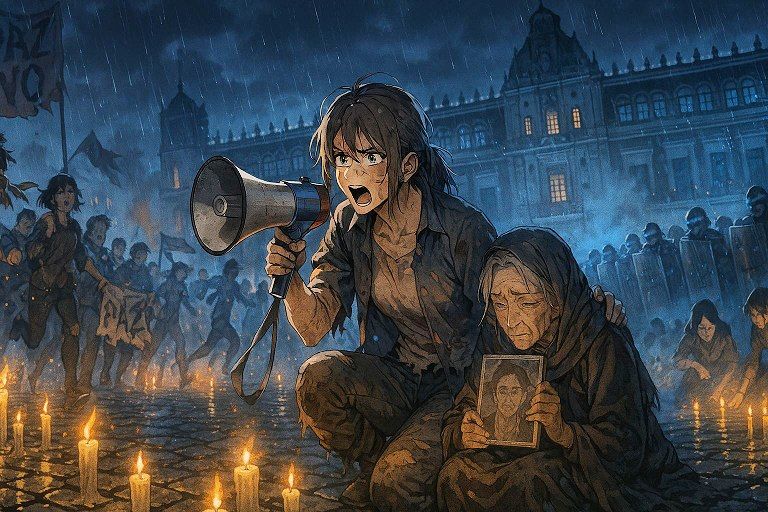
The city throbbed like a wounded animal. Streets and avenues of the center — ancient, worn by centuries of footsteps — filled with a human river that advanced with contained fury, as if each step echoed the collective pain. The call, driven by young people who had turned indignation into organization, drew students, teachers, mothers and workers; all pushed by the same demand: peace and clear accountability. The air smelled of smoke, November damp, and the hardest thing to disguise: rage. Lucía walked at the front, the megaphone in her left hand trembling almost as much as her jaw. She was twenty-two and her face, despite youth, showed fatigue. Her eyes were no longer those of someone who thinks change is only tomorrow’s task; they had seen funerals, nighttime news that kept her awake, and names she repeated like a prayer. She raised her voice and shouted, “Peace!” The word bounced off façades and balconies; then she changed tone, harsher, breaking the forced calm: “No more impunity!” The cry was absorbed by thousands, a single heartbeat pushing toward the Plaza Mayor, where the Government Palace rose like an indifferent stone giant. Andrés, a teacher with a tired smile and hands used to chalk dust, moved among the people handing out water bottles as if distributing small shields against the heat and excitement. “Keep calm,” he repeated, though calm seemed a luxury the collective anger refused to accept. His voice tried to dislodge violence before it could sprout; his body, however, was ready to steady whoever needed it. Nearby, Mrs. Martínez shuffled along, the photograph of her son hanging from her chest like a sentence. She neither shouted nor chanted slogans; she carried grief like someone hauling a slab. Arriving at the heart of the city, the Palace presented itself in all its coldness: closed windows, static flags, artificial light that only highlighted the distance between power and the plaza. A group lit candles in an improvised circle; the fire trembled and cast long shadows across the paving stones. The act, simple and profound, was more than a liturgy: it was a silent challenge. Lucía set down the megaphone, knelt, and, voice breaking, whispered beside Mrs. Martínez: “For my son…” The murmur swelled into a chorus that did not seek an ending but remembrance. Among the crowd, Diego, a nineteen-year-old amateur photographer, captured the day with restrained frenzy. His camera pressed time into frames: tense faces, rain-streaked signs, hands holding flowers. Suddenly, a shove split the human line; a backpack flew, a bottle bounced and struck a young man in the temple. Diego squeezed the shutter with shaking hands, trying to hold the moment before chaos spread. Carmen, a volunteer nurse, pushed through the crowd and fixed her professional gaze on every wound. “I need a tourniquet!” she shouted with the precision of someone who knows seconds make the difference. What followed were sparks that became a blaze. The municipal police closed ranks, shields raised, forming a wall that split the plaza in two. “Fall back or we will proceed!” an order thundered over the roar; the response was a shower of insults, some objects thrown, stones slicing the air like sharpened reproaches. The acrid smell of tear gas mingled with smoke from burning tires; vision blurred, eyes burned, breathing shortened. Screams, running, shoves: the protest took on another face. Andrés tried to calm people, interposed himself between an officer and a mother who had been pushed; there were shoves, grabs, and screams no one would forget. “Don’t leave us alone!” Lucía cried, her voice torn as several youths were forced toward a steel cordon. Violence, when it arrives, makes no distinctions of intent. Some demonstrators had come with sticks and stones, ready to break. Others brought flowers and candles, ready to keep vigil. That internal contradiction became fuel. A dumpster burned, a shop door shattered; the plume of smoke that rose looked like an open wound in the sky. The shoves caused falls; bodies that hit the ground were dragged by the human current, losing shoes, documents, composure. Diego ran after a frightened girl and carried her away from the crush; his photographs would later show a face suspended between terror and relief. Carmen did not stop working. Amid the shouts and glass, her hands moved methodically: dressings, pressure, words of comfort. She treated three people whose injuries required urgent attention: a deep cut on the eyebrow needing stitches, a young man with chest trauma who gasped for air, and a woman suffering respiratory problems from the gas. “Breathe, we’re getting you out of here,” she told one while a paramedic indicated how to position him to avoid further complications. Emergency services operated under adverse conditions; ambulances had trouble making their way through the human tide and rubble. Night brought more shadows than light. The Palace lights remained an impassive witness; the plaza was scarred by torn signs, spent candles and bloodstains that water could not wash away. Mrs. Martínez refused to leave. She stood by her son’s photo, holding it with a strength that hurt. “If they take away my pain, they give it back to me,” she said, her voice mixing exhaustion and defiance, and no one was sure whether she asked for comfort or sought vengeance. The day left at least three injured people treated by emergency services, wounds that would tell parts of a longer story. No one at that moment formally accused the organizers, but responsibility fragmented into invisible hands: patterns of provocation, infiltrators who altered the march, command decisions that created zones of violence. The protest, born as a call for peace, became a broken mirror in which the multiplicity of stances of a battered society was revealed. As the crowd began to disperse, a tense calm settled over Plaza Mayor. Lucía, her face streaked with dust and tears, picked up the megaphone again in a low voice: “This was not in vain,” she murmured. She wasn’t sure whether it was consolation or a promise. Andrés, leaning against an old column, looked at the damaged streets and the people leaving in drips and realized the mobilization had left marks that would not be easily erased: ruined streets, bruised bodies, photographs circulating as proof and memory. Diego put away his camera with trembling hands, aware that his images would become evidence and testimony. Carmen climbed into the ambulance with a bag full of gauze and a fatigue that would linger for days. Mrs. Martínez held her son’s photo closer to her chest as if the pull of loss might drag it to another dimension. Patrol lights mixed with streetlamps, and some echoes of slogans still floated through the night. Despite the pain, someone lit another candle in the circle where the first ones had burned down. The flame, small and stubborn, cast a warm halo over the faces that remained. It was a tiny gesture in the face of what had happened, but also a promise: memory would not be easily extinguished. The city had shown its fracture; the protest had been both offering and warning. Rage and the demand for peace had coexisted, and when patience snaps, an entire city trembles. Lucía knew, as she walked away with no crowd behind her, that the struggle would continue: in courts, online, in future plazas. Nothing would erase the bloodied hands or the faces marked by that night. Yet the flame remained, small and determined not to let memory die out. In the distance, silhouettes dissolved into the night, and Plaza Mayor lay covered in papers, signs and broken candles: the remnants of a day that, for many, would mark the start of a long-lasting demand. Source of the images. Image created with Bing.
No comments yet