 @mc5punk
Short story: The City of Chords: an expanded story
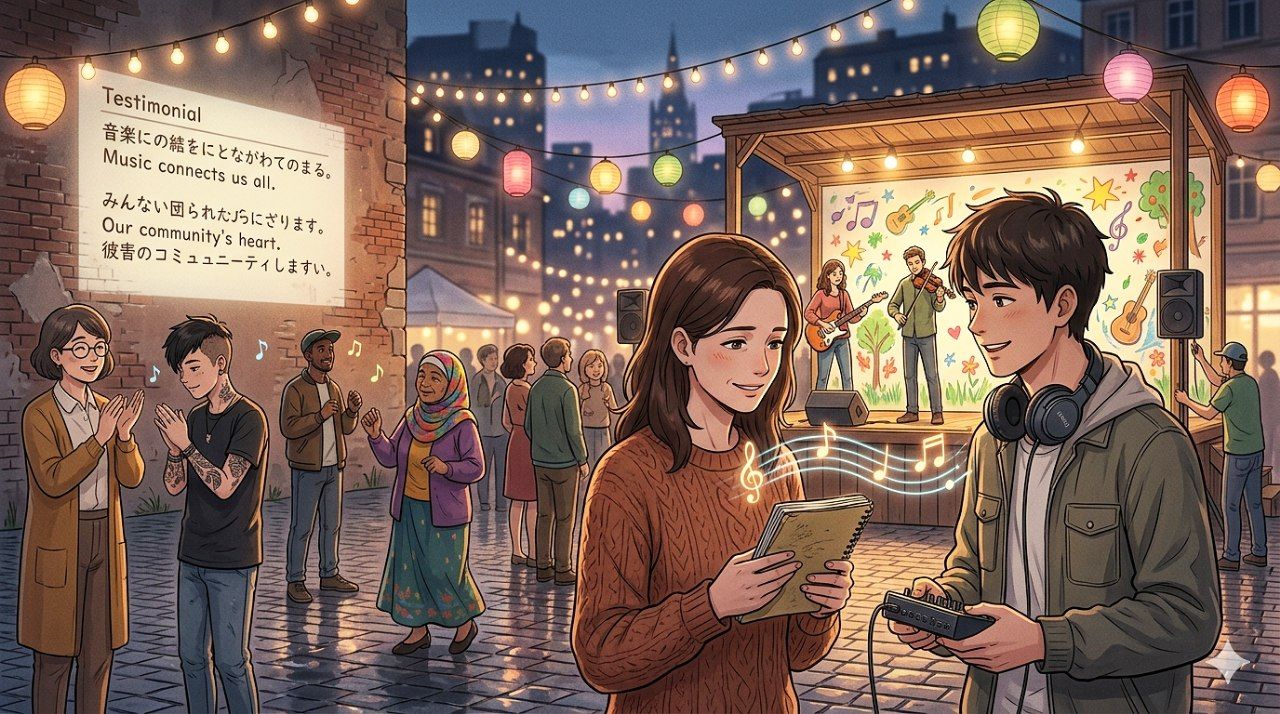
The tram gasped as it descended the hill and crossed the bridge that split the city into brick neighborhoods and glass ones. Outside, winter tapped the windows with an irregular rhythm; inside, passengers traced invisible lines with their headphones, their conversations, and their silences. On the edge of a seat by the fogged window, Clara clutched a notebook to her chest as if its pages were the continuity of her breath. At the other end of the car, Marcos let his foot mark a beat driven by an electric bass only he could hear. They were different worlds inside a metal capsule taking them along, but that day something in the air promised to become a bridge. Clara was thirty-two and coordinated community projects: school workshops, soup kitchens, preventive health campaigns. Schedules and commitments piled in her hands, and questions about justice and responsibility crowded her mind. She listened to music that made her pause: long pieces with silences that invited thought, lyrics that opened questions instead of closing them. She wrote a lot in her notebook: observations, book quotes, lines from people she met in the neighborhoods. Marcos, twenty-eight, was a sound technician and a member of a small music collective that organized concerts in basements and plazas. He loved intense music: guitars that screamed, rhythms that pushed the chest, lyrics demanding belonging and immediate action. In his group he found the sensation of a we—a collective identity that affirmed itself in a changing world. When a jolt made people steady themselves, Clara glanced at the screen of Marcos’s phone, where she could just make out an album cover with aggressive typography. “What are you listening to?” she asked without looking at him, because questions, for her, were a way to begin knowing someone. Marcos tilted his head and, out of habit, raised an eyebrow. “Post-hardcore,” he answered with half a smile. “The kind that takes your breath away. You?” Clara opened her notebook with an almost reverent gesture and rested the tip of her pen on a page as if to underline the reply. “Contemporary classical music,” she said. “Long pieces, arrangements that change slowly. They help me think. When I listen I feel more attentive to small things.” Marcos laughed—not mockingly but with the surprise of someone discovering a different map. “I always thought people who listen to that are too sensitive,” he admitted. “I need adrenaline, to feel part of something bigger. Loud music unites. It tells you who your people are.” Clara looked at him, attentive, not closing off the possibility. “Music connects me too,” she replied. “But in another way. It links me to stories that aren’t mine. It forces me to question and make room.” Before the conversation could become an exchange of labels, an older man traveling with a cane next to the seat intervened in a hoarse but steady voice. “You know?” he said. “Years ago I took part in a study that said exactly that: the music you choose not only accompanies moments but also reflects how you interpret the world and make moral decisions.” Clara and Marcos turned to him, intrigued. The man seemed from another era: wrinkles that told of travels, a worn scarf that still kept a vibrant color. “What do you mean exactly?” Clara asked, curiosity sharpening her tone. “That musical preferences aren’t empty whims,” the man continued. “They’re connected to deep, relatively stable values. Some people seek reflective music: for them, empathy, care, and justice weigh more when they evaluate complex situations. Others prefer intense styles: they tend to emphasize group loyalty, authority, and cultural tradition.” Marcos furrowed his brow as if the idea had triggered an alarm. “So my music makes me rigid?” he asked, a hint of offense in his voice. “No,” the old man replied calmly. “What stands out is that these associations persist even when you control for classic personality traits like extraversion or openness. Music acts as a cultural signal: it communicates beliefs, priorities, and ways of understanding what’s right. That’s not a verdict; it’s a tool for understanding.” Clara closed her notebook with a motion of reflection. “That would explain a lot in my work,” she said. “In soup kitchens and workshops we sometimes see conflicts that aren’t just about resources: they’re conflicts of priorities. Some volunteers prioritize protocols and stability; others prioritize listening and adaptation. The music we listen to helps me understand why we choose what we choose.” Marcos stopped tapping his foot. He remembered arguments with his band about repertoire and how certain topics ignited passions not only for their sound but for what they implied: defending traditions, local claims, stories of loyalty. “I never thought about it so clearly,” Marcos said. “I thought music was just for passing time, for escape. But if it communicates priorities, it can also be a bridge for dialogue.” The old man nodded, stood as the tram stopped, and added before stepping off with steady steps: “Art is a map. Understanding those links can foster empathy and dialogue in diverse societies where we live together daily.” That sentence floated between Clara and Marcos. It wasn’t a closed conclusion but an invitation. They continued the conversation that afternoon in a café with chipped walls and warm lights; Clara ordered tea and Marcos a beer. They spoke without hurry about the music that had shaped them, songs that changed moods at crucial moments, how sometimes a melody seemed to decide for them. “One time,” Clara said, “a song in a school workshop made a group of parents change their attitude toward an inclusion project. It wasn’t just the lyrics: it was the pauses, the way the song asked for listening. It reminded us that justice is practiced in small gestures.” “For me it was my brother,” Marcos shared. “When I learned he was mixed up in trouble, a song brought us closer. It was furious, yes, but it had a chorus about staying with your people. That night we stayed up together. It made me see that loyalty isn’t always closing off; sometimes it’s staying.” Clara smiled softly. “So each song is a compass with many poles,” she said. “It doesn’t pigeonhole us, but it shows tendencies.” They decided to try something new: to create a shared playlist for a community project they were planning. Clara selected long, contemplative pieces; Marcos added intense rhythms that demanded movement. When they combined the tracks, the differences didn’t vanish; instead, they created tension and then a space where ideas could clash and mix. The next day, without any announcement, Clara proposed the idea at a volunteer meeting. A teacher who had worked in the neighborhood for decades showed interest; a graphic designer joined in. The project took shape: a monthly gathering where people chose a song and explained why it mattered to them. There were no rules—only the will to listen. The first meeting was improvised in a community room with mismatched chairs and a chalkboard where someone had sketched a staff with blurred notes. Ten people came, then twenty, then more. Among them were an immigrant blending rhythms from her country with local songs, a tattooed teenager with an intense stare, an older woman defending neighborhood traditions, and an activist who had spent her life designing social justice programs. Each person brought a song and, by sharing it, told a moral story: decisions, losses, loyalties, regrets. The teacher started the round. “My mother used to sing this to me,” she said, voice cracking. “In my home we valued respect for authority. But over time I learned that obedience without care can leave many unprotected. A song I heard at eighteen made me look at power differently: it taught me to ask whether authority cared for the most vulnerable.” The tattooed young man spoke next, his tone mixing pride and tenderness. “My music speaks of belonging,” he said. “In my neighborhood, if you don’t have loyalty, you’re left alone. That music taught me not to abandon my sister when she got sick. It made me stay through the night and learn to cook because she couldn’t get up. Not everything about loyalty is imposition; sometimes it’s support.” The designer, who had felt peripheral in more ideological meetings, explained how a minimalist piece pushed her to change her professional approach: to stop designing for fame and start thinking about projects that protect those who can’t pay. “We’re not made of a single compass,” she said. “Music reveals layers and contradictions.” As the night went on, stories intertwined. Disagreements surfaced; a discussion about the need for rules versus flexibility lengthened and nearly turned tense. However, the tacit rule of the meeting—explain before judging—acted as a brake. When someone said “this makes me angry,” the most common response was: “Can you tell us why?” That why opened stories showing nuances and reasons. Marcos, who’d initially intended to prove intense music’s value, was surprised when he heard how a violent-sounding lyric had driven a woman to denounce abuse in her neighborhood. Clara was moved by a young man’s confession that slow pieces helped him not lose patience with his sick mother. Over time, the meeting became ritual. The shared playlist grew and nobody kept exclusive ownership. Each week someone took the floor and played a song. Sometimes the explanation was brief, sometimes long and filled with details that built empathy between strangers. They adopted a custom: after each song, five minutes of silence so the internal stories could settle without pressure to comment. Months later, the project took a bigger step: a community concert in the central plaza, with sets built by volunteers, lights donated by a local theater, and a stage painted by neighborhood children. The plan was deliberate: alternate reflective pieces and intense rhythms, and project testimonies between songs that recounted moral decisions influenced by music. On the day of the concert, the plaza filled beyond expectations. Families, curious neighbors, street musicians, and students came. Between numbers, recorded testimonies played: a young man describing how the tradition he defended led him to protect a public park; an activist explaining how neighborhood loyalty helped set up shelters during a flood; a mother who told how a slow song gave her patience during long nights. When the last song ended, people didn’t leave right away. Instead, someone started clapping and the applause multiplied into a collective gesture that seemed to acknowledge more than entertainment. Marcos, who’d moderated the sound that night, searched the crowd and found Clara holding her notebook now filled with notes, clippings, and drawings others had left at the meetings. “Remember the old man on the tram?” Marcos asked, breathless with emotion. “Yes,” she replied, holding up a sheet someone had written on: “Thank you for listening.” “He left us the compass.” Marcos looked at the crowd—this diverse assembly brought together by an experience that didn’t erase differences but made them converge in a space of dialogue. “I think music doesn’t just accompany us,” he said. “It tells us what matters. And if we listen intentionally, it gives us a chance to change what we don’t want to define us.” Clara closed her notebook and, with a motion she’d repeated in many meetings, wrote a phrase and showed it to him. “Music speaks for us; we decide how to understand it.” Marcos read the line in a low voice, as if it were a small pledge. He nodded and slipped the paper into his pocket. It was a small gesture, but in the plaza, with the last notes still hanging in the air, it was enough for two worlds to stop watching one another from afar and start listening for real. In the following weeks the initiative spread. Schools opened spaces for students to share songs and debate; a community radio dedicated an hour each week to the playlists and to interviewing those who proposed them; a local organization designed a program using music as a vehicle for resolving disputes among neighbors. Debates remained sharp at times, but there was now a shared practice: before condemning, ask; before excluding, listen. One afternoon months later, Clara and Marcos were again on the tram, now in the habit of swapping recommendations. Clara carried a piece that helped her sleep; Marcos had a track that blended traditional rhythms with synthesizers. “Do you remember the first time we talked?” Clara asked, watching the city blur outside. “Of course,” Marcos replied. “You with your notebook and me tapping my foot.” They looked at each other and laughed. The car filled with people coming and going, each with their music, each with a compass. In that small moving universe, it wasn’t about classifying or imposing labels; it was about understanding that music reveals things about us we don’t always know how to say, and about using that knowledge to build bridges. That night, in a small bar where a band mixed electric guitar with violin, Marcos went on stage with a set that included songs Clara had recommended. Before playing, he took the mic and said: “This song was recommended to me by someone who taught me to listen differently. If I used to think music divided us, today I think it can show us why we think the way we do and, with luck, help us choose differently.” The audience applauded. It wasn’t a definitive ending but a continuation: music continued to act as a cultural signal communicating beliefs and priorities, but now it was also an invitation to empathy and dialogue. In a city where sounds overlap and noise sometimes distances us, the project showed that, if we pay attention, music can be the language that reminds us how to live together. Source of the images. Image created with Google Gemini.
No comments yet