 @mc5punk
Short story: Silence on the Train
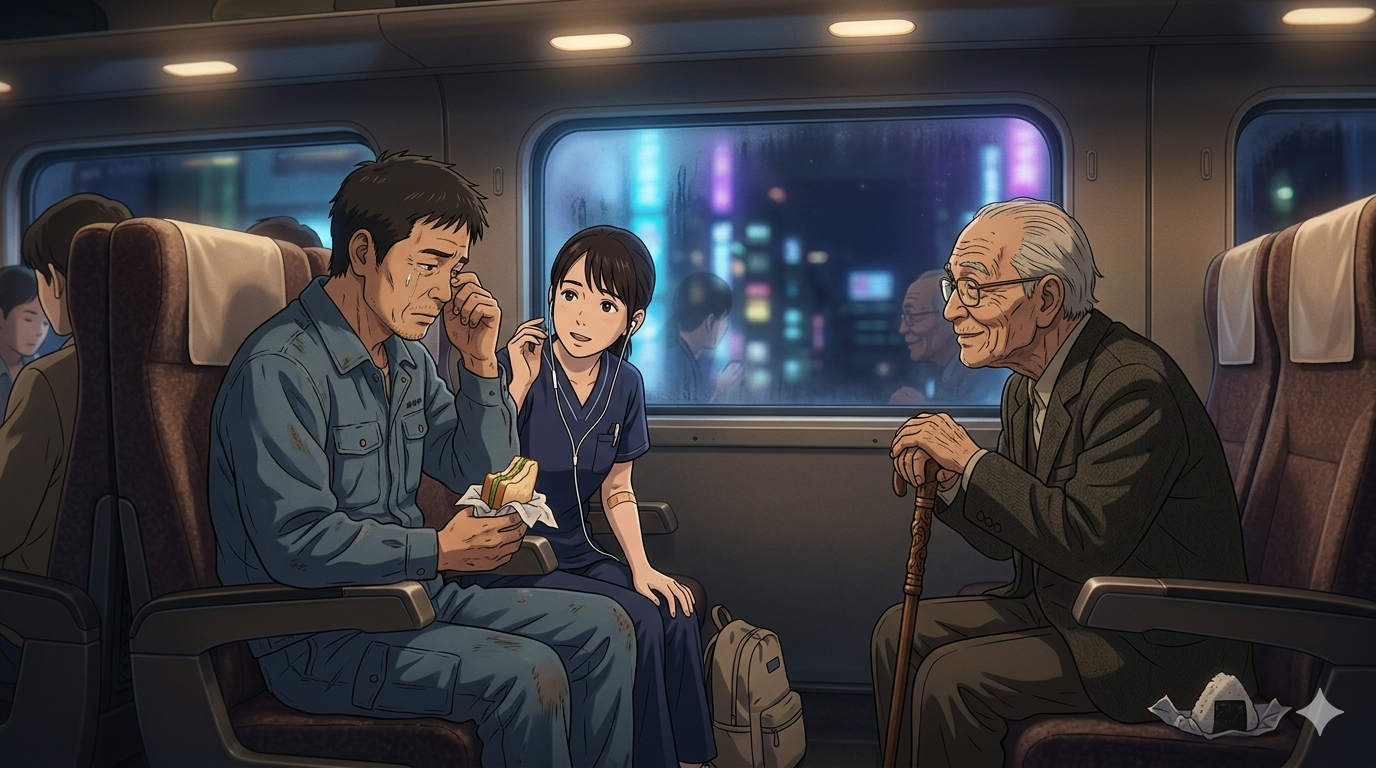
The night train moved like a metallic sigh, gliding along tracks that sliced the city into strips of light. The cars were capsules of routine: passengers leaning against fogged windows, fingers scrolling screens with automatic gestures, headphones raising invisible walls. Everything seemed held together by a collective habit until a small sound—the crinkle of wrapping—broke the monotony and revealed an intimate scene no one had asked to witness. Hiroshi held a sandwich wrapped in white paper. His hands, roughened by years of factory work, moved with the precision of someone who repeats gestures to hide something larger. It had been another long day: production lines, urgent orders, supervisors pushing for speed. When he left the workshop he felt, for the first time in months, that none of what he had done stuck to his life. The apartment he returned to was a silent box: dishes, an unwashed cup, the echo of distant televisions. His son's calls often came late or not at all; his ex-wife had stopped answering questions that for him were fragile bridges to a shared past. He bit the sandwich with measured motions. He wasn't so much seeking food as an excuse to remain, to avoid facing the room that awaited him. A tear slid from the corner of his eye and fell onto the paper, absorbed in silence. Another followed its path, as if carrying memories that refused to stay in. Beside him, Yuki, a young woman with a small backpack, turned her head. She was coming off a double shift at a clinic, and her hands still smelled of disinfectant. She had learned to contain compassion; she exposed it in small, secret moments. Seeing Hiroshi's tears, an old reaction rose: the need to reach out, even if only with a whisper. "Excuse me," she said, lowering her voice so she wouldn't disturb the car. "Are you okay?" Hiroshi wiped his cheek with the back of his hand, trying to put his mask of normalcy back in place. "Yes," he answered, his voice tight. "It's just that today was hard. The smell of hot rice reminded me of my mother and... it became more than I could hold." Yuki nodded, feeling a pang of empathy and her own nostalgia. "My mother always cooked too," she murmured. "Now I do it when I have time. Sometimes it's the only thing that connects me to home." The words flowed between them gently, without demand. The train seemed to slow around that exchange, as if the night had granted a moment for their lives to brush. In a nearby seat, an older man named Sato watched with attention. He had lost his wife years ago; since then stations and platforms had been his everyday landscape. His hands, marked by wind and the farm work of his youth, rested on a cane. Sato cleared his throat before speaking; his rasping voice filled the space between the two younger riders. "My father never cried in public," he said. "But I would sometimes find him looking out the window, like he was searching for something that had been left behind. I think men learn to hide fatigue because the world expects something else." Hiroshi looked at him, finding an unexpected reflection in the story. "Sometimes I feel that if I speak about what I carry," he said, "people at work would think I'm weak. And at home, I don't know how to do it without making it a burden." Yuki thought of the faces she treated at the clinic, of patients who came with wounds that weren't always visible. "It's not a burden," she replied. "It's part of being human. Sometimes saying it out loud is the first permission to stop carrying it alone." The exchange drew discreet glances. A passenger, moved by the scene, silently took out her phone and recorded a fragment: the sandwich's edge, the tear tracing a path, Hiroshi's hands. She did not intend harm, only to hold the image of vulnerability she found so rare in that car. She uploaded the video without commentary, simply inviting viewers to look rather than ignore. Within hours the recording circulated online. Millions of eyes fell on that tiny scene heavy with meaning. Comments ranged from empathy to scorn, from advice to judgment. For some it was evidence of a country that sacrifices private life to the altar of work; for others, a reminder that the most human gestures are often the least visible. But in the car, while notifications buzzed on distant screens, the conversation continued with the calm of people sharing an improvised refuge. "Does your son live far?" Yuki asked, wanting—without planning—to build another small bridge. "Not too far," Hiroshi answered. "He’s at university. He studies in the city and sometimes he's busy with classes and friends... I guess. I find it hard to call him without feeling like I'm interrupting." Sato sighed, recalling his own attempts to reach children who had formed their own lives. "Silences grow," he said. "At first they’re comfortable, then they become huge, and finally habit. Sometimes a clumsy word will break them, and other times nothing will." Yuki closed her eyes for a few seconds, letting the flickering outside lights draw shadows across her face. She remembered her brother as a child: laughter in the kitchen, clinking glasses, a home that felt eternal. "I miss family dinners," she confessed. "The conversations were loud, intimate. Now everything is scheduled. I don't know if I miss the house or the feeling of belonging." Stations passed, each one a waypoint marking the time of their confessions. The sandwich sat half-eaten on the tray. Its taste didn't matter; it was a talisman of memories. Between bites, Hiroshi spoke haltingly about staying late at the factory to cover shifts and returning to only silence. How some nights his son didn't answer, and the apartment door seemed to close not only a place but also a possibility. They spoke until words became comfortable pauses. They shared anecdotes: Sato recounted coming home with muddy hands as a young man and being taught by his father to take pride in work; Yuki described her mother singing while cooking; Hiroshi recalled his mother's voice calling him to dinner, the punctuality of rice, the certainty of a home that no longer existed in the same way. When the train entered the station where the three were to disembark, the platform light greeted them with a yellow pulse. No one wanted to hurry. They rose slowly, like people putting their skins back on after a spell of emotional nakedness. "Thank you," Hiroshi said, with a sincerity that sought no reward. "Thank you for listening. I didn't ask for it, but I needed someone to know." "Don't forget," Yuki replied, smiling with that shy gesture that opens doors, "there are more people willing to listen than you might imagine." Sato, leaning on his cane, offered a final observation like an inherited piece of advice. "Take care of your memories," he murmured. "They're the only things we can share cleanly; if you hide them they rot." They stepped off the train almost in sync. For an instant the city felt less indifferent. Some passengers glanced at their phones; others remained wrapped in their private worlds. The sandwich lay forgotten on the seat, wrapped and mute evidence of a shared intimacy. A station worker found it and tossed it into a nearby trash container, unremarkable, as if burying certain pains. Meanwhile, the video had sparked conversations. Forums, direct messages, long and short comments; stories of workers who recognized themselves in Hiroshi's gaze, accounts of children who understood too late, letters from people for whom loneliness was constant company. Online, thousands of strangers traced a choreography of empathy, judgment, and reflection. For many it was a call to listen; for others, an occasion to politicize suffering. But the concrete effect on the three people that night was small and tangible: a message on a phone. Days later, in the same carriage where it had all happened, Hiroshi received a brief text: an emoji and a short line — "Dad, are you okay?" — carrying the awkwardness of someone trying clumsy repair. Hiroshi read it with hands that trembled less. He replied without hesitation: "Yes. Let's talk tomorrow." It wasn't a grand reconciliation, but it was a beginning. Yuki returned to the clinic with renewed attention. She began offering a few more words when someone seemed stoic. Sato kept riding the trains with a more open gaze, as if every car were a library of lives deserving a page. The city continued its rhythm, outwardly unchanged. But something had shifted among those passengers: a softer readiness toward the person next to them, a gesture they hadn't dared before. Nights remained full of untold stories; yet some voices became a little more audible. Empathy, partial and fleeting, had seeped through a crack opened by a sandwich and a tear. In daily life wounds do not vanish easily. But the scene on the train showed that human life also depends on small interruptions: an attentive question, a hand that doesn't judge, an unexpected message saying "I'm here." And in a country where discipline and efficiency often prevail, the image of a man eating silently while crying forced people to look at what usually stays hidden. In the end the train continued on, stations distributed between farewells and arrivals. The lives of Hiroshi, Yuki, and Sato did not transform dramatically overnight, but they carried the mark of a conversation that reminded them how, even as the world's pace pushes toward piling up tasks, the human heart always seeks an ear to recognize it. That recognition, however brief, had the power to undo the heaviest loneliness for a moment; and sometimes, that is enough to begin coming home. Source of the images. Image created with Google Gemini.
No comments yet