 @mc5punk
more from that month
@mc5punk
more from that month
Short story: The Mural on the Corner
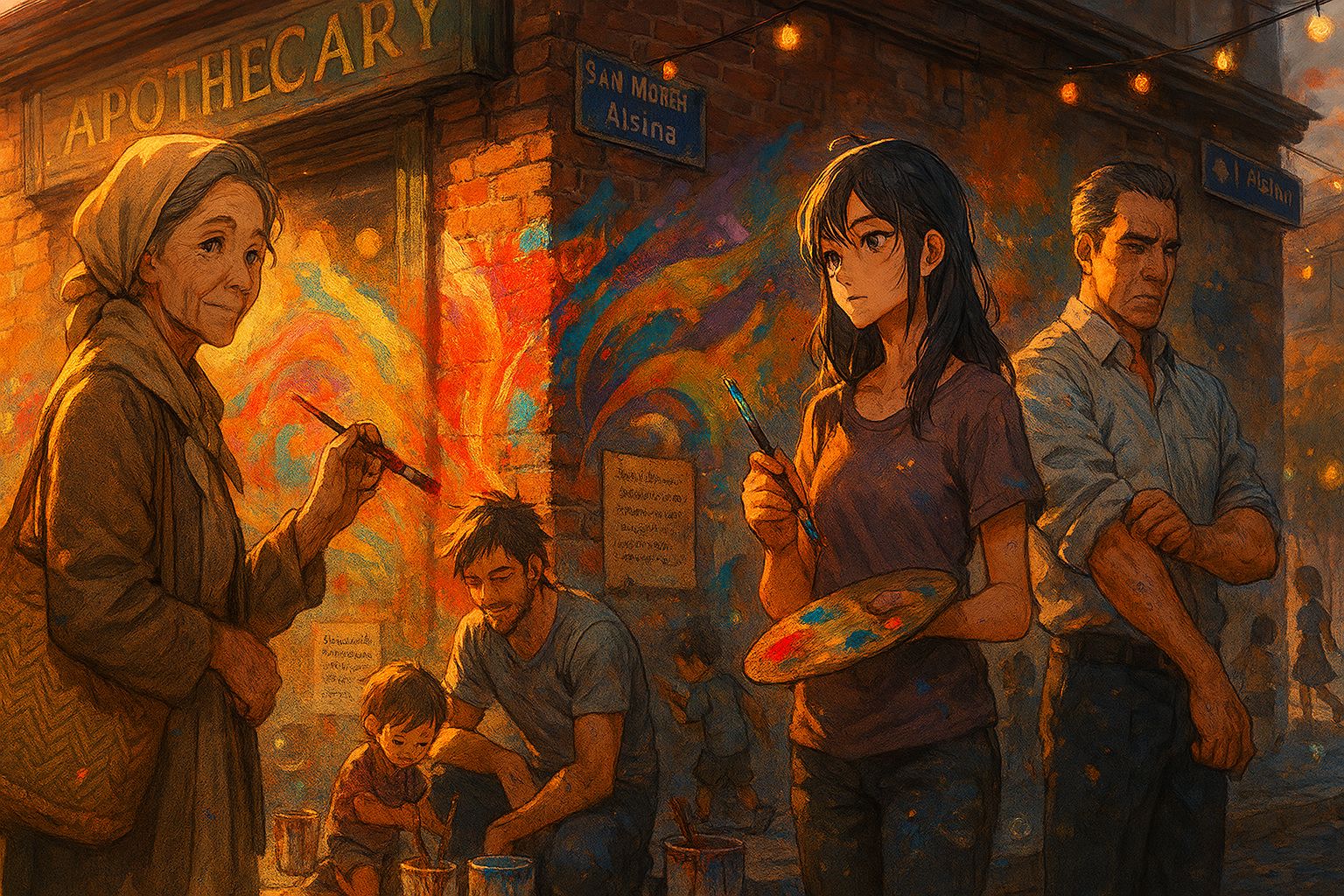
The afternoon fell like a warm sheet over San Martín Street. The last rays touched the old apothecary, brushed the balconies, and stopped at the painted wall: an explosion of color that seemed to inhale and exhale the neighborhood’s breath. There, in front of the mural, those who had suffered, those who had fought, and those who had given the orders met. Wounds and words left unanswered converged. María arrived with a jute bag on her shoulder, hands hardened by years of chalk at the school and a folded list of meetings in her pocket: the schedule of gatherings. Her eyes, deep but alive, scanned the painting like someone searching a lost stretch on a map. Seeing it, Diego clenched his jaw. He had avoided this corner for years; now he returned with the certainty that looking from afar was no longer enough. His son ran among the paint cans as if it were an absolute game — and perhaps, in a way, it was. Inspector Rojas climbed the scaffolding with the awkwardness of someone who had not yet learned how to take apart the uniform of memory. “I didn’t come to erase anything,” Diego said without greeting. His voice trembled as he held it in. “I came to put another piece into this puzzle.” María looked at him with a calm that carried weight. “Then stay,” she replied. “Paint, speak, listen. This is not a trial; it’s a table.” The first time they sat down, the chairs creaked with an old distrust. The inspector bore the gesture of someone trying to pay a debt without knowing how: word by word, promise by promise. Voices crossed like waves breaking against a wall. A woman named an absent brother; another neighbor showed the scar that still burned when she remembered the gas and the high-pressure water. There was crying. There were reproaches. “I’m sorry,” Rojas said, his voice smaller than his rank. “I can’t erase the hands I raised, but I can learn not to raise them that way again.” The room fell silent. It was not absolution; it was the first crack through which light might seep. Lina arrived one morning with a backpack full of brushes and a sketch that sounded like a song. She was twenty-four and had a patience that knew how to wait. Her hands drew linked hands, figures holding one another, a river crossing the mural carrying names written on small banners. She proposed that memory should not be mere text but texture: testimonies sewn to the wall, fragments of words in relief, a flower growing from the shadow of the barricades. “If we paint rage the same way we paint the past,” she said, “we’ll domesticate it. Let’s paint it alive, explicit, but transformed into something that protects.” The day of the final painting arrived like a procession: slow, with small ceremonies. Families brought buckets, gloves, homemade snacks. The asphalt smelled of mate and the neighbor’s frying oil. The first strokes were clumsy, human. The youngest sprayed aerosol with bravado; the elders outlined with patience, as if stitching a seam. Diego approached a section showing stylized flames. He breathed over the color as one who rests their forehead on a wound to feel its pulse. “I never thought I’d come back to this corner without feeling rage,” he murmured. Lina did not take her eyes off the line. “Rage doesn’t disappear,” she answered. “We place it here and make it useful. Hand me that brush.” Diego’s child, who had been tracing the silhouette of a bird on a panel, raised his voice with the innocence of someone who still doesn’t know what war is: “Dad, is this so there aren’t any more fights?” he asked. Diego looked at the mural and at his son, and for a moment the anguish turned into a decision. “It’s so there are other ways,” he said. “So they learn to speak before they set fires.” Inspector Rojas, sleeves rolled up, picked up sand from the sidewalk and mixed it into paint. It was a symbolic gesture: turning dust into color, memory into matter. A neighbor handed him a cup of coffee; he accepted it without pride, with a humility that seemed new. In the following days conversations shifted from hardness to weaving. In workshops, history was told with names: “Ten years ago, here,” “I saw how,” “That person was detained.” Stories were woven and hung on side panels; voices were recorded so those who wished to listen could hear the tone of truth. Some never returned. Some considered the presence of a former officer a betrayal of mourning; others approached and placed their hands on the paint, eager to feel the warmth of a tangible reconstruction. Reconciliation was not a heroic or sudden act: it was a succession of small betrayals of rancor. An adolescent who once threw stones began coordinating a conflict-resolution workshop. A shopkeeper who had closed months after the repression opened her shutter and put up a sign that read “Open — thanks to the corner.” Small signs that, added together, pronounced a change. One night, during an improvised vigil, María stood before the mural as one who makes an offering. Hanging lights trembled in the breeze. Neighbors lit candles and, one by one, read fragments of the testimonies attached to the wall. A song by some young people became the knot that loosened the tension: a song about paths and hands reaching. “We are not asking for oblivion,” María said. “We ask for active memory. Let this remind us that we can fail, but we can also repair.” Rojas let the night do its work. No one demanded more. His commitment took the form of actions: trainings at the station, open lines of dialogue, revised protocols. It was not enough for everyone; some expected more visible reparations. But the dialogue was planted. The mural, its colors still damp from the recent paint, began to age as flesh does: with scars that tell a story. The names on the small banners yellowed; the child’s bird lost a wing in a rub; two students added a signature with spray paint in the lower corner. Nothing was perfect. Everything was human. In the adjacent square the children played inventing imaginary scenarios. A brother of one of the detainees walked with short steps beside his granddaughter. Diego, who once avoided the gaze of police, now found in Rojas a complex figure: a man who had obeyed orders but who now tried to invent another way of being with the community. “Do you think this changes anything?” Diego asked one afternoon, leaning on the café railing. Rojas paused, looked at the mural, and did not seek excuses. “I don’t know if it changes everything,” he said. “But it changes something. And something can be the beginning.” Years came with stitches. The cleaning days became monthly; cultural fairs took place quarterly. A local archive of testimonies was created; high school students researched the event so new generations would not inherit it as mere rumor. And occasionally, a veteran of that night appeared with a gesture of remorse or a new story that added a piece to the puzzle. The city stopped speaking with the nervous violence of the early days. Conversations became longer, questions sharper, and there was a growing will not to repeat mistakes. The mural, once only paint, became counter-history: a place where memory is practiced and the community disciplines itself in the patience of rebuilding. At an especially golden dusk, María leaned her hand against the wall. She looked at the intertwined figures, the flower born of shadow, the band where the word “Memory” was written with the texture of skin. People of all ages walked around, and for a moment the square breathed as one. “We did what we could,” María said, as someone stating a humble truth. Diego watched his son play with other children; his voice mixed relief with warning: “Learn to speak. And if you forget, at least come back and read what we did here.” Rojas, no longer wearing a uniform but still in the habit of responding, added his voice: “My presence here is a debt I take seriously. I don’t promise miracles, but I promise work.” The mural didn’t close wounds; it made them visible. It didn’t answer all the questions; it put them in a place people could reach. Like any collective work, it remained imperfect and alive: subject to hands that retouched it, to words that were added, and to new generations that looked at it without fully understanding but who felt its weight. It was, at last, a pact half-made, an open chapter. The corner remained a corner: a point of passage, of chance encounters, of debates in cafés. But it was no longer only memory. It was a school. A warning. A promise. When night fell, the mural glowed against the backlight and someone left a fresh flower at its base. Voices began to sing in the distance. The community, with its disagreements and its broken tenderness, walked slowly toward their homes. Nothing had been resolved. Nothing had been forgotten. But, at least for that night, the paint and the people were at peace. Source of the images. Image created with Bing.
No comments yet