 @mc5punk
more from that month
@mc5punk
more from that month
Short story: The City of Borrowed Lights
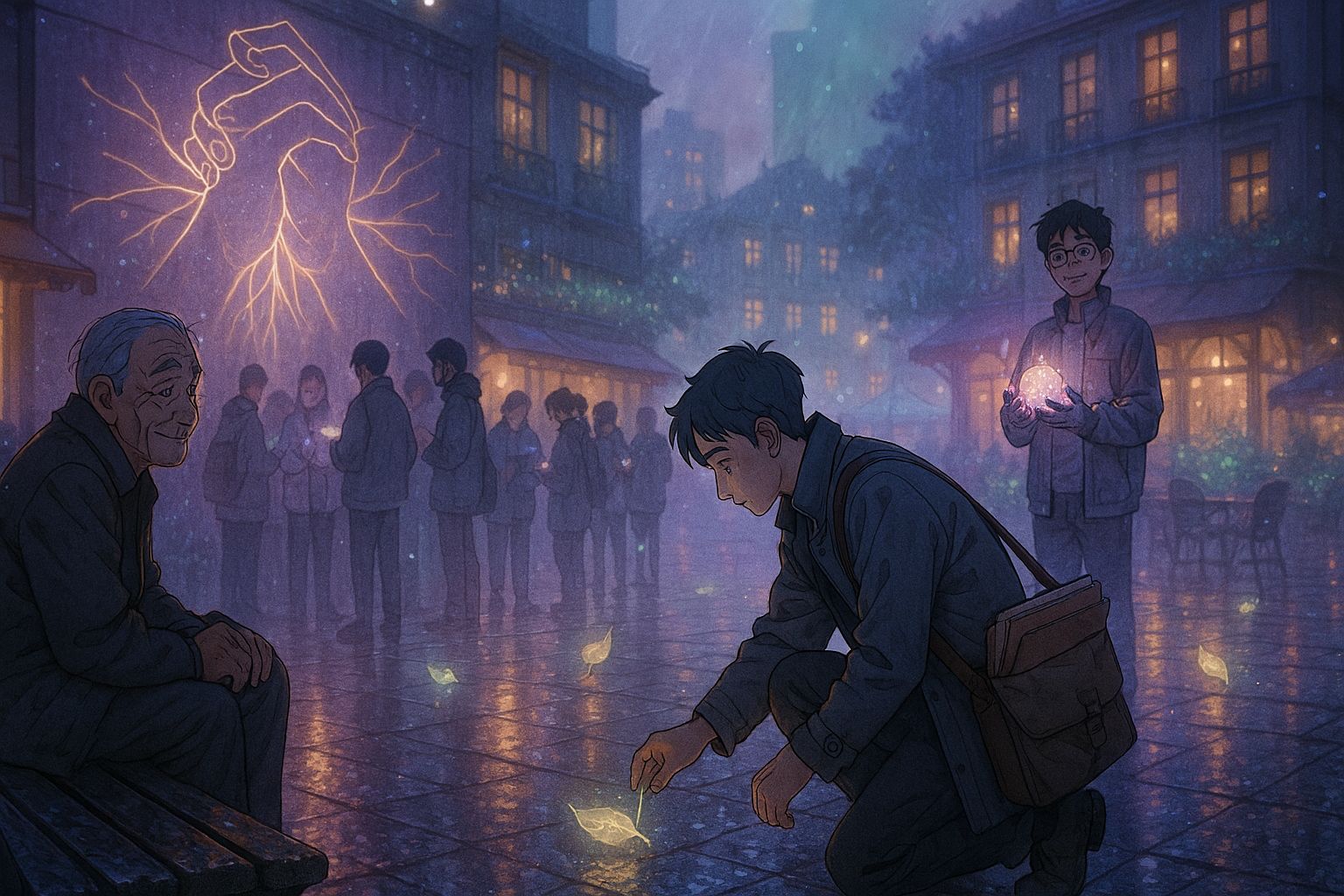
Day thirteen. It’s been nearly two weeks since the luminous fog claimed the city and rewrote our nights. What began as a strange phenomenon quickly started to shape every step: plazas and sidewalks shimmer with iridescent veins, façades reflect lights that have no obvious source, and behind every window there is a shadow of absence that wasn’t there before. The city breathes differently; people walk with the thin alertness of someone who has lost a compass, and their gaze lingers longer in corners, searching for something the fog seems to promise and deny at once. My phone alarm woke me, and as on every morning since life changed its luminosity, I kept a routine that anchored me to the ordinary: a short shower, a brush of my teeth, a coffee that tasted like coffee. The television mixed figures and maps with images that looked like postcards: gardens that had been discreet now glittered like shop windows; terraces that had closed at dusk had been transformed into little plazas of light. Newscasters tried to contain the blend of panic and fascination with serious faces and scrolling warnings. Scientists in improvised labs appeared alongside healers and seers offering contradictory explanations; neighborhood groups circulated both practical protocols and memes. The city, I thought, was looking at itself for the first time in a long while. Leaving with the briefcase that held my folders and résumés—a routine I had not abandoned despite the change—I ran into Clara, the neighbor from the fifth floor, and Tomás, the bus driver who always found a joke to defuse the day’s tension. “Did they give you the appointment?” Clara asked without taking her eyes off the mural across the street, a huge piece of street art showing clasped hands and filaments of light. “Yes,” I answered. “They called me to the research center. They’re looking for volunteers and staff for fieldwork and logistics.” Tomás muttered something about buses rebooting and the fog, and Clara joked about a “touchers of luminous baubles” club, which drew a short laugh from the three of us. Humor, I discovered these days, was a survival mechanism: a way to speak the unbearable without fully owning its weight. The city, overall, now bore two faces in constant tension. On one hand, a comic everydayness: neighbors organizing night walks to observe the luminous flora, impromptu fairs selling iridescent plants, and cafés charging customers simply for offering tables with their own light. On the other, a dramatic backdrop: memories returned to people who believed they had buried them, marriages cracking as borrowed memories surfaced, elderly people weeping with fresh nostalgia for loves that seemed to resurrect in brief, cruel instants. The fog acted as both mirror and thief: it returned visions that did not always bring peace. At the mural, Eloy—a man of advanced age who used to sit on the bench and watch the hours go by—was talking with María, a young volunteer with a notebook full of sketches and notes. Eloy’s eyes were wet and his voice worn by the habit of speaking to anyone who would listen. “Last night it showed me Ana as she was at twenty,” he said. “She was in the kitchen laughing; she spoke of a song we’d forgotten. And then she left. It was like opening a window and the wind taking her away.” “Did that bring you comfort?” María asked without judgment, with the professionalism of someone who records everything. “Sometimes,” he confessed. “And sometimes it becomes more painful: you remember what you lost so clearly that forgetting grows heavier.” That dichotomy appeared in streets and homes: some neighbors found unexpected relief in borrowed memories; others lost themselves in nostalgias that were not their own. Debates in community centers ranged from the therapeutic value of the fog to the ethical risk of clinging to borrowed memories. Who had the right to keep what the fog returned? And what happened to a person’s identity when it blended with fragments that were not theirs? In the research center, the atmosphere was methodical but threaded with human tension. Dr. Becerra, measured-voiced and authoritative, coordinated the team; Samira, patient and precise, organized interviews and protocols; Luis, a young technician with a nervous smile, always carried his tablet and a halo of jokes. Tables were laid out with gloves, reagents and containers for small samples: luminous baubles wrapped in paper, leaves that shed a faint glow, and in some jars a moisture that matched no known plant phenotype. “We’re looking for technical profiles and organized people,” Dr. Becerra explained in the room where they welcomed us. “This is not just curiosity; we need records and order. Every sample must be accompanied by metadata: time, location, witnesses, description of the effect.” “Do you have fieldwork experience?” Samira asked, studying me. “I’ve done logistics and documentation,” I replied. “I can help in that regard.” “If you know how to fold forms and keep your spirits up, you already help,” Luis joked, trying to lighten the moment. Yet humor did not erase the real: hands that signed forms trembled at times, and voices broke when people recounted extreme cases. Families who relived farewells, people whose identities blurred with stories that were not theirs, volunteers who suffered moments of temporal confusion after handling samples without protection. The warning sign on the lab door reminded us that science still had no answers and that ethical handling of the evidence was a joint responsibility. Luis offered me a bauble wrapped in paper with the solemnity of someone handing over a relic. “We picked this up on a rooftop last night,” he murmured. “It pulses, doesn’t it? It makes no sound, but if you stare at it it gives you fragments that aren’t yours. Better with gloves.” Holding the sample was like reading someone else’s old photograph: a scene crossed my mind—a kitchen with blue tiles, a conversation cut short, a child’s laugh that wasn’t mine. I opened my eyes in the center’s cold room with the sensation of awakening from an invasive dream. No one spoke for a moment; the sample’s tactile capacity to project memories had left a dense silence. From then on I understood that the fog didn’t just return memories in fragments; it made them tangible, physically lodged in tiny objects that acted like capsules of time belonging to someone else. While I waited for my technical interview, I ran into Clara, who offered practical warnings. “If they call you to take samples, don’t forget your gloves,” she told me softly. “María said some baubles dissolve if you touch them without protection.” Tomás insisted that he might be asked to measure rooftop light intensity and joked about his fear of heights, drawing the kind of nervous laugh that intermittently appeared among us to ease the day’s weight. I promised to accompany him if called: small commitments, I thought, had become the threads of trust that held us together. Police work had also changed nature: officers who once patrolled now acted as community mediators, facilitating ambulance routes, safeguarding research teams and organizing safe meeting points. In an improvised coordination center I saw a captain speaking with an international mission representative; their conversation revolved around humanitarian priorities and the sharing of personnel and data. The city, I thought, had become a board where local and global met with unusual urgency. Leaving the center with an extra small sample—another fragment Luis slid into my hand wrapped in paper—I felt, for an instant, another borrowed vision: a truncated argument, a key falling, a stifled cry. Eloy watched me from his bench and, with the voice of someone full of years, said: “Take care of that bauble. If it gives you a memory, don’t cling to it too hard. Learning to let go is also part of living.” His words rang with tenderness and warning. Eloy’s lesson was not just about protecting oneself from the fog; it was a reminder of the human risk of building an identity around what does not belong to you. In a city where memories could be lent, detachment became an emotional survival strategy. Turning the corner, I stumbled over a luminous leaf that slid like jelly across the pavement. I picked it up and tucked it into my notebook with the clumsiness of someone who didn’t know whether such a relic would be useful or dangerous. I thought, with a resigned sort of humor, that it might serve as an emergency lamp or a joke for family gatherings; but the sensation that crossed me when I took it was less frivolous: something in the city was looking at me with curiosity. Sometimes it was the fog; other times, I felt it was something living within it, a faint intelligence that collected human fragments. Night fell with its new liturgy. The fog was not merely a physical phenomenon; it acted as an agent that reorganized the city: it collected memories, packaged them, and offered them in portions that could heal or break whoever received them. Volunteer rounds logged data, scientific teams tried to categorize effects, and the population swung between a willingness to cooperate and an ethical fatigue at perpetuating something that touched the most intimate parts of identity. Days took on a theatrical cadence: mornings brought the solemnity of science and logistics; afternoons, the eccentric humor of neighbors inventing practical uses for small luminous fragments; nights delivered the mystery that unfolded in puddles and rooftops, where the fog revealed, for a fraction of a second, landscapes that didn’t belong to the beholder. In the square, María asked volunteers to record carefully: time, hue, weather, testimonies. In the center, Dr. Becerra insisted on chain of custody and on the importance of not attributing more to what, for now, was inexplicable. Amid intimate drama—people reliving absences and reunions—possible comedy—the new customs and small business opportunities—and persistent mystery—the veins of the fog— the city sustained itself on blended voices: a cough from someone remembering, a laugh erupting in a corner, the voice of a scientist debating hypotheses beside a healer reciting verses. All of it formed a strange score: a dissonant symphony whose central theme remained unsayable. At the end of the day I boarded public transport with the luminous leaf in my notebook and the small bauble wrapped inside an inner pocket. In the carriage, the light that leaked through the window seemed intent on reading faces; some passengers bore borrowed stories in their eyes, others the resignation of those who’d learned to live with the incomprehensible. I stepped on another luminous leaf upon getting off and, for a second, felt as if the city was looking at me. I could not tell whether it was a sign of good luck or an invitation to mistrust appearances. In the days to come I imagined many courses: that the fog would finally dissipate, leaving lessons and scars; that it might become a resource for unexpected cures or a danger that forced walls to be raised; that the memories returned would remain as gifts or become chains. Meanwhile, in the research center samples were kept cold, cafés argued ethics and charm, and people on benches continued to mourn and celebrate in equal measure. The City of Borrowed Lights offered no definitive answers, but it forced people to look—at others, at themselves, and at the thin line between memory and ownership. I learned then that in times of fog the most important thing was care: care for the samples, for the memories, and—above all—for the hands that hold what is not theirs. If luck could be measured by anything here, it would be by the ability to let go of what the fog gives and keep walking. Source of the images Image created with Bing.
No comments yet