 @mc5punk
Short story: The Mirror of the Beasts
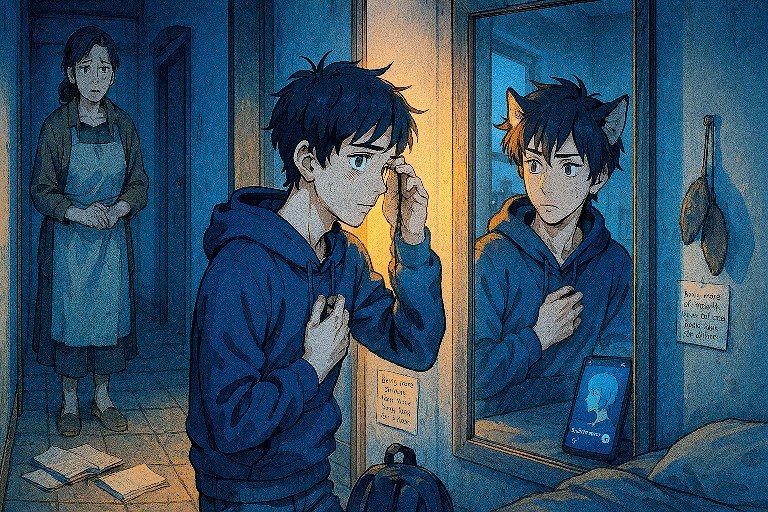
On the second floor of an old building whose walls kept nights of rain and half-finished conversations, Mateo lived. The apartment was narrow: a kitchen with worn tiles, a living room where the clock seemed to have stopped in a sad tick, and his room, both sanctuary and stage for change. He was seventeen, his gaze always moving as if searching the air for an answer he could not find. Hanging from a frayed cord on the wall were felt ears: small, carefully sewn, aligned like offerings. Facing them, an elongated mirror returned the image of a body in transit; sometimes the reflection showed the boy his family knew, other times the silhouette of an inner creature he was beginning to name. The day everything seemed to overflow began with a simple, anguished question. His mother, Elena, appeared in the doorway with her apron tied and tired eyes. “Are you okay, Mati?” she asked, her voice breaking. “Last night I opened your notebook and saw those notes… what do all those words mean?” Mateo made a mechanical gesture, took one of the ears and brushed it with his fingertip, as if its warmth could restore coherence. “It’s…it’s my way of feeling more like myself,” he answered, avoiding her gaze. “It’s not just putting on ears. It’s knowing there’s something inside me that isn’t human, Mom.” Elena gripped the apron between her hands, trying to hold onto routines that no longer sufficed. “It’s not my job to understand everything, but I’m worried you’re drifting away from us. Your father and I only want what’s best,” she said, with a mix of fear and reproach. “Can’t you be happy without this?” The conversation hung in the air like a half-filled glass. For Elena, the ears were a sign that something was slipping away from her son; for Mateo, they were the first visible gesture of an internal search that wouldn’t fit in the house or in his mother’s words. In the corner square, under flickering lamp posts, young people wove codes and rhythms through their screens. Social networks were a fabric connecting those who named themselves in new ways; they made distance seem curable. That’s where Mateo met Mara: a short-haired girl with sharp eyes and a digital voice that promised understanding. She called herself “wolf on pause” in her bio and filled her profile with drawings of fangs traced in black ink. “Hi, Mat,” Mara messaged. “I saw your notebook. Your ears are beautiful. Have you tried walking without looking at people? It’s liberating.” The reply came with the awkwardness of someone who hadn’t yet mastered the confidence displayed online. “And what if I feel ridiculous?” he answered, his fingertips trembling. “Then don’t say it out loud. No one here judges. Here we understand each other,” Mara replied, adding a moon emoji. Virtual acceptance was at first a caress that calmed him. It was a refuge for the anxiety burning inside Mateo: a place to name sensations without the discomfort of explaining or defending himself. But the online community, so ready to offer comfort, also pushed him toward isolation. At night he practiced muffled mews and long breaths, thinking he was tuning a nature no one could prove existed. His schedules unraveled; study hours became screen hours. His grades, once steady, began to fall. At school some classmates laughed behind his back; others looked the other way. What had been a secret game turned into a wall between him and everyday coexistence. The school principal, worried about his declining performance and the rumors, recommended the intervention of the school psychologist, Dr. Rosa. Her office was a room of dim light, books placed in precarious order, and the air of someone who had heard many stories before. Rosa opened Mateo’s file with the calm of someone unwilling to rush pain. “Searching for identity is the national sport of youth,” Rosa said in their first session. “Adolescents want to know who they are or who they want to be. Sometimes, the stranger the behavior, the more effective it is for differentiation.” Mateo shrank in his chair, his body small beneath the clinical phrase. “So this is normal?” he asked, staring at his hands as if they held proof of his normalcy. “Partially,” Rosa replied. “There’s a deep desire to break the mold. But I’m also worried you’re using this identity to disconnect from the real world. Networks amplify and normalize these behaviors. When someone’s functionality is affected—when they stop studying, isolate themselves—it ceases to be merely an identity game and becomes a problem.” Rosa’s words weren’t a condemnation; they were a map pointing to a risk Mateo recognized with a shiver. He began to see his behavior in the harsh light of professional observation: not only as a label that defined him but as something that, if left unattended, could strip away tools for living. Mara, for her part, was a flawed mirror. For her, the label—unspoken but implied in every drawing and ritual—had worked as a cloak. She had tried many communities before: hippie exaltation, emo melancholy, but none had lasted. For Mara, the idea of an animal essence was a primitive beat that sustained her when modern life stifled her breath. Yet privately she noticed cracks. “Do you realize?” she told Mateo one night as they walked through a silent park. “I used to think being like this helped me, but sometimes I feel like I’m losing pieces of myself that aren’t about identity. I can’t remember the last time I talked to my father without feeling like I had to explain myself.” Her words were honest and gentle; an admission that belonging could also cost. The nightly rites and constant exposure entailed the loss of other conversations, of daily learning, and of talks with the people who made up their past. In the neighborhood, discomfort grew. Neighbors who didn’t understand approached the school and the square with suspicion. To organize the discussion about what many saw as a new phenomenon, the school invited a sociologist: Tomás. With measured voice, Tomás took the microphone at an impromptu town meeting and said something that resonated deeply. “I believe the most dangerous part of this social phenomenon lies in the points of violence it can generate,” he said. “Right now it might seem like a joke, but the reality is worrying. An unusual behavior can create discomfort in daily coexistence and from there aggression can arise.” His intervention wasn’t meant to moralize; it was meant to warn. For Tomás, the rituals celebrated on networks weren’t innocent: they could spark rejection and dynamics of exclusion that turn violent. Some adults accused digital platforms of facilitating radicalization: repeated positive feedback turning marginal positions into conventions. For young people, however, the same window—promising understanding—was often the only place where they found words for what they felt. At home, a discussion between Mateo and his father, Ernesto, reached the intensity typical of conversations underpinned by fear. “You can’t go around saying you’re an animal!” Ernesto exclaimed. “Your studies, your responsibilities, your family! What happens if someone reacts badly and assaults you?” “And what do you want, Dad? For me to stop breathing so I don’t make you uncomfortable?” Mateo replied, his voice breaking. “This calms me. I feel recognized.” Ernesto, jaw clenched, saw the risk from a practical perspective: public stigmatization, physical danger, and lost opportunities. Tomás’s words echoed in his head: points of violence. For him it wasn’t a matter of wounded pride; it was a matter of safety. Those fears echoed in Mateo. He began to ask whether his search was selfish or legitimate; whether it was an outlet or a cage. Nights of identity fervor alternated with days of depression: when virtual approval didn’t come, the emptiness drove him into despair. Sometimes he promised himself to stop; other times he plunged deeper into the intensity of belonging. In one session, Rosa read aloud an entry from Mateo’s notebook: “If those who gave me life don’t recognize me, those who share my silence will.” “Have you considered that part of identity comes from what you keep?” Rosa asked gently. “You don’t always have to shout it to the world. Sometimes identity is built with boundaries: with what you choose to preserve and how you relate to others.” The phrase opened a crack. For the first time Mateo imagined a third path: not the polarity between instant online acceptance and absolute public rejection, but the possibility of integration. He could affirm the part of himself that craved animality without abandoning responsibility to his family and school. He could seek balance. The following days were a quiet struggle. There were painful setbacks: a fight with Ernesto that ended with a slammed door; a cruel comment online that made him vanish for days; a formal complaint at school that forced him to explain his behavior to the administration. These episodes tightened the rope. But advances also surfaced: a dinner where he spoke about his father’s fear and, without taking off his felt ears, agreed to reduce his posting frequency; an afternoon with Mara where they talked about the need for support beyond screens and considered joining in-person groups. “I don’t want you to be less you,” Elena said at one of those dinners, her voice frayed with emotion. “I just want you to be okay.” “I don’t want to stop being me,” Mateo replied. “But I think I can try without disappearing.” The turning point came when the school organized a workshop on coexistence. Rosa and Tomás participated: she spoke about the need to limit identity’s impact when it affects a young person’s functionality; he explained the social risks and how collective discomfort can transform into violence. Both agreed: networks amplify, but the real community decides. “Networks normalize patterns,” Rosa said to the audience, “but face-to-face empathy prevents them from becoming storms. Not everything strange is harmful; what’s harmful is when the strange prevents you from living.” “And what seems harmless can become problematic if it generates rejection and violence,” Tomás added. “That’s why coexistence must include dialogue and learning to listen without sacrificing anyone’s safety.” That afternoon, seated in a circle in the auditorium, Mateo spoke to his classmates with a voice that sought clarity and steadiness. “I didn’t come here to ask permission to be myself,” he said. “I came to ask you to listen. I’m not going to impose a way of being, but I want you to understand that behind the strange is a person who feels fear.” His words opened a possibility. Not everyone understood; some mocked, others remained silent. But several people stepped forward with the willingness to approach. Ernesto, surprised to find himself among the audience, came out of the auditorium and, with a voice barely held together, approached his son. “I don’t know much about what you say,” he muttered, “but I want to learn. I don’t want you to get hurt.” “Then let’s start learning together,” Mateo replied, and for the first time he saw in his father’s eyes something beyond worry: a will. The change wasn’t instantaneous. There were days when Mateo intensified his practices and backtracked on agreements; other days calm returned. The felt ears remained on the wall but stopped commanding his life. He learned to ration refuge in the virtual community and to ask for help in reality. Mara stayed by his side; what had been performative intensity between them mellowed into sincerity. Together they joined in-person groups where attention was therapeutic and labels served as tools, not mandates. Mateo’s story did not resolve the conflict once and for all. The search for identity remained, for many, a national sport: generations inventing languages their parents don’t always understand. What changed was how that search was accompanied. The informational barrage and the amplification of networks did not disappear; what emerged was the possibility of accompaniment: boundaries, dialogue, and human presence. On his bedroom wall, next to the felt ears and the moon drawings Mara had once given him as a joke, Mateo stuck a small cut-out note: “Being more of myself must not mean being less for others.” Each time he read it, he remembered that belonging to a community—whether of flowers, songs, algorithms, or drawn fangs—requires a decision: to choose authenticity with responsibility. In that choice he slowly discovered that the mirror could reflect many things at once: the creature that inhabited him, the student who studied, the son brave enough to learn alongside his family. Source of the images. Image created with Bing.
No comments yet