 @mc5punk
more from that month
@mc5punk
more from that month
Short story: Seven Minutes in the Dark
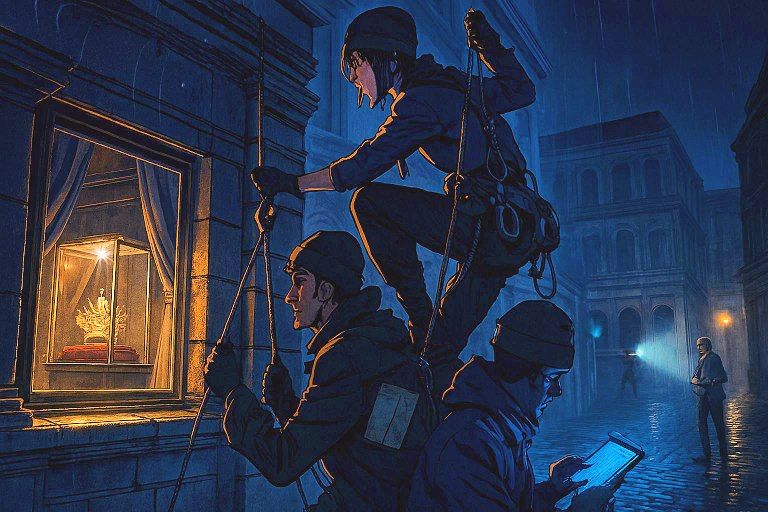
The night over the Seine held the cruel sheen of a broken promise: streetlamps vomiting their yellow light onto the wet pavement, reflections slipping across the cobblestones like small traitors. The Louvre rose up dark and monumental, a colossus of stone that guarded centuries and silences. Three shadows walked down Rue de Rivoli with the calculated indifference of those who have learned to measure their own heartbeat. They spoke only when they reached the façade; then Marco, the oldest and the one who wore the robbery map etched in his eyes, pointed to a slightly ajar side window. “This is it,” he said in a whisper that would not tolerate reply. “Three minutes to the vestibule.” Lú tightened the rope with hands that knew every fiber as if they belonged to her. There was a mix of skill and urgency in her movement that betrayed many sleepless nights. Ari, the coldest of the three and always a step ahead in calculations, consulted the tablet where patrol routes, sweep times and camera topography flashed. “The cameras sweep every four minutes,” she murmured. “I’ll freeze them for two. You, Marco, keep the pace.” Marco barely nodded. His jaw was set like someone who had learned to hold fear in check. Before they moved, he ran the plan through once more: enter through the side window, climb the cornice, access the imperial wing, cut the seals on the central display case, and exit the same way. The watch on his wrist was more talisman than instrument; in his mind it kept the operation’s tempo: seven minutes. They entered through the window using climbing gear. The stone bit into their hands and the cold damp of the night seeped through cracks; the smell of the old city and plaster filled their lungs. They climbed pressed to the façade as if the building summoned them to belong; carabiners kissed moldings, ropes trembled with measured rhythm. Each movement had been rehearsed until it was automatic. Inside, the silence was absolute, broken only by the scrape of boots on marble and the faint hum of a camera that, for an instant, stopped seeing. The imperial galleries greeted them with a gravity that seemed to materialize in the air. The display cases gleamed with centuries’ solemnity; the Napoleonic jewels, set out like relics, flickered small flames when light struck them. Arrangements of gold and diamonds that had accompanied coronations and exiles now slept behind tempered glass, oblivious to the plot closing in. Ari cut the seal with sure movements; the metal of the tool let out a brief squeal that did not shatter the contained tension. Lú leaned in and revealed the tiara: a piece of cold beauty, worked by hands that had wanted to imprint more than luxury onto it. Marco glanced quickly at the tablet and then at the room’s edges. “Don’t touch it with bare hands,” Marco whispered. “Use the cloth.” Their hands moved with reverence and speed. Each item was wrapped in padded sheaths, sealed, and placed in numbered bags. They worked with the precision of those trained not to leave traces. It wasn’t exaltation that drove any of the three, but something darker and decisive: a mix of need, impulse and the sense of a once-in-a-lifetime opportunity. In an opposite wing, routine continued with the apparent calm of the night. Henri, the night guard with a worn voice from endless shifts, walked the rooms with his flashlight. He spoke over the radio with Colette, his colleague in the adjoining section. “Henri: Everything okay in the sculpture room?” “Colette: All calm, step by step.” Henri’s voice was a thread of normality that, for the thieves, provided the perfect background. In the security booth, Madame Brousseau, the Louvre’s head of security, scanned the screens with the exactness of a commander who refuses surprises. Beside her, Paul, the systems technician, monitored the flow of images and logs. “Madame Brousseau: Why did camera seven blink at 02:14?” “Paul: There was a momentary signal loss, madam. I restarted the server; nothing seems wrong.” The blink — an apparently innocuous anomaly — became the fissure Ari exploited. With the screen frozen at precisely the right moment, she manipulated controls on her tablet: a brief command to lift the sweep for two minutes, enough time for her companions to move. It was the beginning of a sort of spell: the fault, the silence, the precise intervention. The museum was evacuated and temporarily closed. The alarm that finally sounded was not chaotic; it was a taut lash that triggered protocols. Colette, on the staircase, ordered visitors to gather and follow the emergency exits with a voice hardened by experience. “Please stay together and use the illuminated exits,” she said calmly. “We’ll know soon.” Visitors complied, bewildered. Isabelle, the gallery attendant who had come back on a last round to collect leaflets she had left at a counter, ran into Colette and met her steady gaze. Together they made their way down the stairs. No one was injured; the staff’s speed and order prevented any confrontation. While procedures activated, the three inside moved like puppets in a choreography. The cases that minutes earlier held history were being emptied with a care bordering on devotion. The tiara was wrapped in silk, placed in padded sheaths, and finally slipped into a bag stamped with an agreed number. Each piece was handled with respect — not only for its material value, but for something ancestral, an awareness of what they represented. The robbery lasted seven minutes. Seven exact minutes in which time seemed to compress and stretch according to those who administered it. For the three, it was a parenthesis in which nothing existed but task and breath. For the Louvre, it was a wound through which history leaked vulnerability. “Seven minutes,” Ari murmured as she closed the final sheath. “On three we go.” They exited the way they had entered, but the city no longer seemed the same. Outside, at a poorly lit corner, Karim, a newspaper deliveryman with rough hands from years on a bicycle, searched for an overlooked parcel. He saw three shadows move like ghosts against stone and thought little of it; Paris at night is full of figures moving up and down. Karim muttered to himself, “What are those kids doing at this hour?” and kept walking. On Rue de Rivoli, among cafes and shuttered shops, an unmarked courier crossed with a box that asked no questions, its destination unknown even to him. An antiques dealer named Laurent received an anonymous call days later: a vague offer, the promise of a transaction that asked for few explanations. Laurent, accustomed to dealing in other people’s pasts, felt his business’s pulse falter. When they discovered the empty cases, murmur turned to alarm. Madame Brousseau stared at the gap where rows of gems had been; Paul cupped his head in his hands. At the station, Inspector Delacroix arrived with the stillness of someone who knows a symbolic scene requires patience and method. “Inspector Delacroix: Did anyone notice anything unusual the night of the theft?” “Henri: A slight camera blink. Then silence.” “Colette: I heard very soft footsteps, but I thought it was the wind.” Their testimonies wove a timeline: the momentary signal loss at 02:14, the calculated cut, doors opened and closed like a score. Delacroix gathered pieces with craftsman patience. The material evidence offered clues: crampon marks on a cornice, dust traces on a window, a white van seen in an alley by a taxi driver who’d woken from a nap at midnight. Everything fit into those seven minutes, into that precision that both amazed and enraged. While the city sought culprits and comfort, the three dispersed along separate routes. Marco took a road that led to neighborhoods where laws seemed more flexible, where old debtors kept favors. Lú returned to a small, tidy apartment in the Marais, where the tiara lay on the table like an object measuring silence. Ari headed toward Canal Saint-Martin, where the waters reflected a pale, suspicious city. At Lú’s apartment she stroked the tiara with fingers that didn’t want to believe what they held. There was more than triumph in her look: memory. She recalled nights of hunger and broken promises, faces that had looked down on her. For the first time, the piece she had coveted returned a mirror she did not like. “Will it be worth it?” Lú whispered into the empty room. Ari stayed by the window, watching the city, her back straight, her breath measured. On her face there was no regret, but there was a weight she would not admit. “Everything has a price,” she finally said. “Just sometimes it’s not money.” Marco reviewed maps one last time and remembered his father, a man who had lost time and with it dignity — a debt Marco felt compelled to repay. In his hands the bags that had carried their flight were now small boxes of future or doom, depending on how you looked at them. Days later the press devoured the story. Headlines dramatized the audacity; editorialists debated security and negligence. Art forensics and restorers began inventories and traced microphysical marks on the pieces. Historians recalled the irreplaceable patrimonial value of the jewels. In cafés and streets the city discussed the wound: a museum assaulted in seven minutes. Investigations traced lines and contradictions. Laurent denied any implication; Karim offered fragmented recollections; and in the precinct Delacroix assembled a puzzle with pieces that didn’t quite fit. There were anonymous calls demanding ransom, rumors of foreign buyers, and the shadow of black art markets that hovered like leeches at the margins. In the city’s underworld, supply and demand began to churn. Talk spread of a buyer who would pay without asking too many questions, of intermediaries who knew names but not faces. In a shabby restaurant, under tables where grease shone on empty plates, figures discussed sums and routes. The pieces changed hands in rooms with heavy curtains. Each transaction left invisible marks: debts, favors, thinly veiled threats. But not everything was commerce. Some saw the pieces differently: symbols that could not be reduced to numbers. For certain historians and curators, the loss was a cultural crime, an amputation. For the thieves, it had been the culmination of a plan promising liberation. Police increased surveillance, followed leads and tapped phones, monitored movement. There were minor arrests—couriers with curiosities, small traders with suspicious bags—but nothing at first to return the jewels. The streets filled with half-answers, and every partial reply bred new doubts. The three’s private lives unraveled. Lú was the first to confront the fact that the pieces had slipped beyond her control. After a sleepless night, she received an anonymous message: a photo of the tiara on some different table, a bank account and a time. Seeing the image tightened her stomach. She did not recognize the room or the light; someone had moved it. Fear braided with guilt. “I can’t do this alone,” Lú whispered to the empty apartment. “I can’t.” She sought Marco at an apartment whose furnishings testified to haste and interrupted plans: folded maps, torn envelopes, a clock that always showed the wrong hour. Marco kept outward calm and inward storm. “We have to sell what’s left,” Marco said, decisive by force. “There’s no other way.” “To whom?” Lú asked, voice breaking. “And if they sell to worse hands?” Ari avoided conversation. Her comings were early, her returns late. She’d begun moving among international contacts, threads that smelled of sea and borders. She calculated options and discarded emotion; in her world everything measured risk versus benefit. But even she could not hide unease: the pieces had become volatile again, and the police tightened the dragnet. One dawn Delacroix received an unexpected tip: a guard at a suburban depot reported a box without markings unloaded from a white van; he remembered a peculiar perfume and a quiet man. With this lead, police staged a raid. They arrived early, with warrants and procedure. They entered a warehouse smelling of damp wood and acrylic. Among boxes and furniture, they found empty sheaths, packaging scraps and a note: “Move soon.” The pieces were gone, but the sense that someone had been there and fled with knowledge lingered. Arrests followed in small waves: a courier with a history of antiquities trafficking; a hotel clerk who’d kept a box without asking; a van driver who told boastful stories. Each arrest added fragments. Delacroix mapped a structure: it wasn’t just three thieves; it was an ecosystem ranging from those who hid to those who sold, from those who asked questions to those who accepted without inquiry. Pressure grew unbearable. Allies turned on each other for fear, for money, for survival. Marco one night stood at the threshold of a van with a small-eyed man offering protection in exchange for pieces. Marco thought it over and declined. That refusal marked the beginning of the end: the man kept ledgers and names and had a thirst for control that tolerated no refusal. The circle closed further when one of the jewels reappeared — not with police, but showcased by a buyer who displayed it in a secured room. The leak spread like poisonous oil. The buyer was investigated, contacts scrutinized; the sale froze and a network of brokers and sellers was exposed. That discovery didn’t return all the jewels but made clear that the black market operated with international ties and actors who favored discretion over legality. In the midst of it all, Lú realized what she truly lost: not only freedom, but the part of herself that had justified the act. She began considering options once unthinkable. The tiara turned into a symbol demanding a decision: continue the drift and risk everything, or seek a way out that required renunciation but might mitigate remorse. Marco, burdened by debts and the eyes of those he owed, developed paranoia. He began suspecting associates and seeking protection from figures working the thin line between crime and shelter. He urged Ari to move contacts and Lú to hide the pieces, but fear shattered communication. The three, once synchronized, fractured in days. Tension reached a breaking point when a planned exchange at a port warehouse became a trap. Marco went hoping to settle accounts; Lú accompanied him out of loyalty and fear. Ari did not appear — her absence a blade severing trust. The warehouse encounter meant for silent trade turned violent: shadowed figures demanded guarantees, a buyer displayed aggression, a gun clattered to the floor. Shouts, commands, and a door slamming behind the chaos. Marco left battered; Lú returned feeling she had crossed an irretrievable line. Delacroix used the chaos. Testimonies and recordings revealed contradictions and names. He linked financial transfers to accounts used by players. Warrants allowed him to seize equipment and phones. Seizures didn’t recover all the pieces, but they cut the ring’s continuity and forced some to talk. The first major arrest came when a courier, pressured by police and his own fear, chose to cooperate. His testimony led to a suburban flat where boxes were ready to be shipped. Beneath common bundles a small sealed box appeared, bearing a seal the police recognized: the mark of a restoration workshop that collaborated with the Louvre. None at the workshop were charged, but the find let Delacroix press on: forensic tests on the box, partial prints and access logs opened doors. Arrests multiplied under those warrants. In a coordinated operation police stormed several addresses. Doors were forced, corridors ran, and contained sobs filled rooms. Ari was detained in a safe house as she tried to cross the border; she carried false documents and cash for a new beginning. Marco was caught in an alley after a failed bribe to an official who surprisingly chose to cooperate. Lú, however, was not found then; she had vanished with the tiara in hand. Ari’s arrest changed everything. In interrogation rooms under harsh light she sometimes broke. Her invulnerable façade cracked when presented with communications and transfer records tying her to international intermediaries. She spoke of names, routes, buyers who feared reputational damage more than prison. Her cooperation enabled authorities to locate caches and verify alibis. Marco faced charges of aggravated theft and conspiracy. Under the interrogation lamp he confessed fragments: how they planned entry, who the contacts were, and how they thought they controlled the sales chain. Between admissions and silences, Marco expressed remorse and danger: his statements implicated third parties yet to be detained. Delacroix made Lú’s capture a personal obsession. He knew recovering the piece along with Lú would speed case closure; and more than that, he didn’t want a young woman consumed by a rush decision. He combed travel logs, reviewed hotel records, watched cameras and spoke with Lú’s acquaintances. The chase became personal: Delacroix saw in Lú a figure trapped between need and error, and he would not leave loose ends. After weeks a tip came to a humble suburban hostel. Police entered a dim room and found Lú on a sparsely furnished bed. The tiara lay on the sheet, wrapped in cloth. Her eyes showed surprise, fear and a peculiar resignation as the handcuffs made the truth official. “I don’t want to fight,” Lú said in a hollow voice. “I thought I could do this differently.” At the trial that followed the city attended with that mix of curiosity and judgment that feeds public stories. Charges were detailed: aggravated theft, conspiracy, receiving stolen property. Witnesses testified; experts explained the impossibility of quantifying the patrimonial and emotional loss; the courtroom heard about the meticulous preparation and the exact execution during those seven minutes that had altered many lives. Sentences varied based on involvement and cooperation. Ari, who assisted the investigation, received a reduced sentence and obligations to provide key evidence for recovering parts of the haul. Marco was met with a stiff sentence, his past and debts worsening judicial perception. Lú, young with mitigating circumstances astutely presented by her defense — economic pressure, manipulation by older figures — received a sentence including restorative measures, reinsertion programs, and time in custody. The Louvre began recovery and repair efforts. Protocols were overhauled, redundant systems installed and display cases reinforced with new materials and alarms. The museum’s administration launched campaigns to restore public trust; sharp criticism and measured support followed. Commissions and public forums debated cultural security and heritage protection. The city learned, at its cost, lessons about institutional fragility and the weight of trust placed in human systems. But the story did not end with verdicts. Months later the black market tried to recoup losses through fragmented sales. Some pieces reappeared in secondary markets; others remained hidden. The tiara — the episode’s emblem — was ultimately recovered in an international operation that involved agents from several countries and the cooperation of collectors who, under media pressure, preferred not to wear the stain of illegality. Its return to the Louvre was discreet, surrounded by security measures that felt more like acts of expiation than celebration. The protagonists’ lives followed different courses. Marco served his time with intermittent dignity and remorse; prison forced him to face ghosts that propelled his choices. Ari, after conditional release, worked with authorities on cultural-crime prevention programs, using her knowledge to undermine networks she once serviced. Lú, aided by restorative measures and support programs, began an uncertain path toward repair: she took part in workshops, spoke at talks about choices and consequences, and slowly attempted to rebuild her life away from the robbery’s shadow. Paris, meanwhile, processed the wound. The episode left scars and lessons: museums that reinforced measures, citizens who discussed ethics and heritage, and a press that continued to track down black market actors. On the surface, the city returned to its usual rhythm; under the skin, however, remained the story of a night that showed how fragile even the institutions that we think indestructible are. Years later, in a small room of the Louvre, the tiara was placed again behind the glass, now with a plaque that narrated its history and the brief chapter in which human ambition tore it from its place. Some visitors read the plaque with curiosity; others, with indignation; a few, with understanding. Lú, who attended the reopening as a participant in a cultural reconciliation program, watched the piece from afar. He did not look for a look of indulgence; his presence was a minimal act of reparation. Delacroix, already with gray hairs on his temples, looked at the return like one who closes a folder. He knew that justice did not completely repair the damage to history, but it had prevented impunity from reigning. In a corner, Marco, from behind a glass, thought about his choices and the chain of small decisions that led him to prison. Ari, now part of an advisory team, reviewed procedures and protocols, with the awareness that his life had taken a turn that he could never have imagined. Seven minutes were enough to trigger a plot that involved pain and growth, betrayal and loyalty, irretrievable losses and partial recoveries. The city moved on, more cautious and perhaps a little wiser. The tiara returned to its pedestal, perhaps less bright because of everything that had happened, but with a story that would now speak not only of coronations, but also of human frailty and the complexity of decisions made in the light of the night. And in the gloom of some rooms, in offices and in humble houses, traces remained: papers, accounts, names that even today, years later, can open doors. Paris, with her pride and her memory, learned to take better care of her treasures, knowing that human audacity can briefly walk the same corridors in which history is kept. Source of the images. Image created with Bing.
2 comments
Such a wonderful story. Thank you for sharing.
You are welcome 😄