 @mc5punk
Short story: The Caiman of La Loma del Chorro
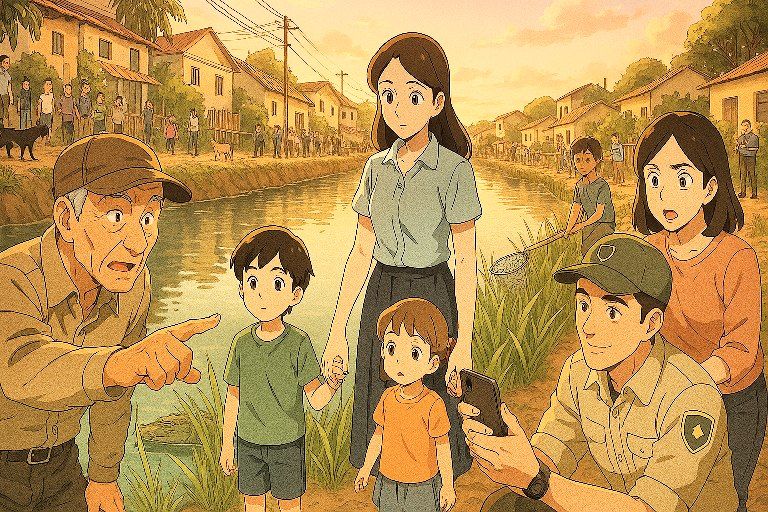
La Loma del Chorro was not a neighborhood that stood out on tourist maps; rather, it was one of those places where afternoons stretched between the smell of freshly baked bread, the sway of clothes on lines, and the constant murmur of the canal that ran alongside the houses. That afternoon, however, a rumor came to break the monotony: a caiman had been seen moving through the sector’s waters. At first it was a whisper on the corner by the bakery, then a phone that rang, and it ended up becoming a small neighborhood commotion. Don Chucho, a neighborhood veteran with a voice even the cats knew, was the one who first sounded the alarm from the bank, his silhouette cut against the golden reflection of the canal. “I saw it, people! There it goes, along the water’s highway!” he shouted with that mix of surprise and pride that only those who have lived many stories on the same street possess. Señora Piedad, who habitually kept her phone at hand and never missed an opportunity to film, reacted as if the news were personal: “My God, I’m going to have a heart attack! Call someone… call, call.” The news spread: children stopped playing, housewives peeked out of windows, and some curious folks approached with the prudent distance that respect for the unknown dictates. Nico shoved his sister Lulú with the innocent clumsiness of someone who wants to see but knows they shouldn’t: “Mom said not to go near! But I want to see it!” Mariela, the local schoolteacher and one of those people who organize neighborhood life without announcing it, took charge with a firm voice: “Nico, calm down. Lulú, take my hand. No one goes near the water. We’re making a human cordon here so no one passes.” In the water, oblivious to the human commotion, the caiman advanced with the slowness natural to its species. In the fiction the community allowed itself to build in their minds, the reptile carried an inner voice that made it seem closer and less fearsome: “This isn’t a swamp, right? It smells like detergent and fresh bread. Better move to the shade.” That imaginary voice allowed some to look at it with curiosity and others with a mix of respect and astonishment. Mariela coordinated. There was no official plan, but there was common sense and a lot of collective energy. “Don Chucho, you put the chairs and cones. Piedad, ask people to move back. Nico, Lulú, stay with me.” “At your orders, my boss! No one’s going to let a caiman touch their door,” Don Chucho replied proudly. Señora Piedad, committed to her role as an improvised journalist, dialed the number with trembling hands: “Yes, yes… environmental agency, please send help. There’s a big caiman… well, medium… in the canal. Yes, we’re containing it… No one touch it, please.” A neighbor’s rumor proposing an extravagant solution — “What if we give it sausages so it leaves?” — was shut down by Mariela’s stern voice: “No, Juan. We don’t feed wildlife, and we certainly don’t convince it this is a buffet.” Common sense prevailed: this was not an adventure movie where improvisation was heroic, but a situation that required caution. Still, tension was tinged with comedy. In the human cordon comments oscillated between fear and runaway imagination. “This looks like a movie,” said Nico, his eyes even wider from excitement. “Look! It’s swimming toward the storm drain,” Lulú pointed out, worried. Don Chucho, always ready with an anecdote, launched into a story: “No, young lady. It’s heading toward the legend! When I was a kid…” —he stopped, hesitated, and chose prudence— “Well, better I don’t tell you the legend.” Señora Piedad, affectionate and theatrical, whispered: “What if we call it Carlitos?” Mariela raised an eyebrow: “Are you going to name it so they don’t kill it?” The neighborhood dog, incapable of grasping the event’s magnitude, began barking enthusiastically until Don Chucho, half reprimanding and half affectionate, quieted it. Hearing the barking, the caiman startled, and the image of that large animal trying to hide beneath a branch was at once comic and pathetic. “Why do those little wolves bark? This wasn’t in the survival manual. Better hide under that branch,” the reptile seemed to think. While the community strengthened their cordon and determination to protect the children, professional help arrived. Officer Rivas, a municipal ranger whose face some recognized from school visits to talk about conservation, stepped down from the vehicle. Serious in tone but with a dry humor that inspired confidence, he asked: “Good morning. Thank you for calling; I understand you kept it at a distance. Is anyone hurt?” Mariela, relieved, replied: “No, thank God. We have it located and people are safe.” Don Chucho touched his cap proudly: “We’re all here, officer. The neighborhood’s on guard.” Officer Rivas inspected the caiman at a glance and explained what people wanted and needed to hear: “Perfect. We will evaluate the animal and relocate it to a wildlife center if necessary. Please keep your distance and do not handle it.” Señora Piedad, unable to give up the thrill, asked hopefully: “Can we go see it when they take it?” Mariela, steadfast in her caretaker role, answered: “Only in official photos, Piedad. Save the drama for the radio.” In the caiman’s mind the little internal novel went on: “People everywhere. Will the next neighborhood accept me? Is there bread?” That innocent, almost human thought helped those present stretch a thread of empathy toward the reptile: it was not a monster but an animal out of its natural habitat or passing along the wrong route. Officer Rivas shared his technical evaluation clearly, the way someone who has seen many similar situations does: “It seems to be in good condition, medium-sized, likely displaced from nearby wetlands. It shows no visible injuries. We will capture it with nets and transport it.” Don Chucho, candid as ever, voiced his concern: “Can’t you release it somewhere closer? Not everyone is brave enough to live with caiman neighbors.” Rivas, with a contained smile, replied: “It’s best to take it to a reserve where there’s food —and fewer human neighbors—. We’ll prevent it from returning to the neighborhood.” Mariela took the moment to thank the neighborhood for their cooperation: “Thank you for your patience. Let’s stay calm and let them do the job.” The capture maneuver was executed with the precision safety demands: nets carefully deployed, measured movements to avoid injuring the animal or exposing people, and a stretcher designed to transport reptiles. A heavy silence formed; even the dog, finally seeming to understand the moment’s gravity, remained still, looking around with questioning eyes. When the technicians immobilized the caiman, they placed it with care onto the stretcher, ensuring the restraint was the minimal necessary. Officer Rivas, in a low tone, spoke to the reptile as if addressing a being entitled to calm: “Calm down, friend. We’re going to take you to a better place.” Don Chucho couldn’t resist a wry comment: “What if the caiman asks for moving compensation?” Mariela let out a hearty laugh: “Let it get in line, Don Chucho.” And the caiman itself, in its inner voice, seemed surprised by the considerate treatment: “Wow! They’re taking me out of this noisy stage. At least someone is polite to me.” Before the stretcher moved toward the official vehicle, Officer Rivas addressed the community to reiterate the basic rules: “We reiterate the call to not handle these species and to report their presence in urban areas immediately. We will evaluate and relocate them safely.” The words, simple and direct, carried a sense of relief and shared responsibility. Señora Piedad, already imagining the reach of her footage, didn’t miss the chance to dramatize: “I told the municipal channel this would be news!” Nico, still excited, allowed himself a small pride: “Can I say at school that I helped take care of the neighborhood?” Mariela, warm, answered: “Of course, Nico. You helped keep calm and safe the neighborhood. That matters a lot.” Don Chucho, watching the road along which the cage was taken, bade the reptile farewell aloud: “Goodbye, Carlitos. I hope it goes well… and don’t come back here.” The official convoy moved on, leaving behind a neighborhood that slowly resumed its usual pace. People dispersed with animated conversations: anecdotes that would grow on every corner, small comedic punchlines, and the certainty that they had done the right thing. That night, La Loma del Chorro fell asleep with less fear and more pride; the incident transformed into a tale for the next day’s gathering. Social networks inevitably filled with photos and videos; Señora Piedad gained followers; the children displayed their experience with the dignity of those who participated in something important; and Nico, in his imagination, added the honorary title of “neighborhood lookout” to his life resume. At the calm of the reserve where it was relocated, the caiman rested in a space more suited to its rhythms: clean water, quiet, and appropriate food. In its final inner voice, almost like gratitude and a simple reflection, it seemed to think: “I miss the smell of bread, but here there is peace and food. Maybe humans aren’t so bad. They just make a lot of noise when they worry.” The episode left practical lessons: the community had proven that staying calm, organizing, and contacting the competent authorities is the safest way to resolve unexpected encounters with urban wildlife; and that curiosity should never overstep prudence. La Loma del Chorro kept the anecdote as a kind of everyday emblem — the time a caiman walked through the canal and the neighborhood came together — and its inhabitants knew that if something similar happened again, they could do it better: with the same humor, but with more experience. The End. Source of the images. Image created with Bing.
No comments yet