 @mc5punk
edited
more from that month
@mc5punk
edited
more from that month
Short story: The Rebirth of the Pencil
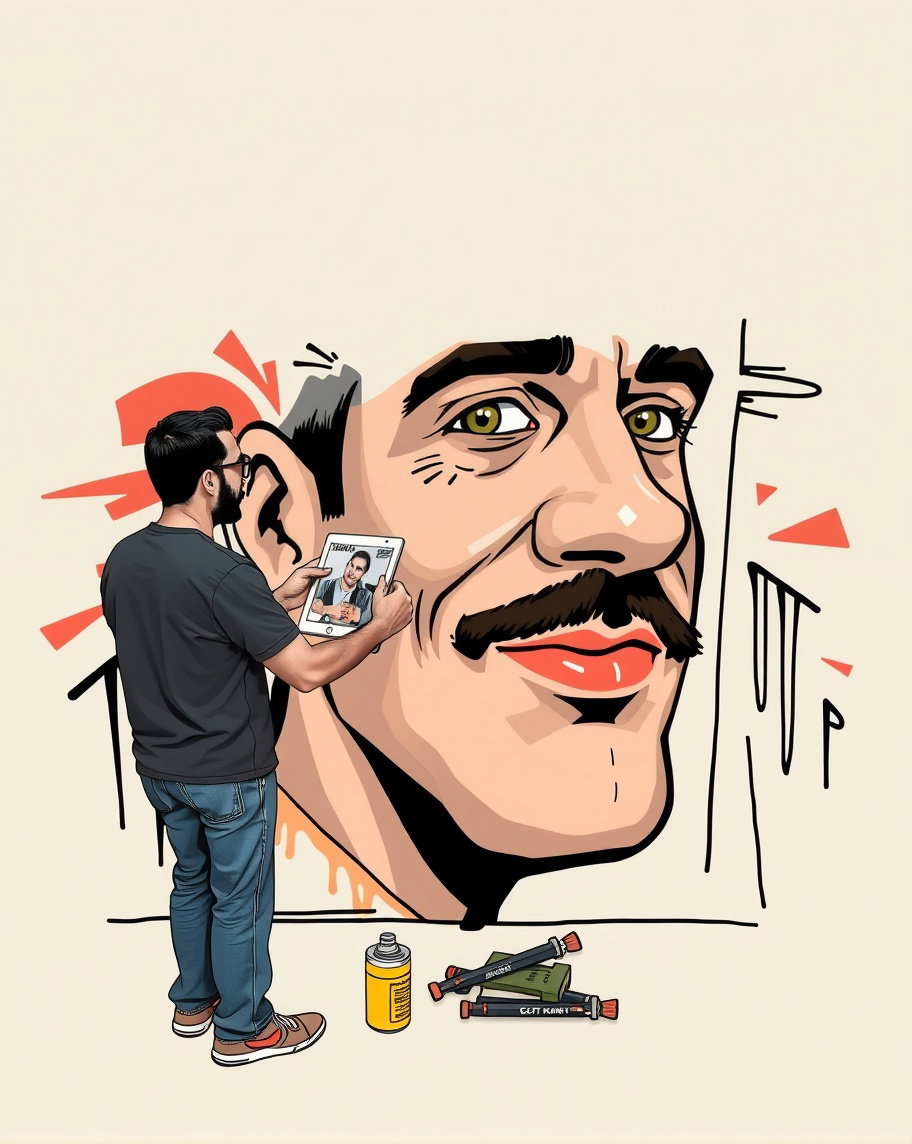
Chapter 1: The Balconies of Resistance The morning woke up to the sun filtering through the cracks of Luciano's apartment, illuminating stacks of unsold comics and cups of cold coffee that seemed to have lost their aroma. The walls, covered with sketches of superheroes with defeated expressions, kept the echo of their sighs. He was tearing up another drawing, throwing the corners to the ground, when a dry knock on the window startled him. - Hey, artist! -The harsh voice of Dona Marga, her neighbor from the third floor, rumbled from the balcony across the street. With one hand he was holding his coffee cup and with the other he was pointing to *Ink*, the stray dog he adopted years ago and who was now nibbling on an imaginary bone—. This bandit dug up something that interests you. A metal tube crossed the gap between the buildings. Luciano caught him on the fly, surprised by the old woman's steady pulse. When she opened it, she found parched but vibrant watercolors, like jewels under the dust. The colors seemed to have been captured in a moment of glory, before time forgot them. - In exchange for what? - he asked, knowing that in the neighborhood nothing was free. The barter economy was the most valuable currency in times of crisis. Doña Marga adjusted the binoculars hanging from her neck — her tool for surveying the neighborhood- and flashed a mischievous smile: - A portrait of *Ink* as a superhero. With a cape, boots... and let it say here - he tapped the air with a finger -: * "Bones are not shared"*. Luciano smiled, already imagining the drawing. *Ink*, with his tousled fur, would become a hero fighting the monsters of bureaucracy. She promised to do it that same night, and Doña Marga nodded, satisfied, before disappearing behind the curtains of her balcony. --- Chapter 2: The market for second chances The street market boiled with the aroma of fried pies and rusty metal. Among stands of used tires and old radios, the "Russian" stand stood out for its organized chaos: boxes of charcoal, jars of dry ink and papers that smelled of bygone centuries. The salesman, with a reddish beard and a worn fur cap, was leafing through a book in Cyrillic when Luciano approached. - Do I exchange materials for comics? - he showed a vignette where "The Rent Advocate" was fighting a hydra of bills. The Russian snorted. His razor-sharp blue eyes scanned the drawing before pointing to a handwritten sign: * "There is no haggling here, but courage is admired." * From under the counter he took out a box of charcoal labeled *1967*. - Here. And listen, he said, marking each word with his finger: Graphite forgives. Not the ink. Draw as if there were no papers tomorrow. Luciano nodded, feeling an instant connection with the seller. The Russian seemed to understand art as a form of resistance, a way to defy fate with every stroke. With the charcoal in hand, Luciano felt refreshed. The economic crisis had not killed her creativity; it had only forced her to look for new forms of expression. --- Chapter 3: The Fair of the broken (and mended) hearts The community square, lit by makeshift lanterns out of cans, was bustling with neighbors exchanging clothes, home remedies and half-finished dreams. Among them, Luciano's stand sparkled with drawings on newspapers: dragons made of tax stamps, superheroes with layers of receipts. - There's no spark in this! -Irene, the muralist with torn gloves and electric laughter, appeared spraying gold on the edge of a drawing—. Your monsters need voices. Before Luciano asked, she took out a phone full of stickers and recorded a girl telling how her mother sold her bicycle to pay for gas. Then, he painted a QR code next to a tentacle of banknotes. "Now, when they scan this..." he made his fingers explode like fireworks. * Boom!* Art that speaks, screams and resists. Luciano drew a QR next to his signature, while watching Doña Marga haggle with the Russian for a brush. *Ink*, with a *"Superdog" sign* tied to his collar, was barking at a drawing of politicians turned into rats. The fair became a melting pot of creativity, where each person contributed their own story and their own art. Luciano sold every piece, but more importantly, he inspired others to create with what they had. --- Final chapter: The Ink of the Forgotten That night, Luciano did not draw in solitude. Irene mixed paint from beans in cans, the Russian carved potato stamps for stenciling, and Doña Marga narrated stories that turned into dialogue balloons. - See? Irene murmured, painting purple flames on a mural. Art is not a pencil and paper. It's this. -He pointed to a grandmother scanning a QR with tears in her eyes, to a child copying her strokes on a napkin-. We are accomplices, not competitors. When he closed his eyes, Luciano saw his next story: Doña Marga riding a *Ink* against sorcerer bankers, the Russian forging weapons with old graphite, and Irene lighting up the sky with slashed budgets. When the first "Legion of the Imperfect" comic sold out in two hours, she knew that true beauty was not in the flawless lines, but in the cracks where the shared light shone. Art did not depend on materials, but on the heart that guides it. And in every imperfect line, Luciano discovered a new form of beauty. The crisis did not end, but Luciano learned that art can be reborn even in the darkest moments. His comics, now more human than ever, found an audience eager for real stories. And in each stroke, the cartoonist discovered that the real magic was in the connection with others, in the ability to transform pain into hope. Thus, Luciano continued to draw, not only with pencils and paper, but with the heart of his community. And in every line, in every stroke, he found a rebirth, a new beginning. Source of the images. Image created with Starryai.
No comments yet