 @mc5punk
more from that month
@mc5punk
more from that month
Short story: The Midnight Guardian
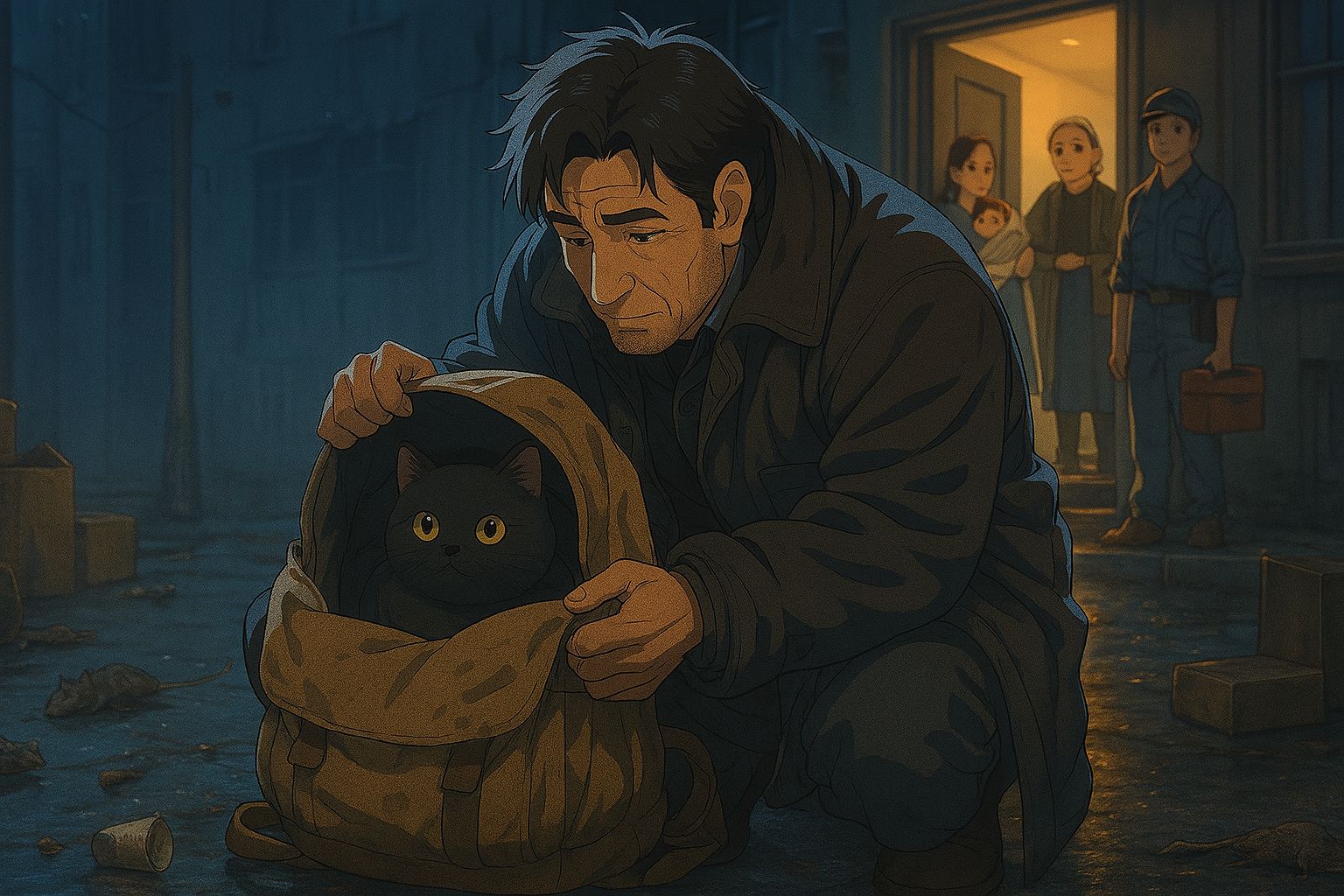
For weeks, the routine in that building had become a succession of small frustrations that wore deeper with each dawn. He, a middle‑aged man who worked long hours and returned home exhausted, no longer found refuge in his apartment: the kitchen was the scene of chewed snacks, corners smelled of damp and excrement, and a constant feeling of being watched followed him down the corridor. The few things that seemed safe were kept in the refrigerator, behind closed doors and precautions that left a bitter taste of indignation. Living alongside the rodents not only threatened his peace; it had turned his flat into occupied territory. Other voices lived in the building: Marta, the neighbor from 3B, worried about hygiene and her young child’s health; Don Raúl, the retired caretaker who knew every pipe and rumor in the place; Elena, the condominium board president, always surrounded by papers and accounts; and Julián, a young handyman with a toolbox at the ready and a habit of seeing every problem as a project. Together —and sometimes at odds— they made up the small community of the block. Complaints to the board had become a fruitless ritual. He filed written reports, raised his voice at meetings and knocked on doors, hoping for concrete measures. Elena listened with a worn expression: the condominium’s accounts were in the red; several neighbors were in arrears and the board, hands tied, justified its inability to hire professional pest control. Don Raúl explained the origins of the problem with a hint of melancholy: deteriorated pipes, poorly sealed trash areas, and the indifference that comes with prolonged poverty. Marta proposed urgent measures for her child’s health, and Julián offered economical alternatives, but nothing seemed enough to bridge the gap between need and resources. Tired of waiting, he decided to act on his own. He didn’t seek a heroic gesture or everyone’s approval; he wanted to restore the serenity of his home. He remembered the old balance between predator and prey: a cat, silent and effective, could reestablish routes and fears. That seemingly simple idea became his plan. He left one night wrapped in a coat and determination. The city was cold and many street lamps, victims of neglect or vandalism, didn’t illuminate as they should, so the shadows grew strange shapes. He walked along deserted streets, attentive to any hint of life: a flicker of movement among boxes, a muffled meow, the shine of a pair of eyes. The urban silence had weight: each of his steps seemed to stake a claim in the landscape. It was in a corner of decay —a service yard tucked behind a closed shop— where the sound led him. It wasn’t a loud meow but a restrained cadence; eyes shone in the dark, two points opening like marbles in the mud. He didn’t find the idealized archetype of a cat: instead he saw an animal with a rounded body, matted fur and a gaze full of a mix of caution and an ancestral calm. There were no rushes: he didn’t improvise a noisy capture but approached with patience. The cat accepted a piece of bread, allowed the hand, and when the backpack appeared, settled inside without resistance, as if understanding that something better awaited beyond that yard. Back at the building, he ran into Don Raúl at the entrance. The caretaker looked at him with that mix of suspicion and curiosity that people who have seen many stories repeat possess. “Got something in that backpack?” Don Raúl asked, raising an eyebrow. “Something that might help us,” he replied, careful not to reveal the anxiety that had pushed him to act. “If it’s another mouse, I’ll take it back,” Don Raúl joked, but his tone carried a tenderness that betrayed his complicity. In the apartment, upon taking the cat out, it became clear the creature didn’t fit the stereotype of an overactive hunter. For a while it simply sniffed, mapped the perimeter with its nose, and stretched as if reclaiming life after a lethargy. It seemed lazy, almost proud of its own slowness. For a moment he doubted his choice: had he chosen the wrong remedy? —but the night still had pages to be written. The rats did not take long to appear. It wasn’t a grotesque invasion but furtive explorations: one peeking from behind a washing machine, another nibbling the corner of a cardboard box. The cat, until then still, changed in an instant. Its muscles tightened with precise coordination; its step shortened and its gaze acquired the coldness of one who knows his trade. It wasn’t a wild spectacle but a technical execution: measured jumps, claws working with punctuality, an almost choreographed cadence. Each fallen prey opened a small truce in the house. The noises were violent; the clatter of falling cups and shifting furniture made him fear renewed complaints, but at least that night the battle was to recover the essential. The next morning, the apartment had a different cast. Not because it was spotless of dust and crumbs, but because the usual noise had been replaced by a won silence. Marta, who always listened for the echoes of the night, knocked on the door at first light. “I heard a lot of noise last night,” she said, her eyes still marked by insomnia. “What happened?” He invited her in. In the living room the cat slept curled on an improvised cushion; its breathing was steady and indifferent to the recent epic. “We took care of it,” he answered without raising his voice. “Everything’s calmer now.” When Julián arrived with a toolbox in hand, he struggled between disbelief and admiration. Seeing the discreet remains of the infestation, he let out a smile. “Looks like someone did the dirty work,” he said. “Good companion.” At the next condominium meeting, Elena —calmer than in previous gatherings— suggested recognizing the initiative that had mitigated a problem that years of paperwork had failed to solve. “We should thank whoever took the initiative,” she proposed. “And also review how to prevent it from happening again.” The community began to operate with new subtleties: Don Raúl shared information about critical waste points; Marta proposed inspection schedules; Julián offered to repair some gaps and seal holes with inexpensive materials. He, who had acted driven by his own limit of patience, didn’t seek praise, but accepted the cooperation with the sense that something larger than his gesture had been set in motion: a willingness to care for one another. The cat, soon baptized by some as “The Guardian,” did not become a magic solution. It kept sleeping long hours and roaming at night on its own terms. Some rats returned months later, as happens in any urban ecosystem, and complementary measures had to be taken again. But the feline’s presence had changed the atmosphere: people spoke more to one another, small cleaning brigades formed, and the board was forced to confront the accounts with greater transparency. The story did not end in a single act of triumph but in a series of small victories and adjustments. What began as the individual decision of an exhausted neighbor became a communal reordering: the building gradually recovered more than physical order; it recovered notions of shared responsibility and the awareness that action, however modest, can open paths where before there were only complaints. The Midnight Guardian continued to do his job, at times indifferent, at times fully focused, reminding them that coexistence is, at heart, a web of small acts that sustain communal life. Source of the images. Image created with Bing.
No comments yet