 @mc5punk
Short story: The Metal Door and Memory
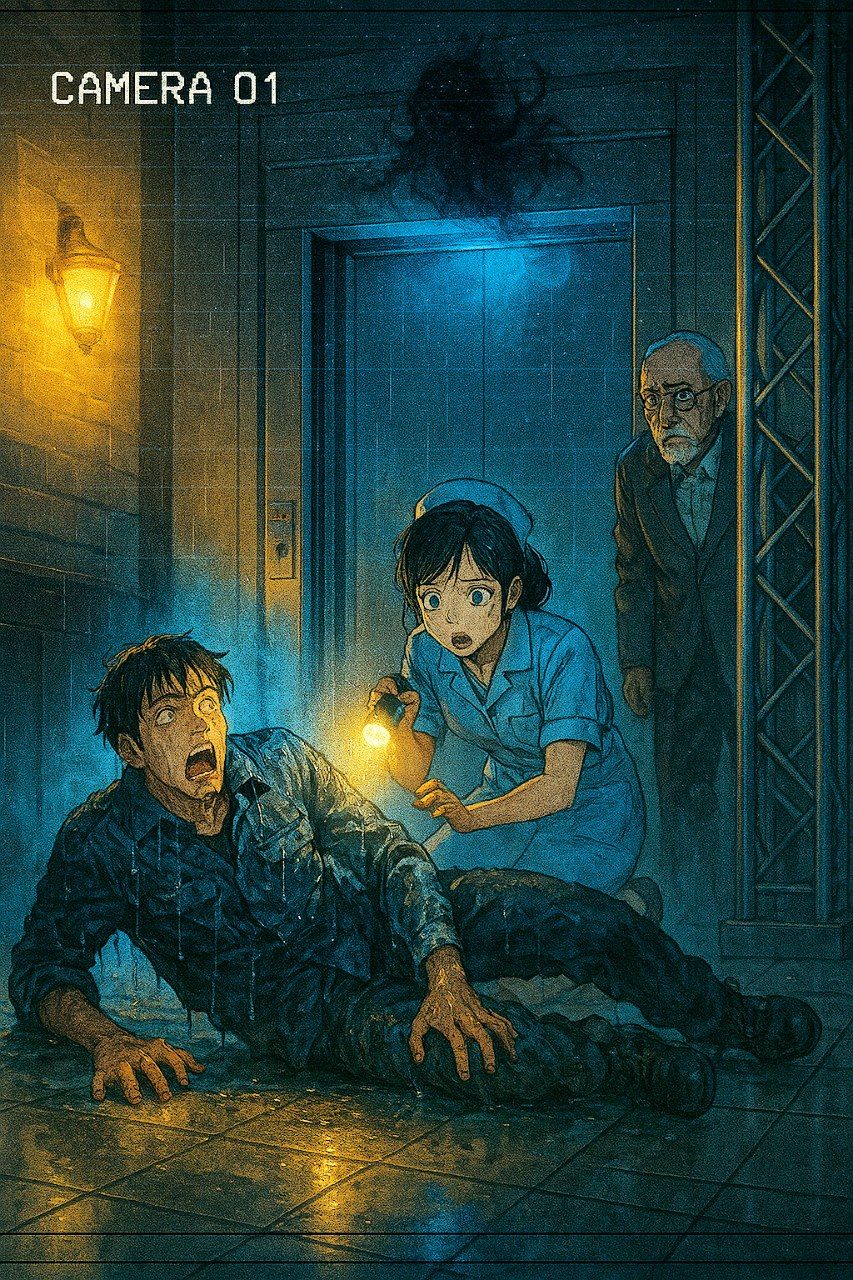
Night fell over the residential complex in Gujarat like a heavy, damp slab that pressed down on the sounds of the city. The corridors, lit by yellow lights that flickered at intervals, smelled of cheap incense and fresh paint; from some distant corner came the constant hum of the electrical panel in the basement, a mechanical heartbeat that seemed to hold the building's stillness. In the lobby, the security camera recorded the scene with an impassive pulse, its lens cold and implacable like an observer that knows everything but can do nothing. Arjun Mehta was descending from the seventh floor with keys in his hand and a bag of rain-soaked clothes clinging to his shoulder. As an ambulance driver, he knew the weight of the night and the economy of gestures: measured steps, a gaze that doesn't linger, hands that work by reflex. He pressed the elevator button and entered; the cabin greeted him with its smell of metal and forgotten perfumes. When the machine reached the ground floor, the doors slid open and the lobby appeared before him: a somewhat threadbare rug, a plastic plant in a corner, Neha's figure rummaging in her bag by the entrance, the dim lighting stretching over metallic profiles. "Thanks. Good night," Arjun said, his voice carrying the fatigue of long shifts and the politeness of someone who no longer expects warm responses. "Are you leaving so late? Another shift?" Neha replied, looking up with anxious eyes—the reflection of someone who works with lives and understands how fragile the everyday is. Arjun took the first step into the lobby. It was precisely then that something in the routine fractured. A sharp jerk ran through the cabin; the floor beneath his feet moved with unexpected violence. The impossible happened: the elevator began to ascend with its doors open, as if the building had decided to break the laws of physics and the rules of human touch. "What the hell?!" Arjun shouted, his voice bouncing off the cold panels. The security camera recorded the scene in merciless pixels: Arjun's foot still brushing the threshold, his hands seeking the metal frame; for an instant his fingers closed on air. The sensation in his body was not just fear: it was the acute awareness that the machine, the metal, and the hollow wanted to claim something that had once belonged to another place. Arjun reacted with the speed that experience imposes on those who have seen the history of flesh and emergencies: he thrust himself backward with all the strength he could muster. He fell into the lobby. The impact on his back hit him like a dull blow that left his breathing broken. He looked up and saw the elevator frame's edge pass by his head like an invisible scythe—something that had come between him and the possibility of ceasing to exist. Neha rushed to his side, pale and trembling. "Oh God! Are you okay?" she asked, her voice fractured. "I think... I think so. I would have been split in two..." Arjun answered, trying to reconcile his disbelief. "Did you see it? The doors... they went up on their own," Neha said, a thin voice that still struggled to believe what her eyes were showing. From the concierge's kitchenette emerged Mr. Patel, a man whose face had been weathered by years of work and vigil, with trembling hands and the fragile authority of someone who has witnessed many small domestic tragedies. "I've never seen anything like this in forty years. The system said there was no failure," he murmured, his voice rasping with the tone of someone who prefers to keep painful things to himself. Still trembling from the adrenaline, Arjun was led to the screen where Neha, with fingers barely able to remain steady, played back the footage. The sequence was sharp and brutal in its clarity: the elevator's arrival, the doors opening, the first step... and the cabin's ascent with the doors open, a movement that defied logic. At the top edge of the frame, barely perceptible as if it were a movement in the periphery of a dream, something appeared: a shadow, vertical and too distinct to be a mere reflection, as if a figure had stretched a hand to close the image. "Did you see that? At the top edge?" Neha asked, her voice tightening with the urgency of fixing a detail before it dissolved. "I've always said this building... has a memory," Mr. Patel replied, with the cadence of someone speaking words that carry weight from years rather than truth. At dawn, in the small kitchen where chai hurriedly boiled, Mr. Patel told the story he had been avoiding for decades: during the building's construction a worker had become trapped between the cabin and the door. No one found him in time. They searched afterward, and the only things left were marks on the metal and a smell no one could describe without faltering. Since then, the concierge said softly, the elevator had shown inexplicable failures; people moved away, some avoided using it on certain nights, and the management, with the distracted look of those who avoid conflict, turned a blind eye to the rumors. "But that's—" Neha stammered, "—an accident?" "Not always. There are nights when you feel the weight of something that wants to come back in," the concierge answered, his words like stones. Arjun understood, with the cold clarity that bodies accustomed to loss provide, that his reaction had not been merely instinct. There was, in the final second before the ascent, a recognition: a presence attached to the elevator's hollow, a trace demanding completion. It was not superstition but a broken geometry trying to recombine itself. Technicians came and went, offering diagnoses that felt like half-phrases and tools that could not explain what had occurred. Records displayed a brief, brutal energy spike with no apparent cause; the thermal camera registered a cold that slipped through the elevator shaft, a bluish curve moving along the metal like a breath. Mechanical explanations could not cover the insistence of that fragment: a force upward, a pull that seemed to obey an impulse that emerged from the building's body itself. That night, Arjun decided not to return to his apartment. He stayed in the lobby, seated in front of the elevator doors like someone waiting for the next assault after a fight with the night. Neha sat beside him holding a flashlight, its beam trembling in her hands. The clock tower struck one and an artificial wind moved through the lobby, though the street outside remained calm. A thick silence lodged between the columns. Then, with a sound that did not belong to the world of men but to mechanisms that have lived too long, the elevator doors opened on their own. The cabin did not descend; darkness itself seemed to pull the metal upward. A cold exhalation brushed Arjun's and Neha's hair at the same time. The shadow that had appeared in the footage as a whisper near the top edge now unfolded into a clearer figure, clinging to the upper part of the door: long, narrow fingers like needles, faceless but with an intention that cut the air. "What do you want?" Arjun asked aloud, as if addressing the shadow could summon a human response. The reply that crossed the room was not the creak of wood nor the whisper of wind; it was a voice that slipped directly into his mind—without lips, without air—with the coldness of metal that remembers hands. "To finish what was left..." the Voice said. "Don't—don't come closer," Neha whispered, almost in vain, her voice shaking. The shadow stretched its fingers and probed the air between the cabin and the lobby; the sensation was that of thousands of invisible hands feeling around, searching for a body to close the form. Arjun felt then a force that did not seek to push him out but to draw him in: a reverse gravity that wanted to consume him into the elevator's broken geometry. The idea of being pulled toward a halfway boundary filled him with panic, which he countered with bodily memory: years of saving others in moments when time was the enemy had given his body the precision of professional instinct. "Don't touch me!" Arjun screamed, the cry torn and deep. With a movement that mixed training and sheer terror, he leapt sideways. The shadow, failing to find the exact line that would complete it, slid like a dark liquid and the doors closed with a dull thud that echoed in the walls. Silence returned, but something in the air had changed forever: the cold had become dense, like a substance that clings to the skin. The next morning technicians found the camera lens fogged with vapor, as if someone had breathed on it. Reviewing the footage, the strange figure appeared longer, more defined and, for a fleeting blink, the screen showed the exchange of looks between Arjun and the silhouette: not a human look, but the correspondence of two orders of existence recognizing one another as rivals. The presence had spoken a word before vanishing—a word that resonated in Arjun's head: "complete." "Did it say anything before?" Neha asked, her voice broken by poorly digested sleep. "It said... 'complete.' As if it wanted to finish something they tore away," Arjun replied, with the clinical calm sorrow leaves after fear. The building was closed for days. Hallways filled with low voices and averted glances. Neighbors argued about contracts and policies, about insurance and relocation; some packed without looking back, others rearranged their lives as one rearranges wounds. Administrators made paperwork and utility companies repaired circuits; nonetheless, the feeling that something had been opened—a wound attached to the metal—remained in the wooden handrails and in the echo of the lobby. With his daily work of seeing bodies and wounds, Arjun understood precisely what that presence represented: not a loose specter but a memory stuck to the machine, a geometry of flesh and metal seeking to complete itself. It was the trace of a worker who, on a day without a name, had been torn halfway between the cabin and the frame and had since remained halfway between floors. The malfunction was not merely mechanical; it was a demanded repair of an incomplete form. In one last viewing, Arjun and Mr. Patel watched the recording again with the scrutiny of those looking for a symptom. The camera showed once more the instant the shadow touched the top edge; for a blink, a half-formed human silhouette appeared: a worker wearing a helmet, his posture pleading, his face blurred by time. From some archive of memory lodged in the building's structure—a sound no one had heard in decades—a name emerged like a key. "Rakesh..." a distant voice whispered on the recording, the word dropping into the room as though someone had let a rusty key fall into a well. Naming it did not repair the past; it did not close the lack nor return the flesh. But that night, after the name was spoken, the doors ceased to open on their own. The cold did not disappear; it remained latent, a poorly sewn suture that separated two temperatures. Arjun then understood that not all voids ask to be filled out of compassion; some demand an exact form, and others insist on completion like someone trying to close an unfinished equation. Weeks later, when building life had regained a certain normalcy, someone reviewed the footage again—out of habit or a fear that does not heal. The final frame showed the empty lobby: the elevator door closed, the rug aligned. Yet in the metal panel, in the fragile reflection that returns light like a mirror, a hand could be made out pressed against the elevator's inner glass. It cast no shadow outside the frame; it merely touched its own world of metal. It was an expectant silhouette that touched nothing beyond the interior glass. It looked outwards, waiting perhaps for another door to open, for another foot to step where it should not. The complex remained standing, with its humming electricity, morning chai cups, and cleaners who passed the mop in the dead hours. But those who knew the story learned to regard the elevator door with the same caution reserved for dangerous objects: a deference that is not faith but calculation. Arjun returned to his shifts, the mark of fear etched into his manner, and on rainy nights he still found himself staring at elevator shafts in stations and hospitals, wary of the possibility that at any moment the memory of a broken metal would want to complete itself. The wound in the elevator never fully healed; it remained contained, a mechanical scar that keeps memory. Sometimes, in metal, old things do not die: they wait. The End. Source of the images. Image created with Bing.
No comments yet