 @mc5punk
Short story: The Trunk and the Letters: An Extended Story
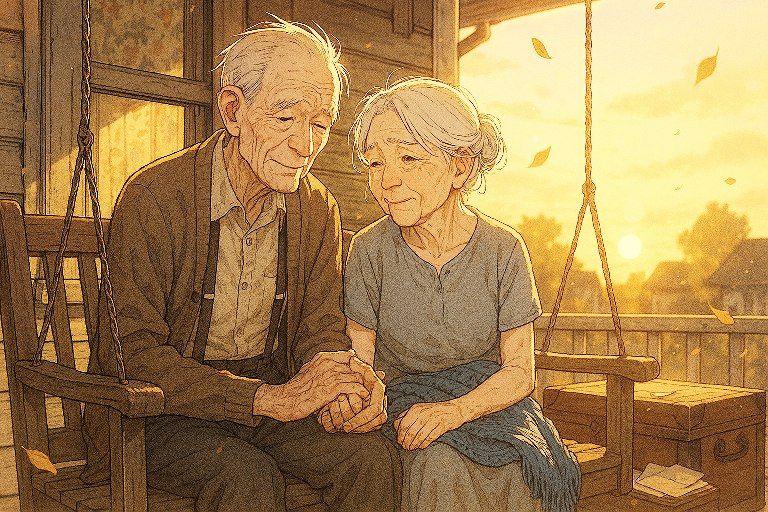
The afternoon that changed the fate of the house on Palmer Avenue, the sun poured into the parlor with a warm, golden light that seemed intent on sealing the years with a benevolent glow. Don Arturo, ninety-nine years old, moved slowly toward the old cedar trunk that had remained in the house since before he and Elena married. Its lid was warped from humidity after so many springs, and the smell of mothballs and dry wood awakened forgotten memories. Beside him, Doña Elena, ninety-six, knitted a blue wool scarf with rhythmic, almost mechanical movements; her eyes clouded at times, but the skill in her hands remained intact. Arturo placed his gloved hand on the trunk's lid. The metal of the lock creaked as if refusing to reveal secrets again, but it yielded. The sound was small, almost a sigh, but for both of them it was like opening the envelope of a story that had been postponed for decades. —What are you looking for, Arturo? —Elena asked without looking up, her voice a familiar caress. He let out a slight sob that she recognized immediately; it was the same sound she had heard on sick nights, the same support she had heard when the children were little. —Only memories, Elenita. I want to see some things before… before time plays a bad trick on me —he replied, trying a smile that trembled on his lips. Inside the trunk were sepia photographs, negatives in paper sleeves, several letters tied with a ribbon now frayed, movie stubs, an almost empty bottle of cologne, and a notebook of childish poems. Among those papers, a yellow envelope with elegant, angular handwriting stood out. It bore no visible date; when he opened it, the first sheet revealed a hand filled with ardor, with promises, with words that belonged to another era: the 1940s. A name repeated through the lines like an echo: Rafael. The air in the room turned cold. —Who is Rafael? —Arturo's tone was sharp, a crack in the calm. Elena put her knitting on her lap. For a moment she did not know how to name what she had been keeping like a stone in the corset of her soul. —He was… —she began—. He was someone I knew before I met you. I was young, confused, and I made a mistake that has haunted me ever since. Arturo stepped back and leaned on the armchair as if the whole weight of the house had fallen on him. —Did you cheat on me, Elena? Seventy years ago? The question hung between the fringes of the rug. The word “cheat” seemed as old as the house itself, and yet it cut just as sharply as it would have in his youth. Elena closed her eyes. She remembered the night she met Rafael: a rain that would not stop, a train station where life seemed to pause, a promise made accidentally. She also remembered the moment when the war redrew maps and destinies, when letters were lost and people left without warning. But what weighed most in her chest was how, years later, when Arturo arrived in her village with his strong hands and frank smile, she chose to build a new life with that honest, patient man. —Yes —she said at last—. It was before you came to my village; I was young, afraid, and I made a mistake. I didn’t seek it out or want it to continue. I withdrew. I was ashamed. I married you because, when I saw you, I knew I wanted another life. But I never told you. I kept the letters as if they were a sentence. Arturo’s face hardened, not so much from the revelation itself but from a more complex feeling: a betrayal experienced belatedly, a wound reopened at an age when he thought passions had turned into gentle anecdotes. —We’ve shared almost a century —he murmured—. Children, grandchildren, Sundays, birthdays, funerals, sleepless nights when one of the grandchildren was ill. What does this mean now? What do I give weight to: everything we have been or what I discovered today? Elena rose with effort and walked toward him. Her steps were short but steady. Her hands trembled when they rested on his. Her eyes, still carrying a faint light, sought in his the comfort she had known from the first day. —Arturo —she whispered—, I loved you then and I love you now. I made a mistake when I was young; when I met you I knew I wanted to build a life by your side. I didn’t tell you because I was afraid. Because I thought time would purify my guilt. Because I believed my silence would be an offering that would close the past. But I understand that the truth arrives when it must. Outside, the world continued with its usual indifference: a cat crossed the street, the postman left a letter at the neighbor’s door; inside, memories aligned like worn soldiers. Arturo sat down again, took the letter in his trembling fingers, and read a passage aloud as if the ink could become speech and, with it, reduce the harm. —I have thought about filing for divorce —he announced with a serenity that surprised even himself—. It’s not out of spite, Elena. It’s because I feel that I deserve, in what time I have left, to be honest with myself. I don’t know whether this is pride or dignity. I only know I can’t live this time pretending it doesn’t cut through me. Elena let the scarf fall to the floor. Her hands rested in her lap. There was in her face the resignation of someone who knows a decision can split two lives, but also the conviction that hiding the truth would condemn her own soul. —If that is your wish, I will accept it —she said with sad firmness—. I don’t want to cause you more pain. But before you sign anything, let me tell you something I haven’t said in decades: you were my refuge when everything in my life seemed to fall apart. You were the person who welcomed me after the war, who held my hand when we lost our firstborn, who taught me to laugh again. I do not come to ask for your forgiveness; I come to offer you my truth: I chose you every day from the moment I learned what choosing meant. Arturo looked at her for a long time. Through his memories passed bright images: the afternoon they shared an ice cream that left sticky faces; the time they repaired the roof together after a storm; the nights they told each other secrets with the complicity of people who know life is a succession of losses and recoveries. The letters were a breach, but behind them a vaster landscape spread: the life they had built together, with its imperfections and its everyday faithfulness. —I am not seeking revenge, nor to remake the past —he said softly—. I only want to leave with the certainty that I was not deceived in spirit. Maybe I’m foolish to think loyalty does not age. Maybe I will hate you for a minute and love you for everything else. Elena took the letter gently and placed it on his lap. —Read it all —she asked—. And then listen to me. I don’t ask you to forget, only to see the whole life we have woven with those broken threads. If you decide to go, I will let you go. If you decide to stay, I offer you my hand with the only thing I can still give: the naked truth. Arturo turned the pages more slowly. The letters spoke of a young woman seeking solace in the darkness of the postwar years, of words that promised worlds reality could not sustain. They spoke of furtive encounters, of farewells forced by circumstances larger than bodies and wills. They also spoke of a goodbye that had never truly promised a future. In the letters, Elena was not yet the woman she later became; she was a wounded, not-yet-formed version of herself. When he finished, he closed his eyes and let out a breath like someone letting a candle burn out. He had read the proof of a betrayal, yes, but also the proof of a lost youth and a destiny that had dragged her toward decisions that were not always clean. —Your truth is heavy, but human —he finally said—. I can’t deny what I feel in this moment. But I do not want our farewell to be an act of pride that erases all the good. I will think, Elena. Not because I lack courage, but because we deserve a farewell that respects what we were. The days that followed became a whirlwind of emotions. The news of the trunk and the letters inevitably seeped through to the neighbors; some looked on with a mix of fascination and judgment, others with pity. The children came, timid, with divided loyalties; some sought consolation from their mother, others from their father. There were long silences at the dining table, and conversations broken by the coughs of old age. But at night, when the city draped its noise like a blanket, Arturo and Elena sat in the parlor and stared at the same point on the wall, as if in that stillness they could recompose the irreparable. One rainy afternoon, the wind gently tapping the blinds, Arturo spoke to Elena again with the firmness time had given him. —I have thought —he said—. I don’t want our story to end with a signature. Not out of fear of the truth, but because when I think of my life you are at the center of almost all my happy memories. I cannot deny you my wish that we finish in peace. If loyalty was broken seventy years ago, loyalty has also been forged in all the years that came after. I want to spend my old age without lies between us. Elena wept then. It was not a theatrical cry; it was a single tear that fell slowly, collecting years of guilt and remorse and turning them into relief. She approached him and hugged him with whatever strength she still had. —I want you to let me stay, Arturo —she said between sobs—. Not to erase what I was, but to accompany you, with the final truth. If some night you keep feeling that edge, promise me you’ll speak and not leave without telling me why. He held her. The embrace was more than a gesture; it was a truce. In his hands one could feel the memory of many long days and many shared fears. —I promise I will speak —he finally answered—. And if one day the wound does not heal, I will let you go with the same dignity with which I thought of leaving today. They decided to stay, but not as if the decision erased the letter; they left it as a witness, placed back into the trunk. They agreed, with the honesty they had practiced throughout their marriage, that truth could not be hidden. They would speak when it hurt, without minimizing the other’s feelings. The family, although surprised, accompanied the decision with respectful attention: the children visited more frequently, worried by the frailty that now seemed more evident than before. Weeks became months. Arturo, at times melancholic, began to remove other things from the trunk: photographs in which time had softened faces, birthday notes, theater tickets that evoked laughter and effervescent nights. Sometimes at night he read one of the letters, not to relive the pain but to understand Elena’s era, to comprehend the girl she had been and the woman she had become. Elena, beside him, listened without interrupting, aware that the reading was a way to purge guilt and to rebuild trust. —You know? —he murmured one day while autumn gilded the lindens in the garden—. If you had asked my forgiveness seventy years ago, it wouldn’t have changed much. But when you give it now, you give me the peace of understanding. She smiled with that expression that held the tenderness of the years. —And if you ever doubt again —she said softly—, remind me that I was human. And you, who were my salvation, remind me that love is not always perfect, but growing together can be another form of loyalty. There were days when doubt resurfaced: small arguments about the order of the house, about the way to name a memory, or about a gesture one interpreted as indifference. But those rifts were closed with the same patience with which they had overcome other losses: plain confessions, clumsy embraces, the humor only the years bestow. The family learned to talk about the matter without sensationalism; the grandchildren continued bringing their games, their questions, their laughter. There were no grand final gestures or cinematic declarations. What there were were a series of small choices: choosing the morning tea over bitterness, accompanying the other to the doctor even though the appointment hurt, tying the shoelaces of someone who can no longer do it alone. Those choices, repeated, became a form of repair that neither letters nor judgments could simply annul. The house once again became a refuge where the letters were no longer a weapon but a witness. The trunk was closed with the same delicacy with which one closes a chapter: with respect, without denial. The yellowed sheets remained there as part of the couple’s emotional landscape, proof that people can be both culpable and lovable at once. On a clear afternoon, Arturo took Elena’s hand and led her to the porch. The neighborhood was quiet, and the sunset light bathed their faces with a tenderness that seemed to forgive without asking. —I love you, Arturo —Elena whispered, tightening her fingers around his. —And I love you, Elenita —he replied with a voice worn by the years but steady—. With your mistakes and with your truths. With everything we were and with what we can still be. They walked slowly, leaning on each other like two trees that support one another in a storm. They did not seek perfection, only companionship. They knew they could not undo the past, but each day they could decide how to look at the present. The town kept whispering; some still talked about the announced divorce, others wondered why anyone at that age would pursue separation. But inside the house there was a new humility: an acceptance that true love is not the absence of faults but the willingness to keep being there. In the end, the letters remained in the trunk, not to hide shame but to witness a life stitched together with broken and mended threads. The act of reading them, of opening wounds and holding them to the light, did not nullify the past but allowed the couple to look at each other with greater honesty. Fidelity, they discovered, was not only the absence of a punctual betrayal but the daily decision to care for one another, even when memory brings painful truths. And so, with their hands intertwined and steps slower than that first wedding dance, Arturo and Elena moved forward. Not because everything was perfect, but because they chose, despite mistakes, to stay. Their last years were a blend of remorse and tenderness, long conversations and shared silences, repeated pardons and humble promises. The story of their announced divorce remained in murmurs, but in the house only the steady breathing of two people remained—people who learned that to love is also to bear the lack and accept the truth. —If you ever doubt again —she said one night, resting on his shoulder—, talk to me. —I will —he answered—. And if I can’t, I will give you time and I will not leave you out of pride. The light faded. Outside, the city lit its streetlamps. Inside, the trunk slept in a corner, and within it the letters still formed a piece of the story: uncomfortable, painful, but honest. And they, with their hands clasped, continued to walk through the life that had been imperfect and yet worthy of being lived to the end. Source of the images. Image created with Bing.
No comments yet