 @mc5punk
Short story: Remain in the Firmament
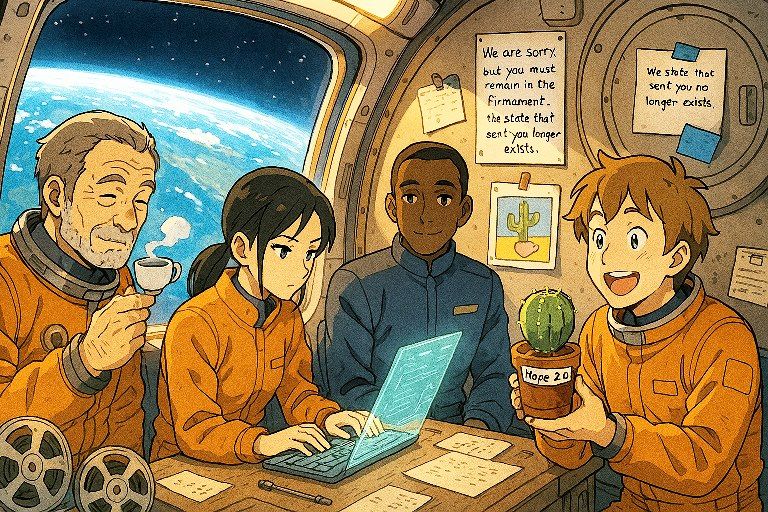
—We are sorry, but you must remain in the firmament: the state that sent you no longer exists. —Remain… where? —asked Yuri Solov, running a hand through his hair while a small water-and-coffee bubble spun slowly in front of his face—. In the orbital café? The touchscreen in the Asteria module blinked with an unexpected envelope icon. Outside, Earth turned like a gleaming coin; inside, four humans and a cactus found themselves, for the first time in their careers, without a political contract that defined their return. The message, repeated through the station’s communications networks with absurd formality, arrived unsigned but stamped with bureaucratic phrasing: “We are sorry, but you must remain in the firmament: the state that sent you no longer exists.” Yuri, a mission veteran with more stories than grass in his logbook, let the phrase float for a moment. A mixture of incredulity and humor crossed his face—the combination that helped him survive the vast loneliness of space and the interminable line at passport control. —“Firmament”? —he repeated, parsing the word as if it were code. —Who writes this stuff, a poet with a space permit? Beside him, Hana Park, the communications engineer with quick hands and an ironic smile, typed to check the message’s origin and route. Hana was the one who could make a stubborn antenna relent and send data with the delicacy of a pianist. —It’s not poetry; it’s bureaucracy with a language-placement disorder —she said, showing the technical header on the screen—. The system returned a standard message, but the identifier packet is corrupted. The issuing agency is listed as “dissolved.” Nazir Omari, mission commander, fixed his calm eyes on them. Nazir was a bulwark against panic; his voice, always at medium intensity, imposed order without shouting. —Dissolved how? —he asked—. Like an envelope in hot water or like a country in official documents? —Like a country in official documents —Hana replied—. The ministries that contracted us no longer exist in the administrative cartography of Earth. Bank accounts closed; contracts show an error 404 with more poetry than they ought to. In the corner, Lili, a biologist with inexhaustible enthusiasm, smiled at her floating cactus. She had brought the plant on a whim—both scientific and affectionate; the cactus wore a label reading “Hope 2.0” and was the crew’s unofficial mascot. —We could proclaim independence —Lili proposed, eyes shining—. “The Floating Republic of Asteria.” I can design the flag: a cactus and a teacup orbiting. Yuri laughed. His laugh produced a chorus of little bubbles that traced graceful paths through the air. —If we do that, I demand the national anthem be a space tango —he said—. And passports must include a section for “gravity preferences.” Communication with Earth suddenly became an administrative maze. The agency responsible for the mission, once clear and hierarchical, had been absorbed by geopolitical changes: ministries merged, republics reformed, factions interpolated. In official reports, where there had once been the name of a nation, there were now blank lines or new acronyms no one had seen before. While officials on the ground debated which body should pay for the return rocket, Asteria became a hive of creativity to make the wait more bearable. The crew implicitly decided: if no one said “come home now,” they would take care of their island in nothingness and turn uncertainty into a human experience. First, routine: they kept the experiment schedule, monitored consumables, performed maintenance spacewalks with their usual meticulousness. Then they added layers of humanity that made them more legendary than heroic: movie nights screening old comedies and documentaries; an improvised hydroponic garden seeded by schools who had followed their story; philosophical debates on whether democracy works better with or without gravity. The station became a social theater where every small act gained resonance. The “remain” message became an emblem. At first, everyone treated it like a joke—an official line from a metaphor-hungry software. But the phrase resonated and spread across networks: “We are sorry, but you must remain in the firmament: the state that sent you no longer exists.” It became a slogan for support campaigns, printed on T-shirts, and chanted on social media. Citizens worldwide began sending messages of affection, children’s drawings, flag sketches, and envelopes full of human worries: “Are you okay? Are you eating well? Will you return soon?” The media fell in love with the story. A TV feature called the crew “accidental ambassadors,” while political columnists debated whether it was an administrative failure or a metaphor for a world changing too fast. Proposals emerged in public forums: declare the astronauts “world heritage,” create an international repatriation fund, impose a solidarity tax on financial transactions to cover the rocket ticket. A pro bono law firm offered to process documents “for humanitarian reasons and good publicity.” A start-up tried to sell virtual tickets to a space dinner (without travel rights). Meanwhile, the terrestrial bureaucracy did what it does with the slow rhythm of its trade: commissions, committees, minutes, and signatures. Agency names multiplied; some merged, others were born. The “Office of Territorial Reconciliations” appeared, vanished, and reappeared under different acronyms. Each official reply that reached them had the precision of a tongue-twister and the effectiveness of a leaky umbrella. To avoid succumbing to the absurdity of the wait, the crew devised ingenious schemes. They organized a satirical gala: invitations to ministers, journalists, and activists with golden borders and the legend “Gala for Repatriation (please bring your own suit).” The event mixed performance art and public pressure; some figures, eager to avoid losing media capital, sent public words of support that accomplished more than signing forms in offices. Hana, always pragmatic, found a technical fix that sped things up: she improved the station’s transmission encryption and created a direct diplomatic messaging channel that bypassed the confusing administrative layers. Through it they could send clear, traceable communications explaining that human presence on Asteria demanded a decision. The technical clarity, combined with media pressure, was the lever that loosened Earth’s bureaucratic inertia. On Earth, public opinion mobilized. Children made petitions, artists painted murals of the phrase in plazas, and people organized digital vigils. Social networks flooded with illustrations of the cactus with a passport and memes that distilled solidarity. Humor, which always accompanies human tragedy, served as a catalyst so authorities would not just classify the situation as administrative and forget it until the last coffee reserve ran out. Months later, a blue envelope finally arrived with a photo: a rocket in assembly, painted by hands that had joined the campaign. Alongside the photo was a brief corporate-style note: “Responsibilities have been reassigned. Repatriation will be scheduled. Please await further notice.” An illegible signature accompanied the note, but at the bottom it read clearly: “Interim Repatriation Office.” The wait left marks. On Asteria, nights were no longer only scientific routines; they became capsules of intimacy. The crew remembered childhood days, named stars with ridiculous nicknames, told stories that on Earth would have seemed unnecessary. Lili documented her cactus’s microbiome; Hana left encrypted instructions so future engineers could follow her impossible fixes; Nazir wrote letters never meant for publication, so his grandchildren would know that serenity is a learned discipline. Finally the order came: the new planetary administration had assumed responsibility. A rocket, modestly and proudly painted with Lili’s design—a cactus and a teacup on the fuselage—carried the descent module. In the hours before return, the station filled with small rituals: recorded songs to sing at reentry, messages for loved ones, and notes on the wall where the crew wrote their little maxims. On the main hatch they placed the note that had accompanied them: “We are sorry, but you must remain in the firmament: the state that sent you no longer exists.” Beneath it, in multiple hands, they added: “But you are welcome here.” Reentry was a reunion with gravity that flattens bodies but lifts spirits. Recovery teams greeted them with protocols, cameras, and formal smiles. At the press center, questions were many: who pays? To whom do you owe loyalty? What does citizenship mean if countries change like seasons? Yuri, with his usual mix of irony and tenderness, raised a standard ceramic mug and said: —I don’t know what color my passport will be, but my cactus has better handwriting than I do. The response sparked general laughter. Lili produced a photo of the cactus, now housed in an improvised display in the descent module, and handed it to reporters. The cactus became a simple emblem: resilience, humor, and the odd way small things hold people together when large political frameworks collapse. In the arrivals hall, officials filled out forms describing reassignment and authority. One bureaucrat, brow furrowed by ink-stained paperwork, tried to levy a retroactive tax for “extended stay in unassigned territory.” Nazir looked at him with calm and offered a diplomatic smile that disarmed administrative rigidity. —I don’t think we can pay taxes to uncertainty —he said—. But we accept donations in the form of coffee and wrinkle-free shirts. The press, always hungry for the human note, amplified the story and turned it into a symbol: there was a lesson in fraternity in the drift and a paradox of belonging in a changing world. Some politicians used the episode to win votes; others recommended reforms to repatriation protocols. Schools used the letters the crew had received to teach empathy and citizenship. Years later, when books recounted the anecdote, some emphasized the comedic aspect—a country evaporating while a man floated above it—; others stressed the symbolic gravity: that the social contract can break and humanity needs care mechanisms that transcend borders. But aboard Asteria and among the friendships forged there, a simpler, homelier truth remained: belonging is sometimes invented by people who share a roof—even if that roof is metal and glass floating in the dark. Yuri kept a final entry in his logbook, written with a pen that defied expectations: “They sent me a message saying I had no country. I learned that a country can change, but small loyalties—to the one who shares your teacup, to the one who guards your cactus, to the one who hands you the module key—do not disappear. If I ever lose another country, let it be for poetic reasons. And if they send someone without a homeland again, tell them there is always a cup of coffee and a cactus with a passport up here.” When asked what he had learned, Nazir said only: —Patience has an orbital form. And terrestrial paperwork will never defeat human humor. The End. Source of the images. Image created with Bing.
No comments yet