 @mc5punk
more from that month
@mc5punk
more from that month
Short story: The city of rhymes and brands
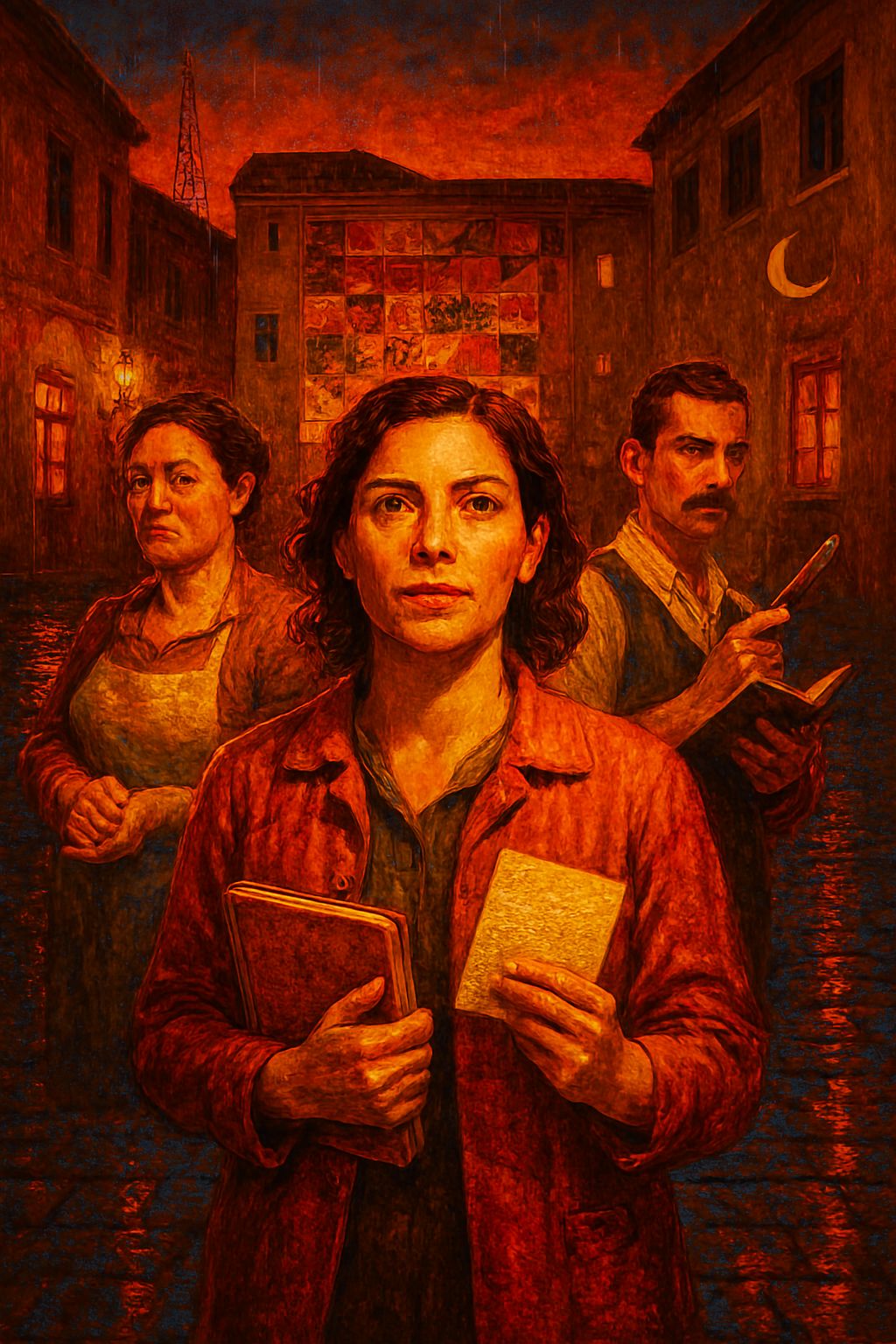
The melody appeared again in Rosa's memory like a loose thread that insisted on pulling the fabric. I didn't know where it came from or why, but I was humming it unconsciously as I closed the last boxes in the municipal archive. That room, lit by a yellow lamp and made of shelves that smelled of dust and cardboard, was his territory: there he catalogued minutes, maps, brochures and photographs that no one seemed to need until, by accident, someone understood their value. The unlabeled box was under a stack of outdated inventories. When Rosa opened it, she found a mess that at first glance seemed insignificant: undated newspaper clippings, a notebook with nursery rhymes, crumpled recipes, photographs with people wearing symbols sewn on the hems of clothes and papers where someone had written down schemes of squares with small marks on the edges. There was a calm in those pages that demanded to be read: they did not protest, they did not shout; they only guarded. Rosa felt an impulse of care, as if the paper was breathing weakly and needed her name back. That same week the melody appeared again in Marta's bakery. The owner, with dough-tanned hands and a folded napkin in her pocket, hummed it while forming buns. Marta had inherited the business from her mother and with the trade she had learned to preserve gestures: folding the dough in a certain way so that the scarcity is not noticed, mixing a spice so that a flavor brings comfort, adding a stanza to a song so that the ear would keep it. He handed Rosa the napkin with the stanza written with a worn pen tip. "My mother told me to sing it like that, to change one word for another," Marta murmured. "If you sing it as it is, you will understand it. By changing her, you will keep her alive without being devoured.' I always said it was superstition, but look — raising his shoulders - here it is. Rosa examined the letter while the smell of hot bread filled the place. In the archive notebook, the rhymes appeared accompanied by notes in the margins: street names, symbols drawn as coordinates, a newspaper clipping with the silhouette of a square crossed out. He began to notice a structure, a logic of small signs that did not seek to stand out but to protect themselves in the routine. The next day he went to the barber shop where Julian worked as his father and grandfather had done. The place smelled of aftershave and polished wood; black and white photographs of perfectly cut men hung on the wall, and in the corner, a faded sticker showed a barely perceptible symbol. Julian, with big hands and serene gaze, received her as if he had been waiting for her question for years. "My grandfather taught me to see where others weren't looking," he said as he sharpened the razor. Those markings are like Moderna smoke signals. They do not announce wars, they point out openings: markets, readings, cures. If you put them together, they tell you more than a map. He showed Rosa a folder with photos of facades, corners and claims where the marks — a white dot, a letter hidden in graffiti - repeated patterns. Some matched the notes she had seen in the file box. Julian spoke of a time when reading these signs was an everyday skill, taught from father to son, imparted without ceremony in the workshops and squares. Rosa started to map. A day at the archive, another at the bakery, an afternoon at the barber shop; the plot was expanded with names and hands. Soon she met Mateo, the retired teacher who took care of the community garden. Mateo was one of those who talked little and planted a lot; his notebook, stained with dirt, kept lists of plant nicknames —“the one that laughs” for a variety of marigolds, “the one that keeps” for an old Jewess — and notes of sayings that his wife repeated. At night, under the light of the garden lantern, Mateo told stories about how naming protected: to say a name was to confirm it in the world. —Names aren't decoration, —she told Rosa one afternoon when they shared a bench and tea—. **They're anchors.** If you stop saying them, you stop calling them. They leave. Each character Rosa found added a different thread to the tapestry: Marta contributed altered recipes stamped with resistance; Julián, maps of signals; Mateo, a living archive of names. With them, subplots were woven that enriched and complicated the main narrative. The clandestine radio was the loudest. Run by Lucía, a journalist who had resisted the corporation's fall and learned to work patiently, the station occupied a basement where fans turned like slow clocks. Lucía had turned her anger and experience into warm waves: gentle editorials, music once considered irrelevant, and small coded announcements. The station returned voices: it interviewed grandmothers, played forgotten songs, broadcast codes that only those who knew the marks could interpret. —Waves heal what screens cut, —Lucía used to say—. Here we don't seek virality; we seek **resonance**. Not everyone shared her caution. Camilo, leader of a group of young activists, saw the station as a tool for exposure. His family had suffered reprisals when the corporation imposed conduct rules at work and school; Camilo wanted names and places, wanted to expose those responsible and force them to face the memory. Between him and Lucía there was a constant argument about timing, ethics, and strategy: reopen the wound or apply pressure so the harm won't be repeated? —If we wait, the guilty will keep walking free, —Camilo said passionately—. **Faceless truth is useless.** —Truth without the fabrics that sustain it can destroy us too, —Lucía replied—. We need memory to be livable. That tension filtered into the nighttime assemblies where the neighborhood discussed how to proceed. Sometimes debates ended in consensus; other times, in long silences. Rosa found herself in the middle of those currents: her impulse to share what she had found clashed with the duty to protect routes that still functioned as refuge. Parallel to this, Rosa's intimate story with her sister Ana added an emotional, painful subplot. Ana worked at an NGO dedicated to digitizing archives to preserve them from decay. In theory, her task was noble: scan and store in the cloud so nothing would be lost. In practice, the application of automatic rules and “data-cleaning” processes—removing duplicates, standardizing formats, stripping metadata deemed dangerous—caused unique documents to be erased. When Rosa showed her the unlabeled box and the pieces she had gathered, Ana faced the evidence of the irreversible. —I thought I was helping, —Ana said, eyes wet—. They gave me protocols and told me it was for safety. I didn't know that by deleting "duplicates" I was throwing away whole stories. Guilt didn't consume Ana; it mobilized her. She began learning alternative preservation methods, talking with technicians and older residents of the neighborhood to understand the context behind each file. Her process was a look at the complexity of well-intentioned technology: how efficiency sometimes erases nuance, and how archival ethics demand more listening than algorithm. Amid these entanglements appeared Sofía, a former corporate executive. Her presence was unexpected and, at first, suspicious. She approached the memory gathering cautiously, carrying a notebook and the expression of someone who had spent a long time justifying decisions. Sofía had been at the apex of the system that pushed micro-information, and the leaks that led to its fall stripped her of misplaced privileges. She did not come seeking explicit absolution; she sought understanding, and perhaps, a way to make amends. —I didn't come to absolve myself, —she told Rosa one afternoon as they walked down a street still showing traces of old posters—. I came to see how things are mended. His arrival generated suspicion, especially among young people. Camilo looked at her harshly: for him, Sofia was the face of the machinery that turned memory into merchandise. For Lucia, however, her access to digital files could be useful if it came with responsibility. Sofia offered files — copies of databases that, out of context, seemed irrelevant — and learned to listen to the oral histories that made sense of them. His integration to the station was a slow process: he asked, observed and let others decide how to use what he brought. The memory day was the moment when all the subplots converged. Proposed by Rosa as an intermediate alternative between confrontation and silence, it was designed to be a celebration with precautions: routes marked with discreet ribbons by Julián, messages in code by Lucia's radio station, bread with notes from Marta and envelopes of seeds with names written by Mateo. The idea was to turn the act of remembering into a physical map that respected those who still needed anonymity. The day dawned gray and full of promises. The rain obscured some plans, but the city responded with umbrellas, voices and footsteps. Whole families followed the routes, children playing to discover brands, old people telling anecdotes to whoever wanted to listen. The station broadcast fragments between songs: small memory capsules, interviews with shaky voices retrieving sayings and rhymes. Marta offered loaves of bread with notes inside and outside the paper, as if each bite was an invitation to read and remember. During the day, tensions arose: a mocking graffiti that alluded to the old corporation ignited passions; Camilo wanted to take advantage of it to convene a public march and demand accountability; Lucia and the elders feared that the confrontation would expose those who still depended on resistance circuits. Rosa then proposed a third way: to make visible without attacking, to show without pointing. He convinced the young people to turn the energy of indignation into collective creation: banners made with textiles that had recovered symbols sewn on and murals that told stories instead of names. It was a transformation of the punitive impulse into memory production. In one of the most intense moments of the day, Sofia appeared and unexpectedly approached the microphone of the station. His voice, hesitant at first, became assertive as he read fragments of internal correspondence that spoke of business decisions that sought to “optimize attention.” It was not a spectacular confession or a media reckoning; it was, instead, a reading that put into the hands of the community pieces that, with their oral context, generated meaning. After that, Sofia was not immediately disowned or embraced: her place was built with work and the demand for responsibility. The station became the laboratory where people chose ways to use information without turning it into a weapon. Sofía learned to give up the center of the story and to offer technical tools to host files with metadata that would preserve oral testimonies; Camilo began to understand that memory demanded weaves before flashes; Lucía continued weaving the pieces, permeating the radio with a balance between denunciation and reparation. Ana's subplot took a turn when the technicians she was working with agreed to review the erasure protocols. He learned how to catalog with context tags and how to save fake versions to protect identities. She and Rosa worked together on a hybrid physical-digital archive: scanned documents accompanied by audios where those who told the story validated their publication and their level of access. It wasn't perfect, but it was an improvement and a community learning about how technology can serve without replacing human deliberation. The meetings in Mateo's garden became a school of names and songs. The children learned to water carefully and pronounce nicknames for plants that were previously known only to the elderly. Marta organized a workshop where recipes became history and strategy lessons: how to change a word in a song so that it goes unnoticed or how to hide a message in a bread like one who keeps a seed. Julián coordinated signaling routes that now worked both for everyday meetings and to protect the privacy of more sensitive meetings. It wasn't all harmony. Some pieces never turned up; documents are still missing and some families did not trust the movement. There were those who saw reconstruction as a threat to personal interests, and others who, out of fear or fatigue, preferred to remain on the sidelines. The discussion about how much to reveal and how much to hide continued to be a living thread. Even so, the overall balance was one of recovery: not because of the amount of files found, but because of the social fabric that was beginning to form. The voices changed. The melody that Rosa was humming no longer sounded the same: she had gained voices, rhythms and pauses. In the main square, where the corporation's sign used to dominate the view, there was now a community mural made with textile scraps and photographs. The lyrics did not ask for revenge; they invited to remember. The day ended with a simple act: children handing out envelopes with seeds and written names, young people hanging banners with handmade seams, old people teaching rhymes and Marta handing out loaves whose crumb had a drawing made with a spatula like someone signing a document. One evening, after the day, Rosa and Ana walked along the river. The lights reflected stretches of water and paper. Ana confessed her fear and her learning: she promised that she would no longer delete without consulting and that she would work to create criteria that would protect the memory before it was shredded. Rosa, for her part, kept the new rhymes and names learned during the day in her stitched notebook. There was a mixture of tiredness and hope in his gesture. I knew that the reconstruction was not linear; it would be protracted and stumbling, but the city had already begun to remember out loud. The following months brought practical consequences. The station created an open archive where oral recordings coexisted with digitized documents and context annotations. Marta and other merchants began to incorporate discreet signs in their premises to facilitate cultural encounters. Julián and a group of young people organized workshops to teach how to read the marks and to sew symbols on fabrics as new ways of transmission. Mateo expanded his garden and organized planting days with names of plants that told family stories. Sofía, adapting to her new position, helped to design access protocols to the archives that included phases of community consultation. His work with Camilo, initially full of friction, turned into a workshop where young people learned to interpret data without neglecting the importance of community. Ana became a mediator between technician and witness: her task was to translate protocols into practices that respected the fragility of certain memories. History did not end in a clear triumph or a definitive remedy; memory remained fragile and the past incomplete. But the city had changed its relationship with memory: it was no longer something imposed from above or eliminated by invisible bureaucracy; it was a collective good, practiced and protected with small actions. Marta's bakery became an informal filing point; Julián's barber shop, instead of paso, was a classroom; Mateo's garden, a shrine of names. In a final scene of calm and noise, Rosa sat on the bench in front of the community mural. A girl with flour in her hands came up to him, offered him a leaf and said naturally: - My grandmother says that if we don't sing it now, the song will die. Rosa took the sheet and put it away. The song, now mutated by thousands of voices, would continue: it would be heard in bakeries, in barbershops, on radios and in gardens. It was not the restitution of a single truth, but the daily construction of shared memories. The revolution that was germinating in the city was not noise but repair: threads sewn with care, bread shared, names that are pronounced and seeds that are planted so that those who arrive later will find something to sustain them. Rosa closed her eyes for a moment and, when she opened them, she heard the transformed melody, already part of the landscape. He knew that, between losses and finds, the city had regained the ability to name itself. Source of the images. Image created with Bing.
No comments yet