 @mc5punk
Short story: When the River Speaks: Chronicle of the Storm
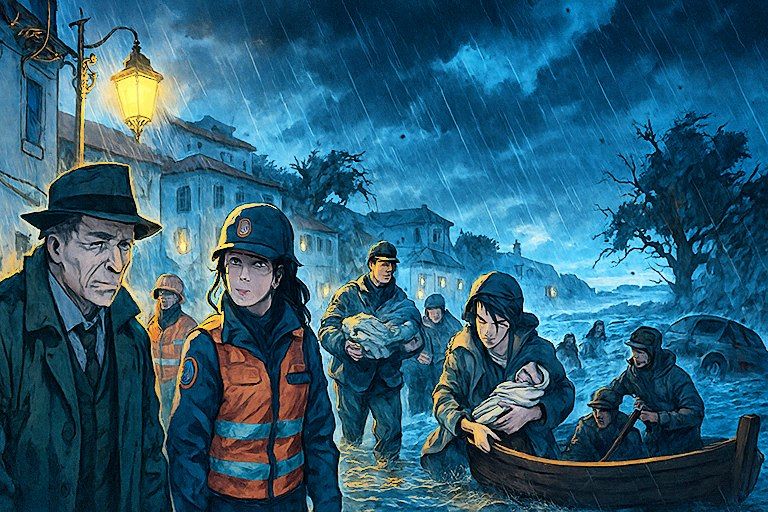
The sound of water arrived first as a low rumor, then as a threat that made its way between houses and memories. In Vila das Aroeiras, a riverside town rebuilt on the banks of the Tagus, people spoke in hushed tones while shutters trembled. The mayor, Manuel Durão, watched the river from the town hall window with clenched fists, reviewing emergency maps and the names of roads that no longer existed in the town’s memory. Outside, the sky collapsed into layers of gray that the rain relentlessly unraveled. Beside him, the head of local Civil Protection, Clara Esteves, held the phone with hands stained by cold coffee. She had slept three hours, if that. “They’ve opened sluice gates in Spain,” she said without taking her eyes off the screen where river lines swelled like inflating veins. “The discharges will raise the flow in a few hours. We have to evacuate the low bank.” Manuel nodded with the gravity of someone who knows every decision carries weight. Executing the emergency plan was no longer a theoretical exercise: it was an urgency that hurt in the throat. Meanwhile, in Leiria, north of the capital, Sergeant Joaquim Ramos walked the flooded streets with a flashlight and boots caked with mud up to his knees. He had been fielding calls for hours; nearly four hundred incidents had driven an unforgiving rhythm into his chest: fallen trees, landslides, roofs losing pieces, and plumes of smoke promising fires in corners the rain hadn’t reached. At every door, Joaquim saw faces he had known for years and witnessed something statistics don’t capture: the humiliating surprise of loss. “We can’t delay the signal any longer,” Joaquim told the volunteer beside him, Marta. “The Mondego is rising too, and the Sado isn’t far behind. If the wind picks up, the sluices won’t be enough.” Marta, whose eyes carried the fatigue coffee couldn’t cure, pointed toward the hill where evacuated families gathered: sacks, blankets, wet toys, and the emotional burden of those carrying memories in plastic bags. Among them was Rosa, a mother of three holding her baby with one hand and clutching her ailing father’s hand with the other, trying to contain a flood of fears with a steel gesture. Her eyes searched not for comfort but for clear instructions and the promise that this had an end. The emergency center’s radio broadcast the grave voice of Elísio Pereira, Operations Officer of the National Authority for Emergency and Civil Protection. His message, repeated over loudspeakers and local stations, was dry and concise: in the coming hours, water levels were expected to rise significantly, “especially the Tagus…” The phrase settled in everyone’s minds like a verdict admitting no appeal. In the south, in the Pias region, news of tragedy began to spread with the coldness of facts: a sixty-year-old man had died after the vehicle he was in became submerged on a road the rain had turned into a deadly trap. The name of the victim would take time to reach other families, but the pain was understood with the same clarity: the storm does not spare according to protocols but according to the randomness of roads. Storm Leonardo did not content itself with rain; it brought biting wind, snow at high altitudes that set off mountain alarms, and waves that battered the coast as if trying to tear away defenses painstakingly built over the years. Meteorologists warned the alert would remain in effect until Sunday. For people living by the river, that timetable wasn’t a figure on a report: it was a burning wait, an hourglass where each grain was another house at risk. In the town school, set up as a temporary shelter, teacher Helena arranged blankets, distributed water tablets, and compiled lists with names written in trembling handwriting. Her hands, used to the calm of classrooms, now trembled tying ribbons to the children’s backpacks. She forced a smile that came out broken, another mask to hold back the overflow. “We’ll stay here until they say otherwise,” she murmured to parents arriving with bags and exhausted looks. Volunteers worked in shifts without a clock. The town was full of silent gestures: neighbors offering to watch houses, young people carrying sandbags, elders pointing out where the most important items were so they could be rescued first. In the square in front of the town hall, improvised plans and Sergeant Joaquim’s calm orders could be heard, like someone dealing cards in a decisive round. “Priority: evacuation of the low bank and critical points in Leiria and Lisbon,” Joaquim told his team. “Redirect resources and control roads. We’re recording landslides in several municipalities; don’t risk vehicles without local knowledge.” Among the foam of the emergency, stories emerged that tempered the tragedy. Ricardo, a weathered-faced fisherman, mended a small boat he offered to ferry families whose homes were being submerged to safety. His boat, now useless for fishing, became a floating promise: to pick up those left behind and return what the current hadn’t swept away. “Get in,” he said to Rosa in a hoarse voice. “We’ll take what you can.” Rosa did not hesitate. In her bag she felt the texture of the photo album she had barely managed to save, a treasure that seemed to weigh as much as her eldest daughter’s restrained sobs. They climbed into the boat amid the splashing of water in the streets and the metallic sound of shutters closing. From the shore, people watched and, united by an unexpected emotion, applauded as if that effort deserved public recognition. On the night the Tagus overflowed, phones wouldn’t stop ringing. The emergency center filled with voices and names; maps were littered with pins marking the worst points. In the control room, Elísio coordinated with a voice made of maps and numbers but tinged with human weariness. “Activate whatever is necessary for the main roads. Priority to medical assistance and search in isolated areas,” he said. “Maintain communication with Spanish authorities: those discharges can change everything in hours.” Supplies began to run low in the hardest-hit spots. Water and electricity failed in several neighborhoods, and tin roofs sang as gusts tore at tiles and loose sheets. Poorly sealed chimneys became hazards in the dark, and smoke required improvised ventilation in shelters while medical staff multiplied their efforts in a makeshift hospital set up on the sports field. There, injured people arrived with cuts from trying to salvage belongings, with falls, hypothermia, and the prolonged panic prolonged fear brings. An elderly man recounted through sobs how the flood had swept away his wife’s photographs; a seamstress lamented that her sewing machine, her livelihood, floated by her shop door. Volunteers responded with blankets, words, and the patience born of ritual: tending, listening, staying. On Saturday morning, when the rain relented enough for people to assess damage, the landscape bared its rawness. Streets turned into small rivers, cars tipped sideways, trees uprooted as if a giant had torn them from the earth. Official numbers remained cold: with the death in Pias, fatalities tied to recent storms rose to six. Material losses were substantial, but the most painful toll had no digits: personal memories exchanged for the necessity of moving to higher ground. In Vila das Aroeiras, the meeting among authorities showed the blend of procedure and humanity that defines those who must make hard decisions. Manuel, Clara, and Joaquim sat at the town hall table with maps spread and name lists. They spoke of reconstruction, resettlement plans for the most affected families, and infrastructure upgrades that couldn’t wait. Technical terms mixed with stories from the street. “Repairing isn’t enough,” Clara said with a tired voice. “We must prepare people for when it happens again.” “And it’s not certain it won’t,” Joaquim replied. “Leonardo could rage again, and another storm—yet unnamed—could follow.” Their conversation was interrupted when Rosa entered carrying her sleeping baby. She stopped by the table and looked at the three, speaking with the clarity of someone who has learned to sum up the world in a few words. “As long as we’re together, we’ll get back up,” she said. The phrase hung in the air like a simple command that, however, contained an entire program. It was not naïveté; it was acceptance that rebuilding required more than concrete: trust and communal commitment. That statement became a moral compass guiding decisions in the days that followed. Cleaning and recovery days turned into choreography of hands. Neighbors swept mud, barrels of hot water were distributed, youth brigades removed debris and separated what could be salvaged from what had to be discarded. There were moments of desolation in front of irreparable objects: charred letters, water-warped photographs, furniture swollen with moisture that for an instant sustained the lives of many families. In Pias, the community mourned its dead in a humble vigil. Candles in the chapel, a bouquet laid on the roadside where the current had shown its most ferocious face. There were no grand speeches; there was silence and a constellation of small ceremonies that gave shape to grief. Elsewhere in the country, discreet tributes were organized: a minute of silence in Vila das Aroeiras’ school, an improvised mass in a Leiria church, a mural appearing on a wall with names and dates no one wanted to say. State response organized in parallel: emergency teams improved communication channels, supplies arrived, and medium- and long-term mitigation plans began to take shape. Talks of higher levees, more precise early-warning systems, and resettlements in extreme-risk zones took place. Yet even the best promises met reality’s measure: no one wanted to leave without being sure they could return. In the following days, stories of solidarity seemed to defy the logic of disaster. A baker handed out bread without asking for documents; young people volunteered to erect tents; a woman went door to door at night delivering hot coffee and words of comfort. Each small act solidified a network more resistant than the damaged infrastructure. Storm Leonardo left its mark: breaks, lives torn apart, and lessons etched into the collective memory. But it also left something statistics don’t measure: a community that learned, amid rain and loss, to stand together. Over time, as the Tagus returned to its course and the sun shone with a harsher light, scars on walls became mute witnesses. In the squares, conversations continued with the same blend of pragmatism and tenderness that had saved so many lives: what to fix first, how to redistribute resources, how to teach children to react to evacuation warnings. Months later, when sluices and levees had been reviewed and public policies began to move toward greater prevention, the memory remained alive. Helena, the teacher, organized evacuation drills at school. Ricardo repaired his boat again and organized shifts to monitor the bank. Manuel, from the town hall, pushed forward resettlement plans and reconstruction funds. Clara continued coordinating drills and training young volunteers who now knew how to read the river with more care. The story of those days was inscribed on plaques, in café conversations, and in the texture of repurposed objects. Loss did not disappear; it never pretended to. But the experience taught them to look at the water with caution and at their neighbor with renewed affection. “We can’t stop the rain,” Helena said one spring afternoon while hanging children’s drawings in the classroom, “but we can decide how we hold on to one another when it comes.” Her words echoed all the others that, amid mud and twisted metal, had woven the network that made the storm less lethal. Thus, when the next rain arrived, the people of Vila das Aroeiras and neighboring towns responded with a mix of active memory and new resources: faster alerts, better-equipped shelters, and a community that knew by experience its true strength lay in the sum of everyday gestures. Storm Leonardo became both a wound and a turning point: painful, yes, but also the catalyst for a recomposition in which the river, finally, was listened to with the attention it deserved. Source of the images. Image created with Bing.
No comments yet