 @mc5punk
Short story: The Folding Laboratory
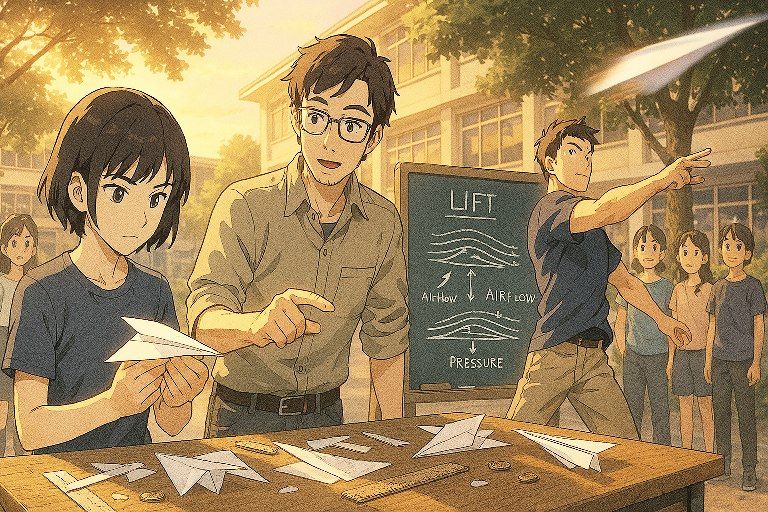
At school we were always taught to fold paper airplanes as if it were a game: a series of quick folds, a wrist that throws, and a race to see which one flew the farthest. But in the afternoon workshop, where the most curious students gathered, Marta discovered another dimension of that pastime: every fold, every edge, every millimetre of paper offered a practical physics lesson that could be explained and repeated. Characters and dialogues Lucas Moretti — aerodynamic engineer: —It's not magic; it's physics. Look how the air accelerates around the wing and creates lift. Andrés Cruz — former university rugby player (thrower): —The key was the initial speed and the alignment. Without that, there is no clean flight. Marta — curious student: —So if I move the center of mass forward, will it fly better? Lucas: —It can gain stability, but you'll lose range if you overdo it. You have to balance mass, geometry and speed. The day everything changed was a summer afternoon when the workshop stayed open until dusk. Lucas Moretti, who lived near the school and came to the meetings sometimes bringing designs, put a carefully folded sheet on the table. It wasn't the typical recess plane: the wings had a deliberately calculated chord, the nose showed a slight added weight with a strip of tape, and the control surfaces —tiny folds on the trailing edge— were adjusted with precision. In the square, under the gaze of a growing group of neighbours and students, Andrés Cruz took that sheet as if it were something fragile and at the same time exact. Andrés —who in college had thrown long passes in rain and wind— focused; his athletic past had left him with more than strength: an intuition about direction, rhythm and body posture in a throw. He walked a few steps, aligned his body with the desired trajectory, and released the airplane with a speed that was not the result of chance but of practice and repetition. —The key was the initial speed and the alignment. Without that, there is no clean flight —Andrés said as the plane already glided, and the phrase hung in the air along with the craft. When the small device described an elegant parabola and disappeared among the treetops in the distance, the meters mattered less than the collective feeling: this was reproducible. Mirna, the neighbour who was passing by with her dog, raised her voice from the crowd: —Seventy metres! Are you sure there's no trick? Andrés looked at her and replied with the calm of someone who trusts his technique: —None. Just technique and calculation in the throw. After the amazement came the explanation. Lucas unfolded another sheet and drew a diagram with chalk on the workshop's makeshift board. He patiently unpacked every element that made a simple sheet of paper mimic, at scale, the same laws that govern a commercial airplane. —It's not magic; it's physics —he repeated—. Look how the air accelerates around the wing and creates lift. In a low, steady voice he explained that lift arises because the air passing over the wing and the air passing under it move at different speeds; that difference generates a pressure variation that pushes upward. He pointed at the leading edge and spoke of angle of attack, that small angle between the wing chord and the direction of the airflow: —If the angle of attack is excessive, the flow separates and the wing stalls. With paper you'll see it as an abrupt fall: the plane shudders and drops to the ground. He showed how the center of mass influenced the plane's response: —If the center of mass is too far back, you get maneuverability but lose stability and it tends to yaw and roll. If it's too far forward, it becomes stable but can lose range because the wing has less capacity to generate the moment necessary to maintain the glide. Marta, who had always folded planes for fun, now asked with bright eyes: —So if I move the center of mass forward will it fly better? Lucas smiled and answered precisely, as if correcting an equation: —It can gain stability, but you'll lose range if you overdo it. You have to balance mass, geometry and speed. It was no longer a guess; it was an experiment anyone could run. The kids began to take notes, as if keeping lab logs: they weighed sheets with small coins, measured wingspan with rulers, marked wing angles with improvised little gauges. They began to distinguish paper types by grammage, to test different tail lengths and to place tiny loads on the nose to shift the center of mass by a few millimetres. In one of those sessions, a neighbour, Tomás, suggested a rougher tactic: —Put a bit more weight on the nose, I think that way it holds better. Lucas listened and replied with the same calm: —Careful: moving too much mass forward can reduce range. Design thinking about how mass, geometry and airflow interact. The trials multiplied: the workshop filled with planes that rolled, glided, fell in spirals or maintained a stable glide. Every failure offered a hypothesis: does it fail because of too much wing torsion? Because of an uneven fold that generates an unwanted moment? Because of insufficient launch speed? They soon learned to distinguish between construction errors and launch technique errors. They understood that initial speed was not just brute force but a parameter that determines whether aerodynamic forces reach the thresholds necessary to stabilise flight. Marta jotted in her notebook as one of her designs described an almost perfect trajectory: —I'm going to try reducing the angle of attack a little. The small workshop community discussed aloud, proposing controlled adjustments and recording results. The conversations combined intuition and measurement, and the yard turned into a practical classroom in fluid dynamics and design. Beyond pride in a record or the distance achieved, what captivated them was the possibility of understanding and predicting: they could design, test, measure and improve. Paper, until then underestimated as a trivial toy, became a laboratory material. Its low cost and ease of manipulation allowed rapid design iteration, experimentation with variables and learning from failures without great resources. For the students, that transformation had an emotional dimension: the workshop gave them the certainty that science was not a set of distant formulas, but something tangible they could touch, fold and throw. On an afternoon when the sky was clear and the wind barely noticeable, Andrés took another sheet —this time designed by Marta, with a slight modification to the tip shape— and prepared to throw. Everyone fell silent; it wasn't the tension of a record attempt but the expectation of seeing a hypothesis turn into a tangible result. Andrés ran, aligned his arm, and released with precision. The plane traced a smooth line, gained altitude, glided and disappeared among the trees in the distance. When the craft was retrieved by the kids who went to fetch it, there were hugs and a shared sense of triumph. Lucas, looking at Marta and the rest, concluded: —We've demonstrated something essential: the same laws that govern a metal giant at an airport apply to a sheet of paper in this yard. You just need to understand and respect them. The experience left marks: some students became interested in engineering, others in physics, and several in design. The workshop became established as a space for experimentation where curiosity guided learning. And although there were always laughs and informal competitions about who made the fastest or most acrobatic plane, every new launch carried the certainty that, with care and method, even the apparently simple can be a gateway to profound knowledge. Paper, then, ceased to be an innocent toy and became a portable laboratory. Among laughter, rulers, cups of mate and notebooks full of simple equations, the kids learned that with a sheet and some hands they could reproduce and feel the same dynamics that keep commercial airplanes aloft. And when Andrés launched again, everyone held their breath; not for the possibility of a world record, but for the collective feeling of having made visible the science hidden in a single fold. Source of the images. Image created with Bing.
No comments yet