 @mc5punk
more from that month
@mc5punk
more from that month
Short story: The City That Breathed Smoke
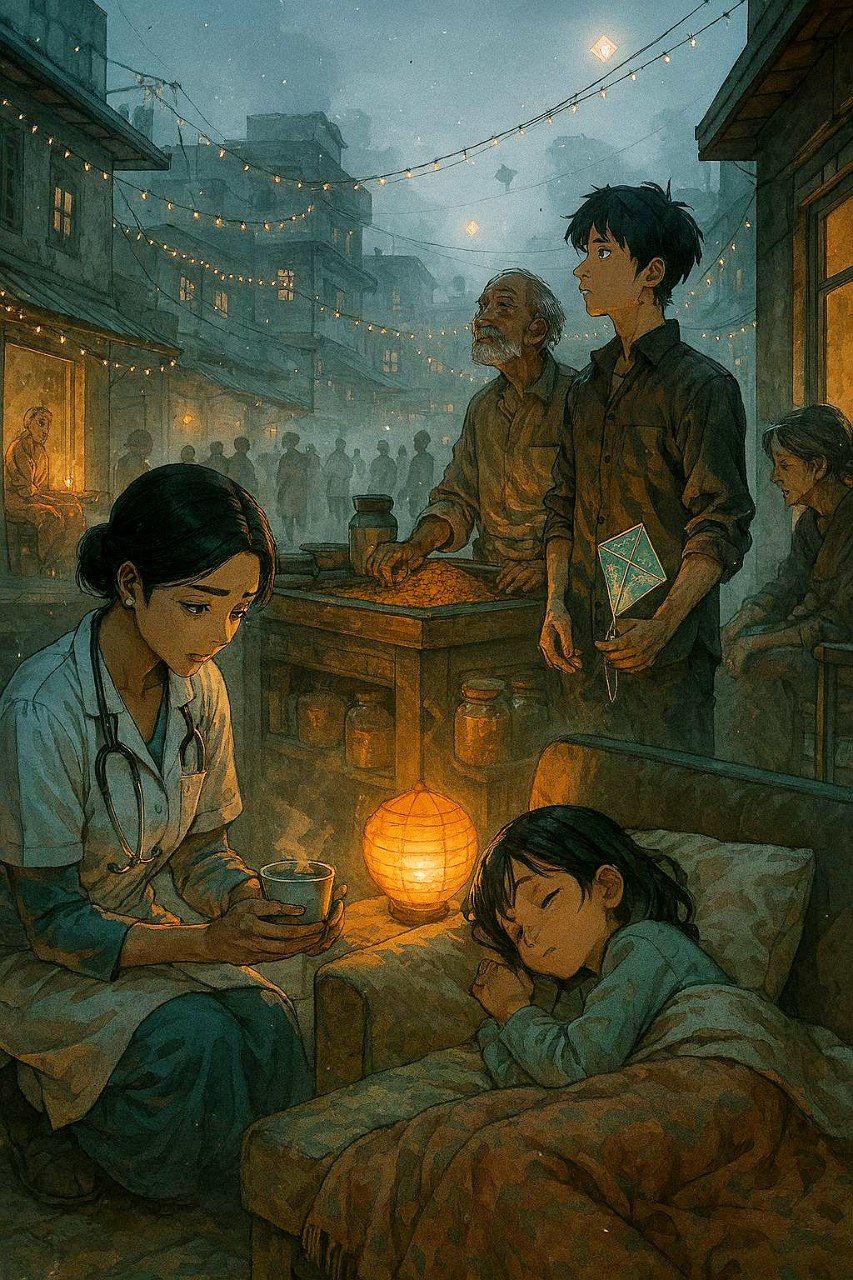
When the first ray of sunlight tried to pierce the dimness, New Delhi was already awake out of obligation: the day after Diwali allows no rest. The city, even as it attempted to recombine itself in clumsy steps, seemed wrapped in a heavy gray sheet that clung to façades, antennas, and people's temples. A metallic smell—part gunpowder, part burnt oil—hung in the corners; tiny bright specks stuck to clothing like ash from a memory nobody had asked to keep. Asha arrived home with the hospital still on her coat. She had spent the night in the emergency room; her hands, used to holding trembling hands and soothing panics, now held disposable masks and gloves stained with antiseptic. The operating theater was not the only battlefield: at reception they took in people choking on smoke and tears, children with burns on their fingers, and elderly patients who arrived gasping, as if the city were denying them air. Dawn left her exhausted but not indifferent. In the living room, Simran slept on the sofa wrapped in a light blanket. Her eyes were glued shut from exhaustion; every now and then a dry cough woke her and set an alarm in her chest. Asha watched her for a long time before making tea. The girl, hair mussed from the forced nap, looked small against the city that stretched beyond the glass. “Mom,” Simran whispered when the cup reached her hands. “Will the lights come back like last night?” “They always come back,” Asha replied, trying to make her voice comforting and ending up resolute. “But next time, we’ll make them differently.” That promise was a thread on which Asha began to stitch something she did not yet know what to call: prevention, hope, resistance. The hospital needed that stitching too. As they drank tea, Asha could hear ambulances in the distance, like tired birds returning to the nest. Each siren was another chapter in the chronicle of that night. A few blocks away, in a tiny shop saturated with the scent of cardamom and clove, Arun shifted spices with the precision of someone who remembers recipes and dates. He was seventy-two; his body had been tempered by an occupation that made him resilient, though his eyes, when he looked at the sky, betrayed a tiredness that was not only physical. The counter remained dusted with fine particles; turmeric beside it shone like a tiny sun. Still, his fingers trembled as he tried to brush the dust off an oil lamp he had kept since times that now seemed distant. Rohan, his grandson, arrived that morning with a stained T‑shirt and a face still lit by the memory of fireworks. He was tall for his sixteen years, hair greasy from a night of excitement. He had dark marks on his palms: traces of gunpowder and adrenaline. “Grandpa,” the boy said as he came in. “You won’t believe what we launched this time.” “I can imagine,” Arun replied. “I can see it in the sky. I can feel it in my throat.” There was a pause between them filled with the noise of the city: vendors calling, radios, a dog trotting aimlessly. Arun looked at Rohan with the severity of someone who has seen his generation repeat mistakes he thought were learned. “Don’t get me wrong,” the youngster continued, his voice trying to soften. “The whole neighborhood did it. People gathered on the rooftops. It was like the whole city took a breath of joy.” “Joy should not cost others,” Arun answered, and in his voice there was less reproach than sadness. “When I was young, we lit lamps in temples and sang in the streets. There was no need to fill the air with this.” Arun spoke like that because memory dictated a past where celebration and prudence could coexist; but he also knew traditions are not fixed: they twist, grow, and sometimes lose their map. In Meera’s house, the neighbor across the way, the morning had a different rhythm. Meera was sixty‑eight and had lived through many Diwalis; her voice held an old, almost ceremonial accent. Sitting in her wooden chair with cold, clasped hands, she lit a small oil lamp and placed it before her like a talisman. The light flickered weakly through the haze that seeped through the window. “Before,” she murmured to herself almost quietly, “the light was softer. It didn’t explode.” Her comment was an elegy for the slow gestures of the festival. Meera kept stories: nights when silence allowed prayer to be heard, laughter that emerged without blasts. Her memories were precedent for the complaints and advice that would soon circulate through the neighborhood. That day, official figures were not long in arriving. The measurements, cold and exact, returned an air quality index that left no doubt: 491. PM2.5 particles recorded 321 micrograms per cubic meter. For technicians those were data; for residents they were a sentence. Asha, who spent the morning at the hospital, received them as confirmation of what she had seen in patients: inflamed airways, red eyes, spikes of anxiety in people who felt the air slipping away. Priya, her colleague, arrived at the door in a rumpled lab coat and a look dimmed by fatigue. They shared that border between duty and impotence. “Can you believe people didn’t see this coming?” Priya said as she came in. “It’s not that they didn’t see it,” Asha answered while arranging clean masks in a row. “It’s that they believed tradition justified excess. There is always a moment when ‘this is how it’s done’ wins over ‘what if…?’” In the neighborhood plaza, tension took the shape of public argument. Teenagers clustered around improvised fires; they spoke of rights and rebellion, but their conversation was energized by the electricity of the previous night. “It’s Diwali!” one shouted, frustrated that his right to celebrate was being questioned. “Since when did a night of lights become a crime?” “I’m not saying don’t celebrate,” another replied calmly. “I’m saying we could find ways to do it without the air paying the price.” Rohan, who had stayed silent until then, spoke with a voice he did not entirely expect. “I don’t regret living it,” he admitted. “But seeing Mrs. Lalita coughing on her doorstep and the kids running scared… I didn’t like it. I won’t do it again without thinking.” That simple gesture became the first thread of a network the neighborhood did not know it was weaving. Regret was not an earthquake: it was a murmur that turned into conversation. Some apologized; others justified the evening with old arguments. Meera, from her chair, listened and spoke with the tenderness of someone who has seen cycles repeat. “Customs change,” she said, looking at people as if distributing an inheritance. “It is not sacrilege to change how we celebrate if by doing so we care for those who are most vulnerable.” Meera’s words acted as an invitation to consider alternatives. Asha, moved by the anxiety she had seen in the hospital and by her daughter’s cough, decided to start the change at school. She spoke with the principal and prepared a talk for students about protecting themselves on high‑pollution days and about ways to celebrate that don’t compromise health. “We can teach children how to make paper lamps,” Asha said. “And explain why avoiding certain fireworks is an act of care.” Priya, for her part, proposed organizing a community brigade to inform neighbors and help distribute masks and filters to those who needed them most. Not a grand gesture, but a concrete one. Rohan, propelled by youthful energy, thought of something that combined his love of tech with the desire to keep the night’s thrill. “We can make kites with LED lights,” he proposed at an improvised meeting in the plaza. “They don’t explode, they shine. I’ll teach the kids how to make them.” The idea was met with initial skepticism and then with enthusiasm. Arun, who had first looked on with reproach, offered his stories and sweets. He coughed a little more that morning, but when he spoke, everyone fell silent. “When I was young,” he said, “festivals were full of stories. We can tell them again. Give them flavor without burning them.” That small coalition of intentions took shape. There were no official proclamations or grand banners; the community began to work out details: buying materials for paper lamps, designing illuminated kites, recruiting volunteers to care for the elderly and children on high‑pollution days, coordinating with the school. The neighborhood that had overflowed in noise the night before now organized itself around care. Meanwhile, hospital shifts continued. Asha carried the burden of seeing the immediate effects of pollution. An elderly woman refused oxygen out of pride; a father wept because his little daughter could not breathe; a young couple argued about whether to punish their son for lighting firecrackers. Each case was a life story that rooted change in everyday reality. One afternoon, to crown the learning process, the community organized a small fair in the central plaza. It was not a huge event but it was symbolic: tables with materials to make paper lamps, a stall to assemble lighted kites, a tent with information on pollution and health, and a small stage where Meera and Arun told old Diwali stories—not as nostalgia but as instruction. Children arrived curious; some still had remnants of the previous night in their pockets and the trembling desire to feel it again. Rohan patiently taught how to build kites; his voice shook the first time one rose into the air and did not explode but blinked with cool, safe lights. Simran, with small hands, folded a paper lamp with Asha’s help, and when they lit it, it produced only a contained flame and a big smile. “Mom, it looks pretty,” Simran said, and relief showed in her voice. “I know,” Asha replied. “And next time it will be just as pretty.” Cleaning the city would not be immediate. For days the haze lingered, forcing adaptations: schools closed temporarily, fewer people on the streets, businesses with less traffic. But in that time the community learned to look with different intensity. The bonds forged in need—help for the elderly, food bags for those who could not leave home, volunteers to discourage illegal firework sales—created a network that, hopefully, would survive the fog. One night, weeks later, people gathered again in a closed, protected park. There were no fireworks; instead illuminated kites rose into the sky, paper lamps floated on a pond reflecting the moon, and elder voices recounted stories that required no explosions to be memorable. The celebration was modest, almost austere compared to what came before, but longer in time and meaning: it lasted several days in workshops, activities, and meetings. Rohan looked at his grandfather and noticed eyes that had once been heavy with guilt now shining with a mix of pride and relief. Arun, hand on the sweets table, felt that an old lesson had found an echo in the younger generation. Meera, perched at the edge of the plaza, lit her lamp as a sign of continuity. When Asha returned from the hospital that night she found Simran asleep with a folded kite at her side. She wrapped her daughter in a blanket and watched her. She thought of the promises she had made and those others had made quietly. There were more nights to face, decisions to negotiate, habits to change; the path was not just the novelty of a reinvented tradition but the patience to sustain it. That season’s story did not become law across the entire city, nor was it the treasure of an immediately attainable utopia. But in the streets of that neighborhood, in hospitals and homes, a possibility was forged: that celebration could coexist with responsibility, that light need not demand smoke as payment. They learned that memory is malleable and that what is celebrated today can be preserved for posterity without destroying the breath of those present. New Delhi had breathed smoke that time; but also, more quietly, it began to inhale the idea that joy should not mortgage the community’s health. The city was not cleaned instantly, but it changed the way it looked at the sky. And in the hearts of Asha, Arun, Meera, Rohan, and Simran remained the conviction that if they changed how they lit the heavens, they could continue to light what truly mattered: the clarity of a shared future. Source of the images. Image created with Bing.
2 comments
Such a good story.
Thanx 🙂