 @mc5punk
more from that month
@mc5punk
more from that month
Short story: Neon Tide
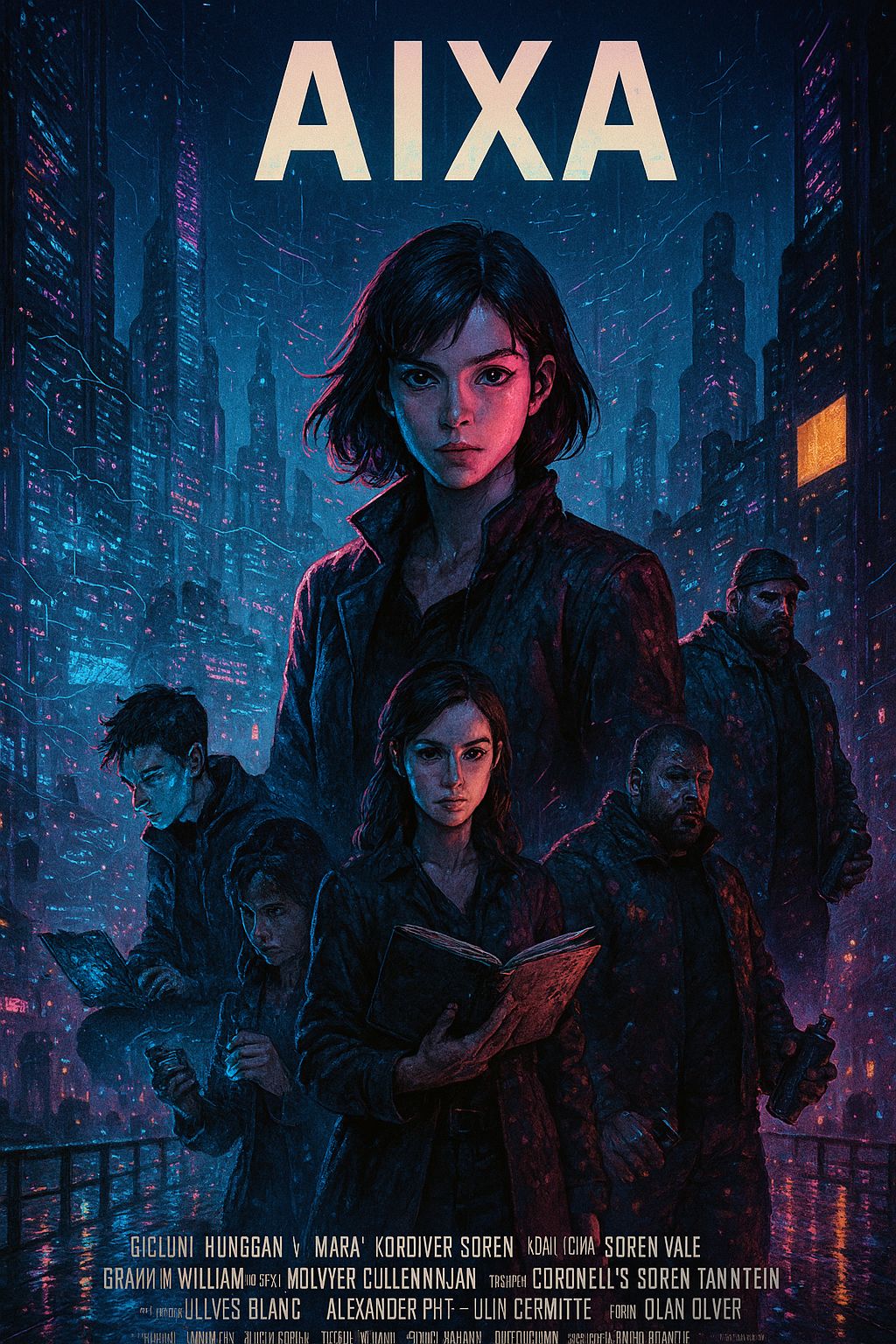
**Chapter I - The City in neon tide** The towers of the plutocratic monarchy cut out the sky like glass fangs, bleeding advertisements that stuck to the skin of the rain. Its summits were crystal gardens where contracts and reputations were incubated; its facades projected figures and faces that smiled with the rehearsed smile of one who should not doubt. Down below, between moving walkways and electric canals, the city was breathing in sync with the data engines: transactions, reputations, decrees. The high officials called this balance Dynamic Harmony — a kind name for a destiny-calculating machinery - and the language that legitimized this balance was called cultorology: an academic and administrative apparatus that transformed myths into indexes, rituals into protocols and affections into bar graphs. In the depths, where cables become roots and asphalt becomes wet memory, Aixa learned to read the city by its seams. He grew up in tunnels that smelled of rust and stale coffee, human mouths ventilated by graffiti that spoke of departures and escapes. She was a poet and a saboteur: she wrote sentences that sometimes stuck on the eyelids of sleepers and other times detonated in the center of speech. His notebook was studded with metaphors and diagrams; in it, verses were aligned with emotional intervention schemes, as if the insurgency also demanded a cartography. His creed was simple and dangerous: words shape flesh and city, and he who masters language gains the skin of the other. On the surface side the Guardians operated: executives in leather suits and eyes calibrated by interface, colonels who measured truth in probabilities, cultorologists who spoke in matrices and administrators who looked like marble entities. At the head of that central apparatus was Colonel Soren Vale: elegant figure, temperate voice and face cultivated for the cover of speeches. Vale embodied the functionalist theory applied to the entire city: every institution, every rite and every consumption should have a place and a function. Stability, for him, was a mathematical condition. The subterraneans had their own allies: Lucho, a linguistic hacker with quick hands and tired eyes; Mara, a clandestine psychologist whose smoothness of voice concealed a sharp logic; Ivo, a giant graffiti artist with carpenter's hands who turned walls into memories; and Ana, a waitress at a bar called Nostalgia, which functioned as a human node between both worlds. They were craftsmen of intervention: they did not seek to bring down towers by force, but to reconfigure the words that supported those towers. The culture war was not born in an afternoon of headlines or in a decree: it was incubated in ciphers, in small interferences that eventually became open contention. The Guardians launched the Dynamic Harmony 2.0 project - dubbed by themselves "the Formal Closure" - a comprehensive upgrade of the symbolic infrastructure of the city. Their algorithms not only managed material resources; they redefined festivities, awarded honors and regulated public language. With improved cultorology they could predict tensions, reallocate symbolic subsidies and neutralize dangerous rituals. For the bureaucracy, the world had to be optimized like a factory: minimize noise, maximize order. Aixa saw in the update a threat that went beyond censorship: it was the transformation of language into calculation, the domestication of desire. He gathered his network in a wet room under the bridge of the old station. On the table: homemade projectors, semi-illegal neural patches, folios with verses that were instructions. Mara held a neuroparche between thin fingers and said in a no-nonsense voice, "It's not enough to sabotage the signal. People have to be taught to feel outside the protocol; if they calibrate the emotion, they will tame us again."Lucho tapped the screen with a dry gesture: "I can open a window on your filters. Brief window, lethal window: twenty minutes. Ivo smiled with that mixture of tenderness and hardness: "With twenty minutes and ink, we tore down a symbolic statue." **Chapter II - Operation Relearn** The operation was called, without rhetorical enthusiasm, Relearning. Relearning did not seek to impose a new dogma; it sought to recycle perceptions. In a world where vital cards issued rank reminders and payments per second, the tactic was to return to the citizen small acts of agency: naming his fear before offering his name, reciting a verse before collecting a subsidy, breathing in a smell that was not on the official menu. In the moonless early morning, Aixa divided its network into strategic routes: coffee line, canal bank and augmented reality nodes around the floating plaza. Lucho assembled low-frequency transmitters: noise boxes that emitted encrypted metaphors; Mara calibrated neuroparches that induced micro-tremors in the area of language and tested them in a trusted group; Ivo prepared murals that acted as memory sticks, QR codes that did not lead to propaganda but to voice files with grandmothers counting songs. At the Nostalgia bar, Ana changed her daily practice. Before: "What do you want, customer?"Now, without a script, I was asking: "What do you dream about when you turn off the app, Ernesto?"A man at the bar, who usually answered with his position, stopped. His fingers fiddled with the cup. "My name is Ernesto," he said, as if breaking a label was an act of trembling. "I am afraid that I will never be a child again."The phrase fell like a coin into a puddle. The neuroparche located in an anonymous listener replied a pulse: a new word emerged from his throat that no one expected: "anchor". The word is not an occupational category; it is body, root, weight. Ivo's murals connected hands with memories. A teenager scanned a QR and heard his grandmother's voice talking about orchards that were not measured by cultorology before. For the first time in years, the official narrative was cut off by sounds that were not foreseen by the tables. The Keepers detected anomalies: affective spikes that their models dismissed as noise. Cultorology marked deviations, and Vale sent calibration equipment. These came with paternalistic accounts: state therapists offering "adaptive wellness," language inspectors with eraser devices and drones to clean up any impure traces. But the underground strategy had already learned: they used sensory overload as camouflage. Electronic ink projectors left verses stuck on the cameras; simultaneous performances saturated channels that the algorithms did not expect, creating gestures that did not fit into their lexicon. **Chapter III - Crash on the Floating Square** The monarchy's annual gala was a ritual in which order was displayed as sculpture: live broadcast, synchronized luminaries, sponsors who were emblems of concentrated wealth. The floating square, a glass amphitheater on the main canal, was the stage to tear to pieces any act that dared to contradict the liturgy. Aixa chose that place for a big intervention: if the public language was broken at the heart of the broadcast, the official narrative would lose its pulse. The plan was set up as a precise choreography. Lucho compromised a twenty-minute infiltration window; Mara temporarily deactivated the emotive blocks on the perimeter network; Ivo and other graffiti artists planned a fall of drones loaded with sonic ink filaments—threads impregnated with particles that, when resonating, modulated the auditory and visual perception of whoever received them. Aixa prepared a poem-artifact: a piece that would not only evoke images, but would incorporate semantic triggers designed to activate primary memories in the listener. The action was violent and almost ceremonial. When the transmission started, Lucho cut redundancies and opened the gap. A chain of voices emerged from the crowd: Aixa climbed to the stage and recited with terms that seemed to shake the metal of the square. "You have counted our absences in scales," he said. "Today we will count presents that do not fit on their tables."His words weren't just lines; they were charges that exploded inside the attendees' headphones. The patches that Mara had inoculated — some clandestinely - made old nursery rhymes seep into the memory of those present. Those who had become accustomed to saying their position recited grandparents' names; those who measured in dollars uttered words of loss. Colonel Soren Vale ordered immediate containment. The Guardians deployed drones with containment pulses and affective neutralization devices: fields that stunned language, mild shocks that clouded immediate memory. The square erupted into choreographed chaos: poetic networks tangled with antennas, human shadows ran between columns of digital smoke, and the official transmission collapsed. In the confusion, physical confrontations took place: adapted knives, cables turned into whips and fists that knew the weight of misery. In the end, the gala was silent outside; the screens of the towers showed only an emptiness, a blank that revealed that the machine had been touched on its most vulnerable string: the narrative that legitimized the city. **Chapter IV - Psychology as a Shield** After the skirmish, the city did not return to its previous pulse. Operation Relearn had introduced a new pattern: affective disruptions that inhabited the social body. Aixa and Mara realized that the battle was not only for the word but for the answer: if they taught citizens to modulate their affection, technological manipulation would be less effective. With psychology turned into a shield, the population could wrap words in layers impenetrable to sensors. Mara articulated teaching programs that seemed like simple exercises: in markets, sellers learned to respond with metaphors; in hospitals, clinical diagnosis was completed with a sentence in verse; in a neighborhood school, children practiced naming fear out loud before learning to read a list of instructions. These practices did not seek to subvert for the sake of the gesture, but to create an immunity: if the state tried to measure and normalize the responses, the inhabitants would return gestures that the algorithms did not know how to understand. The Guards reacted with greater sophistication. His cultorology developed affective sensors, devices intended to quantify emotional intensity in real time: cameras that analyzed microgests, microphones that detected tones and algorithms that pretended to infer motivations. Calibration nodes were installed in squares, hospitals and schools. But the more they tried to fix affectivity in numbers, the more it escaped them: the population mixed tones, invented semantic passwords, and used hypnotic rites that disoriented readings. A salesman who recited a multiphase sonnet to give change made the sensor attribute the measure to "cultural fragmentation" and did not act. Bureaucratic tools encountered something they could not simplify: human ambiguity. **Chapter V - The Night of Language and the Formal Closing** When the Guardians saw that the intervention lacerated their possibilities of control, they ordered the definitive Formal Closure: an update of the city that would recalibrate all public communications, rewrite signs, redefine voices and replace potentially subversive gestures with neutral phrases. It would be, according to his memos, "the symbolic cleansing that will restore stability." The poets responded with the Night of Language, an operation of maximum audacity. It wasn't just about performative resistance; it was a massive denial of the expected words. During the night of the Closure, the city was covered in a silence that was not absence, but coded language. The screens showed fragments of songs from before the Harmony, but interrupted; advertisements showed blanks with wind sounds; people stopped using titles and were named by smells, by the sound of one's own breathing, by the texture of pockets. An official who recounted the night in his report the next day said simply: "There was a lottery of names." In the central square, Soren Vale, who was walking guarded by his escort, met Ana. She offered him a glass of water, a simple gesture and deeply subversive in its context. - Colonel, would you rather smell the rain or keep your post? - Ana asked, as if offering a choice on a menu. Soren hesitated, and for the first time the breastplate creaked. "Call me Soren," he said, and the request was a fracture. A thread of humanity ran through the uniform: a name without hierarchy. The scene was not dramatic in the official press; it was intimate, and for that very reason devastating. **Chapter VI - Breakups, truces and adaptation** With the partial failure of the Formal Closure, the monarchy did not collapse: it retained its towers, its access to capital and its privileges. But his symbolic hegemony had been damaged. Cultorology, once an indisputable orthodoxy, began to hiss: some academics were forced to recognize affective variables in their models; certain officials accepted —with reluctance — dialogue tables with representatives of the underground to avoid more public scandals. The negotiations were of exquisite political precariousness. Symbiotic agreements were accepted: controlled cultural festivals but with improvisation spaces; official "affective resilience" programs that in practice taught meta-response techniques; permits for muralism that turned city walls into legible only by those who knew how to decode them. These measures were presented by the monarchy as gestures of openness; by the underground, as tactical victories conquered by dint of ink. In the corridors of the academy, some cultorologists half explained: "We have detected an emerging variable of affective resonance."In less formal offices, officials learned to ooze poetry in their reports to soften the tone, whether out of prudence or genuine discovery. Aixa continued to write and teach affective immunization methods in clandestine workshops; Mara organized emotional clinics; Lucho dedicated himself to storing lyrical binaries on camouflaged servers. **Epilogue — The Echoes that Remain** The changes did not bring back the purity of either side. The war had no absolute winners: the monarchy still held economic and formal power, and the underground preserved its daily resistance. What changed was the texture of the cohabitation. The city began to breathe with two rhythms: a calculated one that circulated resources and maintained infrastructures, and an improvised one that insisted on naming wounds and joys out of the picture. Aixa returned to her notebook, where she wrote down verses, sequences of emotional reactions and action diagrams. He visited, as a rite of passage, the cultorology salons and left lines there that he did not allow to be catalogued. Once, Soren found her in one of those lounges and sat down unescorted. He didn't come to stop her; he came to understand. — Why are you still writing? - he asked, with a sincerity he hadn't shown in years. "Because words must touch the skin so as not to be corpses," Aixa replied. If we leave them on boards, they die. Soren opened the notebook, read a short line and closed his eyes. "Maybe there's something we didn't know how to measure," he muttered. "Maybe that's what saves us."It was not a reconciliation, but a recognition: the existence of the unpredictable within the calculation. Ivo's murals kept lighting up alleys; Mara's neuroparches were sold in illegal little bags with instructions that read like poems; Lucho kept a replica of a broken window on his server, in case it ever needed to be opened again. Ana kept asking about dreams in her bar, and many began to answer with the words they had forgotten. The city, flooded with neon, had learned to live with its own contradiction: power was sustained and invention persisted. Sometimes, on the nights when the electric tides collided on the docks, citizens wondered who won. The answer - like a verse that refuses to be completed - was uncertain: maybe no one, maybe everyone. And in that doubt, language remained a weapon and psychology a shield; and in that double face the city found its improbable beauty, a beauty that burned at the margins and that would continue to defy any attempt to tame it. Source of the images. Image created with Bing.
No comments yet