 @mc5punk
Short story: Cliff in the Mist
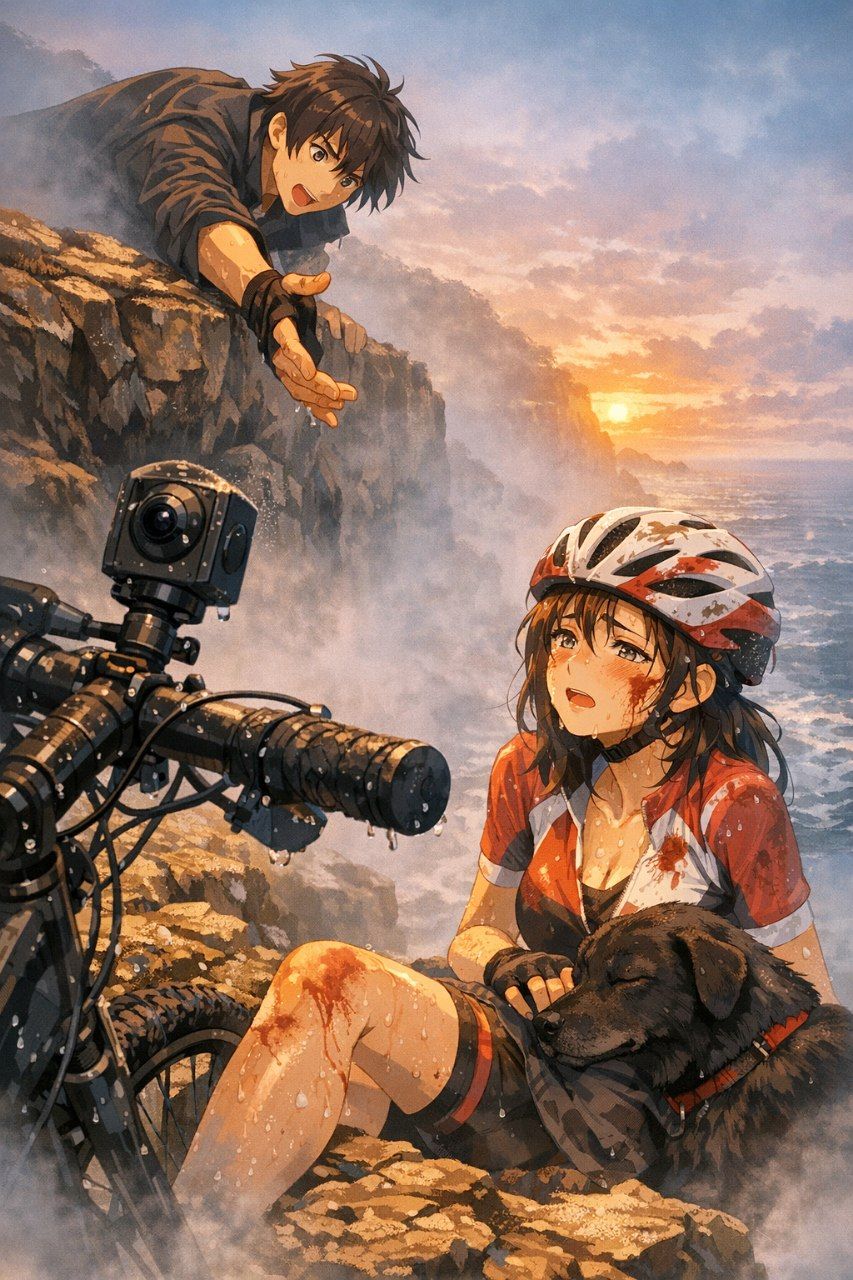
The mist had arrived early that day, like a blanket slowly spreading over the coastline. The smell of salt and seaweed mixed with the cold mineral scent of the rock; the wind, irregular, brought gusts that toyed with hair and cycling clothes. The coastal trail — a narrow ribbon of gravel, stone, and slippery slabs — traced the cliff’s edge with a dangerous precision. Every meter seemed designed to remind those who rode it how close they were to the void. Marta Olmedo glanced at the horizon one more time and then looked back at her handlebars. The 360 camera she had carefully mounted on the mount was slowly turning, recording everything in silence. It wasn’t out of vanity: she liked keeping a record of her routes, the precise memory of the landscapes, the chance to revisit a day. Also, her route-and-landscape channel gave her a bit of income; but what really drove her was the search for those hours when the world seemed to shrink to pedaling and breathing. At her side, calm in contrast with the route’s tension, trotted Lúa, a medium-sized dog with dark fur and a focused gaze. Lúa knew the trails as if they had been mapped together: she didn’t run ahead, didn’t get distracted by gulls, she simply kept presence. She was the perfect companion. “Come on, Lúa,” Marta murmured as she adjusted her speed. “One more stretch and we stop. Do you see that light? Today looks good.” Marta’s voice sounded steady, perhaps because she was used to holding calm even while her body pedaled at the limit. Behind her came Hugo Díaz, a friend from other rides, with whom she shared maps and coffee. Hugo kept a few meters’ distance out of caution; both knew that a slip in that section could be costly. “Don’t go too far,” Hugo called without forcing his voice, his figure cut through the mist. “If you get ahead, the camera won’t tell us the exact ending.” Marta laughed with a hint of fatigue. “I’m not planning any finales today,” she replied. “I just want the wind to let me see the sunset.” The trail narrowed even more and the rock became smoother. The morning’s humidity had left a treacherous gloss on the slabs, turning the passage into a question of rhythm and trust. Marta calculated the braking, measured the weight distribution, but nature, capricious, had another idea. The front wheel hit a sheet of rock covered in algae and moss. In an instant, that small slippery patch broke her balance. The bike skidded; the handlebars twisted toward the edge and Marta’s body projected forward like a marionette whose strings had been cut. The world seemed to split: sound and light in an untamable fraction. The scraping of rock filled the air, a rasping metallic noise; the 360 camera, faithful and impartial, kept rotating, capturing the woman who fell and the bicycle that, in its trajectory, drew a suspended warning sign over the void. Lúa, loyal until the last second, stopped, her paws planted in the dirt, eyes fixed on Marta. “Marta!” Hugo shouted when he saw the fall. “Marta, hold on!” Hugo’s voice tore the mist, a rope flung in desperation. But gravity had already pronounced its sentence. Marta slid several meters, dragged across the rock with her body in direct contact with the cliff’s edge. Every centimeter burned her skin. She tasted blood and sand. For a brief flash she thought of everything she had left to cycle: work, quiet sunsets, the routine that now seemed so far away. In the midst of the pain, her right hand found something: a sharp crack, a small ledge that, cruelly, was going to be her lifesaver. Skin gave way, her palm tore against the stone, but the muscle responded. Her body lodged itself. For an extended second, no one breathed; time tightened like the strings of a harp. The bike ended up lodged on the edge, like an iron figure pointing into the void. The handlebars hung, the rear wheel swung with hypocritical slowness. Helmets, Marta’s jacket, all the everyday items piled into the scene with a new, intimate gravity. “Don’t look down!” Hugo shouted as he finally reached the rim, breath ragged. “Stay still, don’t make sudden moves.” Marta squinted. The view was a mosaic of gray sky and the sea’s foam far below, a depth that seemed metallic and eternal. Lúa had come closer and stayed by her side, resting her head on Marta’s thigh, as if with that gesture she wanted to hold her. “Lúa,” Marta whispered with a broken voice. “What would I do without you?” The dog answered with a soft whine and licked Marta’s hand, insistent, patient. It was a simple, powerful contact amid the chaos. Hugo looked for a way to help. He reached the edge as far as the rock allowed, dug his fingers into the rim and extended his arm with all his might. “Hold on, I’m going to pull your hand,” he said, though he knew one hand wouldn’t be enough. Fear gripped him — a mix of adrenaline and the cold that comes when danger is real. Marta tried to obey. She used her left hand and shoulder as points of support, dug her boots into tiny ledges, bit the air. In a strained voice she said, “I can’t climb up… the bike is heavy and my leg…” — a grimace of pain contorted her face. “Pull on me, with everything you’ve got,” Hugo ordered, though the command was more prayer than instruction. She grabbed his hand and with an effort that was more will than muscle, managed to pull herself to a ledge where the rock made an embrace. Her legs trembled like stems in the wind; blood pounded in her throat. Hugo helped her to sit up. They stayed there, both sunk on the edge, breathing hard. “Jesus,” Hugo said, releasing a hoarse laugh that was more disbelief than relief. “You could’ve gone to hell, Marta.” His hands shook so much he didn’t know whether to check her wounds or to cling to something that proved this was real. “Thank you,” she replied, without irony. “Thank you for coming.” Sirens were quick to arrive. The following hours were a choreography of lights, commands and hands moving with precision. A rescue team rigged ropes and, with pulleys, secured the bike and stabilized the site. A medic examined Marta: cuts, bruises, hyperventilation. Her lips, dry and grazed by salt and stone, cracked into a weak smile when they told her there were no serious fractures. Meanwhile, the 360 camera, recovered a few meters down among the rocks, kept recording the rest. Its memory card would soon contain images viewed by hundreds, then thousands. On the recovered screen the initial footage showed the mist, the ribbon of trail and then the rupture of balance; after that, the descent, the bike lodged, the hand seeking a ledge and Hugo’s arrival. All in a continuous sphere — objective and terrible — that left no room for gentle interpretation. Marta watched the rescue footage of her fear. She felt a mix of shame and gratitude: shame because a reckless act had been exposed; gratitude because chance had placed Hugo at the right moment and because Lúa hadn’t abandoned her. On the stretcher in the assistance vehicle, Marta had time to think. Not about likes or numbers, but about the chain of decisions that had led her there: the choice of route, the camera mount, a minute of distraction, the pleasure of the light. She also remembered the voices of those who had asked why she exposed herself so much. Today that exposure had come due. “Don’t post this,” Hugo whispered as he helped her fasten her jacket. “We don’t need people to see how the abyss brushed you.” Marta looked at him, tired. “I don’t know if I can delete it,” she answered honestly. “But I do know I don’t want people to think this was a feat. It was luck and a bad decision, and two helpful hands.” They returned home as night fell. The mist had thickened into almost fog. Lúa walked calmly by her side, indifferent to the stories others would tell of the episode. Inside the apartment Marta dropped her backpack in a corner and closed the door with the soft click that announces safety. Lúa settled in her usual spot; Marta sat at the computer and opened the folder where she kept the recordings. The file with the incident date blinked on the list, like a small digital heartbeat. Marta selected it without haste and let the video play silently. Watching it, she saw her own body moving with the same strangeness one sometimes feels when reliving a dream: the fall seemed like another life; she was a mere observer. Victim, protagonist, witness: the roles blurred. She didn’t publish it immediately. There were sleepless nights when the fall replayed in vivid detail: the smell, the scraping, the mouth full of stones. There were days she thought it should serve as a warning, and others when she felt sharing it would be exploiting herself. Hugo visited, brought food and said simple things: that she was alive, that the dog had saved her. His presence was a balm. Finally, she wrote a message that didn’t aim to viralize the scare, but to acknowledge it. On her feed she posted: “I came back. I almost didn’t.” Nothing more. She accompanied the post with a photo of Lúa sleeping at her feet. She didn’t attach the video. She left it in a folder with other memories: routes, sunrises, mistakes. Over time, the wound on her palm left a thin scar, a white line that, when the sun touched it, gleamed like a seam. Marta went out again, but with greater caution. She avoided wet slabs and changed the camera setup: she no longer sought the best shot at any cost. She learned to measure light with a different respect. The routes continued, less daring but equally necessary. She understood that the beauty of the edge doesn’t demand you get to the brink; sometimes looking is enough. The 360 camera stayed on a shelf with dust clinging to its casing. From time to time Marta took it out, cleaned it, and looked at it as one inspects a scar. She knew that if she wanted she could release that footage and stir debate, alarm, mixed feelings. She preferred her memory to be something else: the certainty that a friend’s hand stopped her, the faithful presence of a dog that does not judge, the unexpected strength of a friend who arrived in time. And on stormy nights, when the wind beat the windows again and the tide rose violently, Marta sat next to Lúa, looked at her phone and breathed. She had touched the abyss and, in that brush, had learned something about balance: it isn’t about daring, but about recognizing when to hold on and when to step back. The mist still sat on the shore, as always; the sea neither remembered nor celebrated. But inside Marta there remained a deeper calm, like that of someone who has tested the limit and decided, gently, to ride again. Source of the images. Image created with Bing.
No comments yet