 @mc5punk
Short story: The Sofa That Wanted to Fly (and the Truck That Asked for Runway)
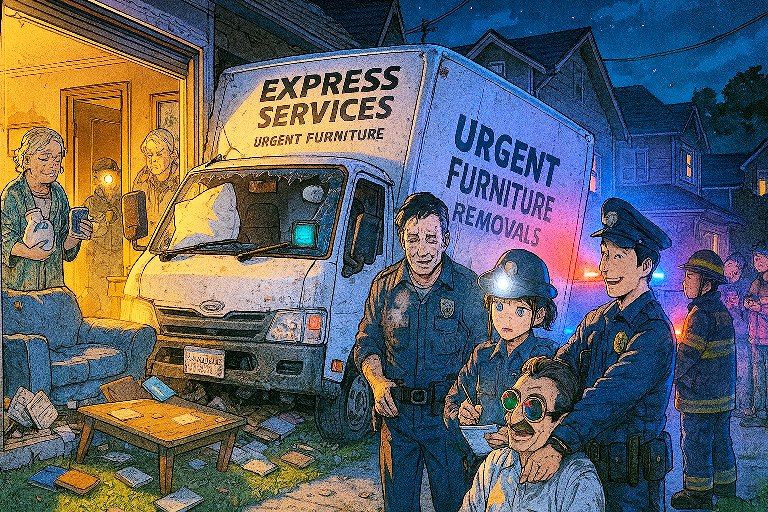
The night had decided to dress itself in calm when, without warning, the neighborhood's silence was shattered by a crash that mixed metal, wood, and an odd chorus of crickets that seemed to ask if all of it was strictly necessary at three in the morning. Darkness was sliced by flashing lights and a column of dust rising from the entrance of a house; in the living room, a delivery truck lay lodged among the sofa, the coffee table, and a collection of framed photos. Óscar, a veteran patrol officer, arrived first. He had smoke on his shirt and an expression that swung between weariness and contained amusement, like someone who has seen accidents but still appreciates the details of a good story. “Did someone say ‘dramatic entrance’?” he murmured as he pushed aside debris with his knee and examined the impact with practical eyes. Beside him, Lila, his partner, searched for prints among the rugs and the remains of what had been an orderly dining area. She wore a headlamp and had a notebook where, with quick strokes, she was already sketching what she would later describe in the report as “evidence with style.” “If the house was on sale, he left it as ‘all-inclusive,’” Lila replied, shaking a pillow that had stuck to the fender. The homeowner, an elderly woman in a floral robe, peered from the doorway with a mix of surprise and dismay. Her brow was furrowed and she held a vase between two fingers as if it contained a fragile treasure. “My porcelain shelf!” she exclaimed in a trembling voice. “Who does this and doesn't even leave a card?” The living room, which moments earlier had been a quiet refuge, was now the scene of an improbable tableau: books scattered, the TV tilted, a lamp hanging by a cord, and, amid it all, the driver trying to sit up. He was a middle-aged man wearing sunglasses despite the night, a carefully cultivated mustache, and a faded T‑shirt with the logo “Express Services.” On the truck door, taped in place, was a sign that read: “Express Services — Urgent Furniture Removals.” The sign fluttered with the drafts coming through the house. “I... I am Mr. Fast,” he stammered, his voice choked by dust. “I was just delivering a sofa. A flying sofa. It must have been the GPS!” Lila looked up at the GPS device hanging from the rearview mirror; on its screen, an arrow bounced over a map with the street name blurred and a loud message: ROUTE: “FORCED LANDING.” Her fingers, smudged with soot, touched the glass with the disbelief of someone watching a bad trick. “Wings on the sofa?” Lila asked, not really expecting a believable answer but wanting to keep her composure. “Did you fit it with engines?” The man made a gesture that was equal parts confession and excuse. “No, no, no,” he said conspiratorially. “It was an experimental magnetic levitation system... or that's what the online tutorial said. Maybe I mixed magnets with permanent magnets; the technical word was… ‘cataclysm.’” Óscar, with the seriousness the law demands but also the calm needed to narrate much of the night, approached with measured steps. He carefully removed the man's sunglasses, like someone lifting a hat to get a better look at a suspect. “Mr. Fast, do you admit you just crashed your truck into a house?” he asked. “Do you admit to endangering the residents and their property?” The man, still dusting himself off as if that might restore his narrative, answered with the mixture of embarrassment and pride of someone confessing a creative mistake. “I admit it was an improvised landing,” he said. “The sofa had wings. I swear it on my grandmother and her spoon collection.” From the opposite balcony, a neighbor filmed the scene on his phone. At the corner store, the shopkeeper had already hung a sign that read: “Tonight: Surprises on the block. Free coffee for the curious,” because in those moments the neighborhood had become an impromptu nighttime spectacle. A child wearing a superhero helmet—because every child needs to be ready for adventure—appeared among the crowd. His eyes sparkled as he applauded without shame. “That was awesome!” he exclaimed. “Is it going to fly again?” The elderly woman, now looking at the truck like someone evaluating a particularly unfortunate museum piece, fixed her stare on the man. Years and experience had given her a coldness only acquired when life has seen you tinker with appliances and not always win. “You broke my living room and my routine,” she said in a voice that, for a moment, sounded sterner than any officer's. “But you reminded me of when my husband tried to put turbines on the toaster. So I'm sorry, young man: the law takes its course. But please, tell your sofa to behave next time.” Her line drew a round of laughter, which served as a backdrop for the arrival of true authority: a patrol car that pulled up with the classic awkwardness of officers who did not expect that kind of scene in that neighborhood. Two more officers climbed out wearing helmets and carrying flashlights. One of them, Martín, a self-described specialist in improbable domestic incidents according to his card, approached with a professional smile. “Mr. Fast,” he announced, “you are under arrest for dangerous driving, property damage, and endangering a piece of furniture with aerial aspirations.” The man, who until then had been walking the line between explanation and farce, allowed an offended expression to surface that was barely performative. “I was just trying to make the delivery on schedule!” he protested. “Besides, there was no signal to lower the sofa's med‑kit backpack.” Martín laughed and produced a pair of handcuffs that looked more like metallic bracelets suited for a comedy. He put them on with care, as if fastening the final details of a stage set. “You have the right to remain silent. Anything you say may be used against you—and could also be recycled for local memes.” Resigned to the inevitability of the situation, the man looked at the elderly woman with a mixture of plea and regret. “Can I at least pick up my YouTube tutorial?” he asked, hope weak. “No,” Lila replied in a dry tone but with a twinkle of humor. “But we saved your sofa's life, and that's all we needed tonight.” As officers escorted him to the patrol car, he turned his head and looked up at the sky as if searching for a cosmic alibi. “I promise the next delivery will be... on foot.” A crew of firefighters, summoned to assess the home's integrity, inspected the place with professionalism and a hint of dry humor. One of them, helmeted and carrying tools, entered and later came out with a verbal report that sounded almost like a common-sense ruling. “Ma'am, the house is fit to remain inhabited, provided it doesn't receive any more rolling visitors,” he said. “We recommend not parking in the living room unless it's Sunday and the sofa is visiting.” The woman nodded, already imagining a sign forbidding nocturnal parking by nonhuman vehicles. Meanwhile, the truck, skewed on the rug, looked weary and defeated; a cushion peeked out from the windshield and hood as if it had attempted to soften an otherwise undignified fall. At the station, among forms, a coffee maker that seemed to have witnessed many nights, and the low murmur of private conversations, Óscar and Lila completed the report with the seriousness an official document requires. Lila, methodical, closed each point in firm handwriting. “What will you write in the report?” Óscar asked, stifling a yawn after a shift that had stretched longer than expected. “‘Unusual incident: unauthorized aerial delivery; subject arrested; sofa rescued,’” Lila replied, pleased with her phrasing. “And add: ‘Recommend: do not follow tutorials that include the word “provisional.”’” Martín, from the interrogation room, couldn't resist one last joke to end the night on a lighter note. “If he has trouble with his GPS again, tell it to do the right thing: turn left... and lower its intensity.” Laughter, the smell of coffee, and the closing of another file marked the end of the shift. In the neighborhood, comments on social media multiplied: the video went viral among local circles and the corner store's sign stayed in the window until morning. The home's actual owner, a freelance young man who had gone out for a night ride, returned when he saw the commotion and photographed the mess, captioning it ironically: “When you order a sofa and get a truck with attitude.” At dawn, the truck was carefully towed away to the impound lot; Mr. Fast waited in a holding cell with a face covered in dust and the feeling that, for the first time in a long while, his creativity had betrayed him. The elderly woman recovered her teacups, though one bore a hairline crack she promised to mend with glue and patience. The child in the helmet, now a budding chronicler, stored the night in his memory—the night the neighborhood's peace was interrupted by a vehicle that wanted to be part of the furniture. Months later, Lila would retell the anecdote among colleagues with a blend of professionalism and amusement. Óscar, for his part, would add a line to his police recollections: not every arrest comes with drama; some come with a sofa and, occasionally, a tutorial. At the heart of it all, an unwritten moral: some inventions belong in a workshop, other ideas need permission, and almost always, a GPS knows less about structural integrity than a firefighter with the look of someone who has seen it all. The city gained a new urban legend: the night a truck decided the living room needed renovation and the police had to arrest a man who defended the noble cause of express delivery and ideas with wings. Source of the images. Image created with Bing.
No comments yet