 @mc5punk
Short story: Leo and the Night of Flames
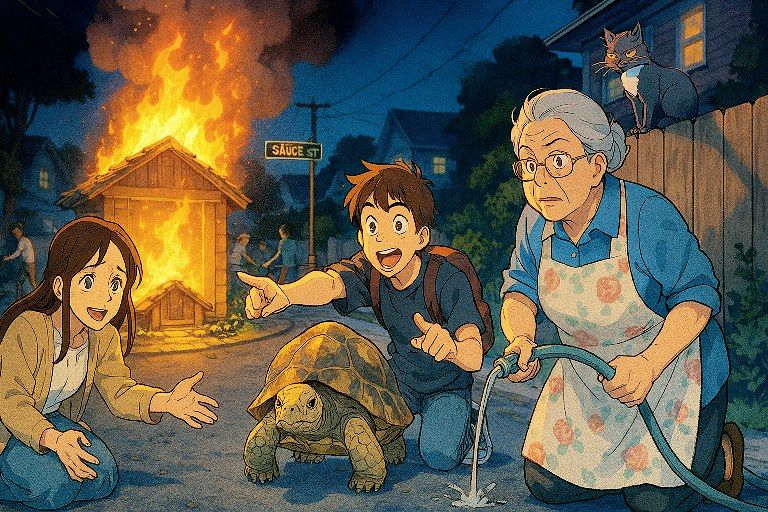
In the dimness of Sauce Street, a mild night was broken by a different scent: hot smoke that warned of trouble. In his little wooden-and-straw shed lived Leo, a mottled-shelled tortoise with a steady gaze who spent his days on lettuce, sun naps, and the calm that comes from knowing haste rarely helps. That night, however, a faulty heat lamp had come loose and set the straw that sheltered him alight. Within seconds, the interior of the shed crackled and woke even the neighborhood cats. Leo rose without hurry. It wasn't that he didn't feel the heat—he did, clearly. But his nature dictated calm; for years he had learned to move with the patience only a seasoned reptile possesses. He pushed the lid of the shed with his snout. The narrow opening was just enough for his head and legs to find the outside; behind him, flames licked the wood and the air filled with an unsettling red glow. From the fence, Efraín, the stray cat known for his sharp tongue and love of drama, fretted in his usual theatrical way. "What on earth are you doing, little tortoise? You'll melt!" Efraín cried, raising a paw as if that could stop the fire. Leo looked at him with his customary calm. He did not speak human words, but in his expression there was a message of contained composure. "I'm not in a hurry. I just need to get out safely," he seemed to reply in his own language of pauses and glances, legible to those who knew him. Efraín overacted, for his own entertainment and the neighborhood's. "Easy for you to say... you've got a helmet!" he muttered dramatically. Meanwhile, next door, Doña Rita—the elderly neighbor with gardener's hands and a nose for trouble—smelled smoke from her garden and did not wait for the disaster to grow. "Tomás! Do you have the hose? The tortoise shed is on fire!" she shouted, with the voice of someone who won't accept delay. Tomás, a tech- and tool-loving teenage neighbor, kept an eye on the security cameras he'd installed on his property. Seeing the first live images, he leaped from bed and ran, tool backpack on his shoulder and flashlight in hand. "Right away, Doña Rita! I saw it on the camera—let me grab the footage!" he called, unable to resist capturing events for later editing into something epic. Mara, Leo's owner, arrived at the scene from the corner; her face mixed panic, remorse, and a hurriedness that contradicted her usual absentminded librarian demeanor. "My Leo! Is he okay? Damn the lamp!" she cried, dropping to her knees a few steps away when she saw that Leo had already made it to safety. Leo, safe for the moment, turned his head and positioned himself as one who knows how to forgive but not forget. For him, that look was enough to hold any reproach at bay. Mara let herself fall to the ground and placed a trembling hand on the animal's shell. "Little one... I meant to buy a new lamp tomorrow," she confessed in a broken voice, part promise and part apology. A silence filled with human looks followed; Tomás, however, couldn't resist turning the event into audiovisual material. "Look at this footage! The camera recorded everything. It's action cinema!" he announced, showing the security camera recording on his phone. On the screen, Leo walked with slow, steady steps while the shed behind him began to collapse with theatrical creaks. Doña Rita, practical as ever, already had the hose in hand and her eyes fixed on reducing the flames. "Get that shed wet before the wind turns it into a drama!" she ordered, and Tomás handed her the hose without thinking about the camera for once. The neighborhood mobilized within minutes. Some brought buckets; others, rugs and shovels to remove smoldering straw. The cooperation unfolded like choreography, as if Sauce Street were one organism responding to danger with reflexes of solidarity. While Doña Rita and Tomás extinguished the embers and secured the perimeter, Mara and Leo sat on the porch. Tomás proposed turning the footage into a mini-documentary; Doña Rita suggested options to rebuild the shed and protect it from future misfortunes. "I promise not to use lamps unsupervised. And you, Leo... I'll give you extra lettuce," Mara said, trying to ease her anxiety with small promises. Leo looked at her with a gravity that seemed more like that of an old sage than a household pet. "I don't need extra lettuce. I need you to watch over my nights," he appeared to say, a gesture that blended humor and seriousness. Tomás, imagination already fired up, looked up eagerly. "If you want, I can install a video system and a sensor to alert us if the temperature rises. I can even add sound effects," he offered, half joking and half serious. Efraín, who had returned to the scene and settled on the fence like a critic ready to pass judgment, seized the opportunity to add a snarky remark. "Sound effects? That sounds like an opera! 'The Fugitive Tortoise, Act One,'" he quipped with a crescent-moon smile. The next morning, the community woke determined not to let the mishap go unaddressed. Leo's shed became the object of a collective rebuild that, in short order, turned disaster into a lesson in good workmanship. Under Doña Rita's practical guidance and with neighbors' hands, a new structure rose: a stone base to isolate it from flammable ground straw, reinforced walls, and a tiled roof that promised greater safety. Around it, a band of gravel was laid to prevent combustible material from reaching the structure; Doña Rita planted fire-resistant succulents around the perimeter—small green guards meant to temper any stray spark. Tomás, proud of his technological contribution, installed a new camera with a wide angle and a thermal sensor that would send alerts to Mara's phone if the temperature climbed beyond normal. With a blend of pride and teenage tenderness, he also placed a small speaker to play "calming" music for tortoises according to his own technical-musical judgment. "Done! Now if it heats up, we'll get an alert. And I put calming music for sleeping," Tomás announced, receiving a round of thanks. Leo, curious, stepped up to the small door Mara had painted in green letters: "Casa Leo." He tested the entrance with a foot and paused before the speaker, imagining the strange rhythms that might reach his reptile ears. "Calming music... sounds dangerous," he seemed to say with a hint of suspicion. Mara laughed and shook her head, explaining aloud as if Leo could grasp every human nuance. "It'll be music for tortoises: slow rhythms, no electronica," she said. Efraín, from his perch on the fence, rolled his eyes theatrically. "Slow rhythms? Are you going to play a waltz? Better not start with flamenco—makes me want to dance and ruin everything," he joked, and laughter closed the day of communal labor. In the days that followed, the footage captured by Tomás's camera circulated through neighborhood chat groups and became a story told in plazas and doorways. Leo was transformed, unintentionally, into a local celebrity: the tortoise who escaped a fire with dignified, unhurried steps. Messages of support arrived, offers to repair sheds were made, and shelter design proposals were suggested. Doña Rita fielded questions about fire-resistant plants; Tomás earned the reputation of "the technician who saved the tortoise," his phone ringing constantly with safety advice requests. Efraín, meanwhile, was enshrined as the neighborhood's unofficial theater critic, always ready with sarcastic commentary on any new episode. One golden afternoon, Mara sat on the porch with Leo on her lap while Doña Rita gently watered the succulents that now formed a small protective ring around the shed. Tomás, from the gate, was already imagining the final edit of the video: slow-motion shots, triumphant music, and Leo's silhouette advancing like a silent hero. "I promise you safety and fewer flying lamps," Mara said solemnly as she stroked the shell. Leo, with the expression the Sauce Street residents had learned to read, seemed to accept the promise without melodrama. "As long as there's lettuce and attentive neighbors, we can survive any fire," he seemed to conclude, a sentence that rang more like a principle than a mere observation. Doña Rita raised a watering can as if it were a cup in an impromptu toast, and the whole street celebrated the tortoise's safety with the same communal spirit that had rebuilt his home. "For Leo, the slowest and the cleverest among us!" she cried. Tomás was already planning the heroic finale for his video. "I'm going to edit a triumphant ending. Leo in slow motion?" he suggested, and dozens of possible images began to run through his mind. Efraín, from his fence post, capped the anecdote with a comment that sealed the story in humor. "If there's slow motion, I demand credit for the soundtrack," he said, and the neighborhood laughed heartily. The small tragedy—a fallen lamp, a shed in flames—thus became a neighborhood comedy: a shared adventure where care, repair, and solidarity replaced loss with learning. Leo went on with his days as calmly as ever, but now with a new shed and more watchful neighbors. From that night on, walks down Sauce Street came with tales of slow heroism, of how foresight sometimes saves more than haste, and of a neighborhood's boundless ability to come together when a tortoise decided it was time to move forward—not running, but moving with quiet resolve. Source of the images. Image created with Bing.
No comments yet