 @mc5punk
Short story: The Light of Mei
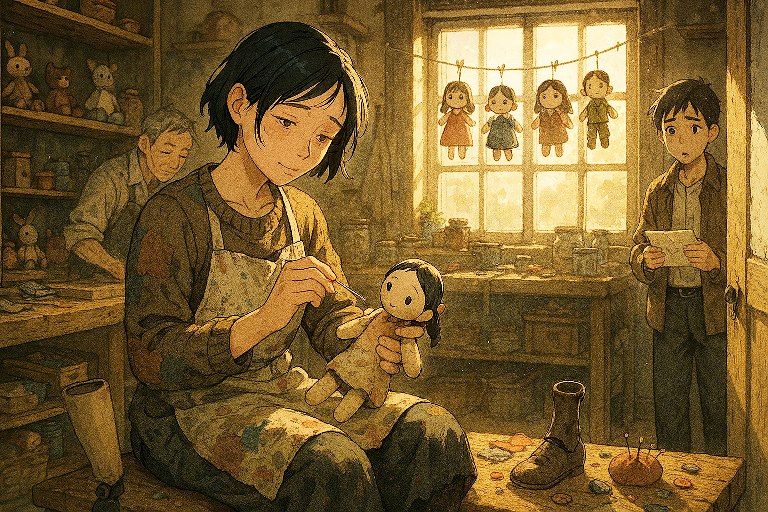
Mei Lian was twenty-three when the doctor told her, in a measured voice and tired eyes, that the tumor had consumed a large part of her femur. The sentence hung in the air like a heavy object no one wanted to pick up. She had spent years with architecture notes and afternoons shared with her family in a worn apartment; now the promises of blueprints and trips were replaced by consultations, surgeries, and a painful decision: amputation of her right leg. The operation was a succession of hours of white and anxiety. When she woke, the room smelled of disinfectant; the sheets stuck to her skin. She felt an emptiness where the limb had been, and an unfamiliar cold in the pit of her stomach. Her parents watched her from the doorway with reddened eyes but said nothing about how they would pay for treatment, prosthetics, or care. Two months later, one night without ceremony, they left the keys on the table and her mother closed the door without looking back. They had made the cruelest decision: to flee a responsibility that had become unbearable for them. Loneliness, at first, struck like a physical blow. There were no hands to hold the sheet when the fever rose, no calls reminding her to drink water. The neighbor, Mrs. Huang, visited during the first weeks bringing rice and tea; then the visits became less frequent and eventually stopped. Mei had to learn to manage the pain, the medications, wound care, and the new frustrating logistics of life with a prosthesis packed in the corner. However, despite the abandonment, Mei decided she would not let illness define her existence completely. The university offered her the possibility of continuing the semester remotely; her request for online exams was accepted. She returned to her architecture notes with hands that sometimes failed from weakness. She drew holding the pencil tightly in her left hand, bracing the paper on a tilted table. It wasn’t the same fluidity as before, but each line she traced was proof the human routine endured: get up, study, breathe. One day, while searching a box in the closet, she found scraps of fabric, buttons, and thread her mother had kept for years. They were sewing materials, relics of a domestic skill the family had always considered secondary. Mei, out of curiosity and need to occupy her mind, began to sew. The first doll she made had an imperfect smile and one eye larger than the other; holding it, a surprise ran through her: the awkward, endearing piece gave her a sense of purpose. Without much pretension, she took a photo and posted the image to an account she named LuzMei. She wasn’t seeking fame or pity; she simply wanted to share something beautiful she had made amid pain. She wrote a brief caption: “Handmade, for whoever needs a smile.” She didn’t imagine those words would kindle a flame. As days passed, small sales began to arrive. At first they were sporadic purchases from university friends and neighborhood acquaintances. Each doll carried a small patch with a hand-sewn star and a note inside: “For the one who doesn’t give up.” The photos accompanying the posts showed not only the toys but also trembling hands, scars, and the determination of someone rebuilding themselves step by step. Soon those human elements became the essence of the project: they sold not only dolls but stories. The online community grew slowly until it became a solid network. People from different neighborhoods wrote to tell her how a small doll had been given to a sick friend or a child in a hospital. On nights when anxiety tightened her throat and depression called her to give up, messages from strangers reminded her that what she did mattered. “Mei, how do you keep going?” a follower asked in a live stream on a gray afternoon. “I lost my job and don’t know if I’ll get up tomorrow.” Mei looked at the camera: the scar on her thigh, the prosthesis at her side, her tired face lit by the screen. “Because I didn’t choose to stay in the dark,” she answered slowly, with a controlled voice. “I don’t have another option but to look for light wherever I can. Sometimes I fall, of course. But I get up and sew. I get dressed and go on.” The words resonated. People began sharing their own stories of falling and rising, turning the space into a virtual square where vulnerability was not weakness but a currency of hope. One day, Raúl, a carpenter from the block who had spent his life with wood and patience, saw her at a local fair where she’d put some dolls on sale. With a rough voice from years of breathing sawdust, he offered her a place in his workshop. “You have an architect’s hands,” Raúl said one afternoon in the workshop, where light sifted through dusty windows. “With patience, everything fits. I can teach you to work wood; many of your dolls would look good with small wooden pieces, a base, something to make them more durable.” Mei accepted. In the workshop, amid sawdust and tools, she found the warmth of a shared routine. Raúl, a widower and solitary man, discovered in the young woman a companionship that awakened in him an interest he thought extinguished. While they sanded planks and tested designs, they talked about life, mistakes, and second chances. “Why did your family leave?” Raúl asked one evening as the sun began to set. Mei put down the sander and sighed. “Out of fear and lack of resources,” she replied. “They felt overwhelmed. I understood, but I didn’t accept it. It hurt as much as the wound.” The support network continued expanding. A group of students organized a small exhibition at the university to sell pieces made by vulnerable people; they displayed her designs and dolls. Among the audience was Clara, a nurse who had worked many years in pediatric oncology. Moved, Clara approached Mei after the presentation with an envelope in her hand. “I can’t pay for everything,” Clara said with a trembling voice, “but I want this to help you not feel alone again.” Inside the envelope was a mix of donations and a list of people and professionals willing to help: physiotherapists, psychologists, and doctors offering free consultations. These small, concrete, human helps began to recompose what rejection had dismantled. They offered support not only for physical care but also for emotional reconstruction. Not everything was a sequence of victories. There were nights when sorrow overcame her and she deleted posts for weeks. During one prolonged absence, she received a handwritten letter in trembling script from her younger brother, Jian. He didn’t have the courage to call; the letter was his way of approaching without risking rejection. “I was wrong,” the sheet read. “I didn’t know what to do. I didn’t know how to face the shame I felt; I thought if I left it would be better for everyone. I want to see you, even just to say I’m sorry.” Mei read the letter in Raúl’s workshop while the wind carried the smell of sawdust and coffee. Her hands, stained with paint and glue, trembled holding the page. She didn’t seek revenge; she replied with a simple invitation: coffee in the plaza where they used to go as children. When Jian arrived, thin and with red eyes, Mei’s first reaction was to contain the avalanche of resentment she had accumulated. She looked at him long, measuring each word. “You were my family,” she said firmly. “You owe me a lot, but today you owe me honesty.” Jian began to speak in fits, explaining social pressure, fear of what people would say, the sense that his sister’s illness would drag them into ruin. He cried as he confessed that many nights he had thought about returning but had been unable to find the strength. “I was wrong,” he repeated. “I didn’t know how to care for you. I thought running away would avoid shame. Forgive me.” Reconciliation was a slow process. An apology was not enough to heal the abandonment; it required time, small gestures, calls, and visits. Jian learned to ask for help and to attend medical appointments, to handle paperwork and sit in the workshop to talk about trivial things. Little by little, the habit of fleeing was replaced by the practice of being present. The scars of the past weren’t erased, but the new everyday life rebuilt the levees. Despite everything, LuzMei’s story spread beyond the neighborhood. Followers were not just numbers on a screen: they were people who resonated with Mei’s honesty and humility. Letters arrived from parents grateful for a doll that soothed a child in a hospital, messages from people who bought a toy to give to someone in need. Each tale became a mirror reflecting the usefulness of her work. One winter night, when the city lay under a light snowfall, Mei received an invitation to speak at a local conference on resilience. Getting on stage scared her: the idea of exposing herself reawakened the shame her family’s abandonment had left. Still, she decided to go. She covered her prosthesis with a discreet shawl and stepped onto the stage with trembling hands. She looked at the audience: expectant faces, some tears held back, hands clasped. She opened her mouth and, with a voice that faltered at first and then grew steady, said: “I didn’t come here to ask for compassion. I came to say that you can keep dreaming even when something is taken from you. I’m not brave all the time; but I choose to get up.” The audience burst into applause and many left in silence, moved to tears. After the event, a woman approached slowly; sorrow was written in her eyes. “I lost my daughter two years ago,” she murmured. “Since then I can’t find how to stop sinking. Seeing what you do makes me want to try something small again.” Mei hugged her with tenderness and said honestly: “Pain doesn’t define us. It defines what we do with it.” The words were not a miraculous cure, but they were a bridge for the woman; the embrace, a truce that allowed hope to surface, even for a moment. Over time, Raúl’s workshop transformed. What began as an invitation to learn woodworking became a social cooperative. People with difficult histories found an opportunity there: a young man recently released from prison learned to sew and handle tools, a mother left alone after her husband’s death, a teenager with reduced mobility contributed inclusive designs. Mei, who had once been the recipient of others’ charity, now led the collective naturally, believing in an ethic of care. Together they produced dolls, wooden bases, utensils, and artistic objects; more importantly, they created support networks and belonging. During the workshop days they shared stories, learned techniques, and practiced listening. The exchange of skills restored dignity to people who had seen it dwindle in painful circumstances. Each doll leaving the workshop bore a tag telling the maker’s story: a name, a short account, and the phrase “Made to hold.” On a summer afternoon, sitting by the workshop window while sunlight painted golden lines on dolls hanging from a clothesline, Mei reflected on how much her life had changed. She bore visible and invisible scars; a prosthesis that sometimes reminded her of nights of solitude; a family that slowly relearned to be present. But above all, she possessed a certainty she had lacked before: loneliness had been the crucible where she forged her dignity. It wasn’t an epic glory but a quiet certainty that even if the world abandons you, there is an inner source that can be cultivated with work, care, and shared help. Before sleeping, she wrote a note and sewed it into the simplest doll: folded paper, black ink, and a small phrase. “For whoever fears being left alone: hope is learned.” That night the city drew its curtains under the normal noise of cars and footsteps fading into the distance. In the workshop, the light stayed on a little longer. Inside each doll and in the hands that made them, life was celebrated in discrete acts: a well-made stitch, a conversation without judgment, a shared cup of tea. Thus, what had begun as the story of an abandoned young woman became the story of a community that learned to hold one another and to turn pain into creative strength. Years later, Mei continued to sew and teach; her project became a small support network recognized in the city for its social commitment. She never forgot the night she opened the box of fabrics and accidentally found the key to begin again. In every doll, every workshop, and every hand that took hers, remained the mark that hope is not something that appears from nowhere: it is learned, practiced, and shared. Source of the images. Image created with Bing.
No comments yet