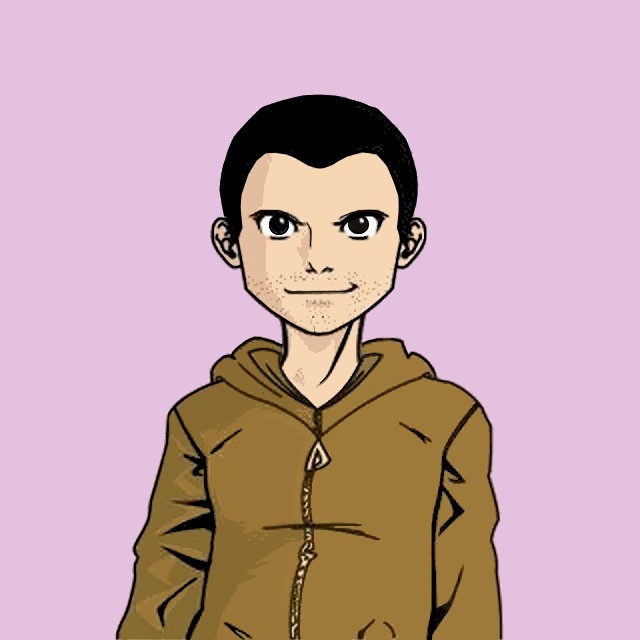
 @mc5punk
Short story: The Camera and the Mirror

Sweat ran down Martín's temple as he adjusted the tripod with clumsy hands that had repeated the gesture until it became routine. The attic room-gym had bare walls, a long mirror with smudges around the frame, and a threadbare rug where dumbbells rested. The blinds let in a strip of golden light that cut across the morning shadows. Martín placed the phone on the mount, chose a filter to soften the highlights, and looked at his reflection once more, practicing the smile that worked on camera: slight, confident, barely human. "Ready," he said aloud, as if addressing an invisible faithful audience. "Three sets, eight reps. Let's go." His voice sounded better outside the silence than in his head. He had the text prepared: discipline, consistency, overcoming. Words that, repeated like mantras in the caption, functioned as both shield and currency. The words were his sales pitch: the promise that behind the sweat there was a coherent, admirable, repeatable story. At that moment the hallway door opened and Camila appeared with a steaming cup of coffee. She was his downstairs neighbor, pragmatic and quick to smile. She leaned against the frame, watching with curiosity more than judgment. "Again at seven," she commented, with the naturalness of someone familiar with neighborhood habits. "Don't you get tired of posting so much?" Martín paused, closed the app, and gave a smile that did not reach his eyes. "It's not just posting," he replied. "It's showing that I don't fall apart. If people see me trying, I can't feel so small." Camila set the cup on the workbench and reached out to touch Martín's shoulder with a brief, neutral gesture. "What if you didn't do it for others?" she asked. "What if you did it for yourself?" Martín tilted his head. The question struck a place he'd always kept covered. "I don't know," he said softly. "When the likes go up something calms down. Like someone telling me I'm enough." Camila looked at him with that blend of patience and firmness she reserved for simple but essential truths. "Then cultivate that without the camera," she suggested. "Not everything valuable needs public validation." Martín dropped his gaze to the dumbbells as if looking for an answer in the metal. He had learned to translate attention into comfort and its absence into emptiness. The camera, the light, the carefully crafted captions: everything was part of the ritual that protected him, albeit with fragile seams. In another city, miles from his attic, Dr. Lara Morales leaned over a folder of notes and graphs. Lara taught at the local university and had translated and adapted Tara Marshall's study for her seminar on social behavior online. On her laptop screen, the numbers took faces and profiles: posting frequency, correlations with personality traits, and interaction patterns. "It's not that posting is bad," Lara murmured, speaking more to herself than to the bookshelf-filled room. "It's the intention behind it. The gap someone is trying to fill." Her colleague Andrés, who preferred the simplicity of data to the complexity of human stories, tapped a paragraph with his pen. "What if it's simpler?" he replied with a shrug. "Motivated people share motivation. Not everyone who posts a set is narcissistic." Lara breathed and closed her eyes for a moment, weighing the response. "Exactly," she said. "But when frequency becomes dependence, when comments dictate the day's mood... that's where there's something to investigate. It's not an automatic diagnosis, but it is a clue about how the person regulates their self-esteem." The research on her screen described how likes, comments and shares activate reward circuits in the brain. Dopamine, that chemical messenger, celebrated each interaction and reinforced the behavior until posting became a habit difficult to maintain without digital stimulus. The conclusion, precise and sober, did not aim to blame: it pointed to a social and emotional dynamic. Martín still felt his palms damp and his stomach clenched by the imminent exposure. His relationship with the camera had developed after years of family silences. He remembered his father—a man of few words who, when he praised, did so with a blunt and spare gesture—and his mother, another distant figure in his memories, distracted by different emotional stitches. In the absence of household applause, the feed had taken that place: instant, measurable rewards arriving as hearts and effusive comments. In the afternoon his sister Daniela found him on the couch, scrolling his profile with a mix of curiosity and concern. Daniela was three years younger, more direct and less composed by others' expectations. "Couldn't you train without getting everyone's attention?" she asked bluntly, folding a shirt with decisive movements. Martín looked at her, wounded by the simplicity of her observation. "That would be too easy," he answered with a thread of irony. "Who would know I did it? Also, when people comment... they tell me I'm on the right track." Daniela gave him a soft look, full of tenderness that did not avoid frankness. "And what happens when nobody comments?" she pressed. The question hung in the air like a warning. Martín didn't know how to answer and stared at the screen as if he'd just received news he couldn't interpret. Days went by and Martín began to notice patterns: the posts with the most interaction were the ones showing visible progress, explicit effort; the more authentic or less aesthetic ones received less attention. On the days he felt worse about himself he avoided posting; those were precisely the days that sank him deeper. He found himself revisiting old posts to count reactions, an archaeology of approval that reminded him of times his worth had been measured by others. At the neighborhood gym, amid the clatter of weights and half-conversations, Martín met Samuel, a trainer with the deep voice of someone familiar with comebacks and breakdowns. Samuel spoke little and listened a lot; his gaze did not judge, it simply observed. "Are you looking for followers or calm?" he asked one afternoon while Martín wiped down a bar. Martín frowned, surprised by the simplicity and bluntness of the question. "I want applause," he admitted, voice breaking. "And if they don't applaud, I feel invisible." Samuel placed his palm on the bar slowly, meditatively. "Acclaim is a social drug," he said calmly. "External validation gives you momentary energy, but it doesn't fix what you don't want to look at in the mirror." Martín thought of Dr. Lara's words: "the intention behind it." He thought about every imagined clap from childhood, how he'd learned to translate attention into self-affirmation. He realized the camera wasn't just a tool but an altered mirror that sometimes returned a made-up version of himself. One night, after polishing a video with precise cuts, exact music and a carefully chosen caption, Martín sat down to read the comments. Among compliments and emojis a line froze him: "All this to hide something?" Signed: @lucia_r. The phrase, blunt and direct, reached into a vulnerable spot. He didn't know her. Out of habitual curiosity—an instinctive mechanism—he opened her profile and saw photos of a serious-looking face, intense eyes, and a bio that read "clinical psychologist." It wasn't the title that pricked him so much as the fact that, for the first time, someone had pointed clearly to the possibility of sadness behind the shine. The next day Lucía left another comment: "If you want to talk, professional or not, I'm here." Martín felt a mix of fear and relief. He wavered between curiosity and shame. He finally replied privately. They arranged a call. Lucía's voice—steady, warm—contrasted with the feed's superficial noise. "I'm not here to judge," she said when they introduced themselves. "I'm here to ask. What do you feel when you post?" Martín hesitated, as if talking about something he'd always kept behind layers of polished words. "Fear... and a need to be accepted," he confessed, voice trembling. "When likes go up I feel I matter. When they don't, I get consumed." Lucía nodded, listening with clinical attention but without losing human warmth. "That sounds a lot like what we call emotional regulation through others," she explained gently. "It's a strategy that works short-term but leaves you more wounded long-term. How would you feel if you tried to recognize your achievements without measuring them against external reactions?" The question opened a door Martín hadn't known existed. In the silence that followed he remembered small victories he'd never celebrated alone: the first time he added an extra set, improved endurance during a bad week, the day he didn't skip training despite feeling low. Meanwhile, at the university, Lara prepared her lecture on social reinforcement and the brain. She used Martín's example (without names or faces) as a case illustrating a social trend: public exposure of the body and effort as status indicators within fitness culture. She showed graphs, compared studies, and above all raised ethical and clinical questions about mental health behind the behavior. "Digital reward activates pleasure circuits," she said. "It's not magical or evil—it's biology. But the clinical question is: what function do those posts serve in the identity of the person who posts? Are they an impulse to improve, or a mask to avoid internal looks?" Her students debated: some defended the community generated by shared training, others pointed to risks when the line between motivation and need blurs. Lara emphasized that posting does not mean pathology; however, frequency, intention and dependence can be indicators of external emotional regulation. As Martín opened up to Lucía and his close circle, an impromptu meeting gathered at a nearby café. Camila arrived with her coffee, Samuel with a notebook of routines, and Daniela with her mix of sarcasm and affection. Between sips and confidences, Martín spoke of an upbringing marked by silence, the lack of family applause, and how the camera had become a plausible substitute. "You could train for yourself," Camila suggested simply. "Without the camera. Just to feel strong inside." "And balance," Samuel added. "Train, post if you want, but don't let likes dictate your day. Make training serve its own purposes, not only performance." Daniela took her brother's hand and said firmly: "Start with one day without posting. If you hold out, increase to two. Do it to find out if what you do belongs to you or if you only do it for the noise." The first day without posting felt like a tight test of endurance. Martín felt restless; the habit of checking notifications chased him. But at noon he discovered a different calm. He trained without turning on the camera, counted reps mentally and refined technique without thinking about framing. In the afternoon, when the urge to open the app arose, he closed it. That night he fell asleep without scrolling through reaction lists and woke up without the compulsion to check his feed. He rose with the feeling that something had changed: small, discreet, but his. It was not a total victory nor an instant cure. Digital culture and comparison remained shadows. A local influencer posted a viral transformation video and got hundreds of thousands of likes. Martín felt a pang of envy and desolation—the comparison was inevitable because networks feed on it. He learned to accept that he couldn't switch off the outside world, but he could decide how to respond. In a clinical session, Lara summarized an idea that resonated: "Exposure can be an act of empowerment or a mask. The difference lies in conscious choice." The phrase became a practical mantra for Martín. He learned to ask himself before posting: am I doing this to share motivation, to celebrate a personal achievement, or to seek applause that reaffirms me? With that question he began to build a more deliberate relationship with the camera. He continued posting, but with a new rule: only when the action had meaning that belonged to him. If he completed a week of realistic, personal goals, he allowed himself a celebratory post. He didn't use it as a measure of his worth but as a record of effort, a snapshot of commitment to himself. When reactions were tepid he breathed, spoke with Camila or called Daniela. He started keeping a notebook where he wrote small achievements he once waited for others to point out: the first time he increased load safely, a session where technique improved, a time he didn't let a bad mood justify absence. Writing became a private substitute for public validation. His relationship with the camera changed slowly. It was no longer the absolute judge of self-worth; it became a tool—sometimes useful, sometimes misleading, sometimes a faithful witness. The need for approval never disappeared entirely; no one promised a miracle cure. But he gained awareness of the habit that pushed him and of the roots of that need. He learned to tolerate occasional invisibility and to seek support in real people who listened without giving likes. He discovered that breath, a notebook, and patience could also be forms of reward. One winter afternoon, adjusting the light for a clip he planned to post for different reasons—self-recognition rather than comment-chasing—Martín looked in the mirror and breathed. He thought of Dr. Lara and her explanation of dopamine; of Lucía and her nonjudgmental offer; of Samuel and his warning about acclaim; of his sister and her practical tenderness. He smiled from the chest, not the surface. "Today I do this for myself," he said quietly before turning on the recording. "And if someone appreciates it, welcome. But if not... I'm still here." The small red recording light clicked on and Martín began to train. This time the repetitions were his; his breath set the pace and the mirror returned a less adorned image: a man learning to fill the gap with discipline, with help, and with the slow practice of accepting himself without depending on digital applause. He recorded the clip and saved it without hurry; when he finished he did not wait for reactions. He sat on the bench, closed his eyes and listened to his breath. It was imperfect, but sufficient. There were relapses: some afternoons he checked his phone anxiously, compared his performance to viral standards, felt tempted to revert to old logics. But each time he gave in, he talked to Lucía or called his sister; each time he allowed himself silence without posting he counted it as a small victory. Over time he posted less often and trained more privately, and in the notebook the list of reasons to feel proud grew. The story does not offer a cinematic ending where everything is fixed at once. Martín never completely stopped needing approval; there is no guarantee the habit will vanish. But he gained something important: awareness. He learned to distinguish when a post was an act of celebration—sharing a reached goal—and when it was a mask to cover an inner absence. He learned to ask for help and to recognize that social media status is neither the only nor the best indicator of who he is. He found support in real people who listened without likes, and discovered that breath, the notebook and patience can also be rewards. One day, while preparing the light for one of those rare, deliberate clips, Martín hesitated and smiled—this time for himself. The camera's small light came on. He breathed, began his set and, when he finished, put the phone away. He didn't look for the screen or approval. He stared at his reflection for a long minute, feeling for the first time in years that his effort belonged to him. The End. Source of the images. Image created with Bing.
No comments yet