 @mc5punk
Short story: The Assembly of Fangs and the Lost Socks
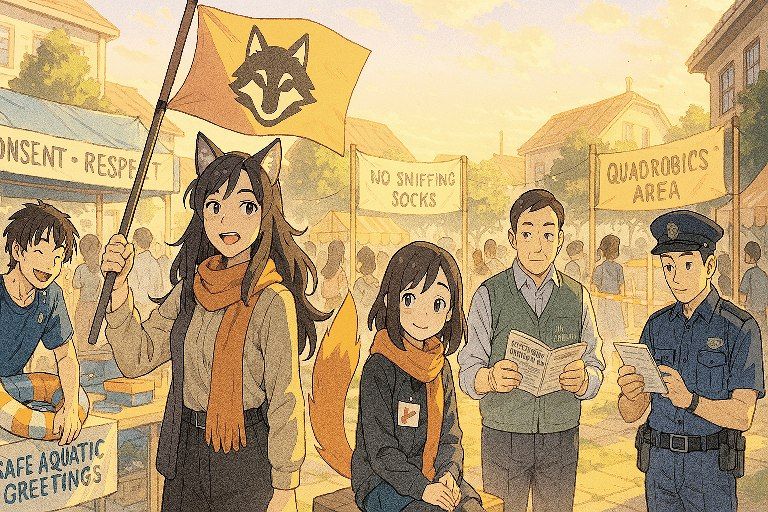
The Flores Verdes neighborhood kept its usual rhythm until the therian community decided to move their meetings from anonymous online spaces to the benches and fountains of the neighborhood. What had once been debates and memes on specialized forums became a visible movement that filled daily communal life with gestures, sounds, and improvised rules. The neighborhood plaza, now renamed Plaza Aurora by the municipality, became the stage for the first large public gathering: a hybrid of festival, community workshop, and performance of identities. Mariana, carrying a flag with a stylized wolf, promoted the event as the “Gathering of Non-Human Identities and Community Wellbeing”: stations for quadrobics, aquatic meditation, and “conscious wing-flapping,” alongside information tables about safety and consent. At the opening, the plaza’s dispersed calm turned into a bustle of laughter, incredulous questions, and distrustful reactions. Ricardo, reading the program, could not hide his surprise at the announced activities. For him and many long-time neighbors, the idea of adults moving on all fours or practicing “olfactory greetings” represented a rupture in the accepted routine of public space. Carmen, meanwhile, walked among the tables with her notebook and her particular request: to recover a pair of socks that, in her imagination, had been marked or misplaced. Valeria arrived accompanied by her mother, visibly trembling. Adolescence already posed enough battles; now she also faced the shock of recognizing herself in something she had until recently only read about in forums. She approached a station where Bruno, still with drops of water in his hair and a permanent smile, tried to explain that greetings could take many forms: hand claps, light hand brushes, or—in community contexts and with consent—a brief olfactory gesture that for some functioned as an affectionate hello. Carla’s concern surfaced in the form of a worry for Valeria’s safety and for the boundary between identity expression and invasion of personal space. Recently, local news had reported an incident in Córdoba: a minor who said she had been sniffed and bitten on the ankle by a group identifying as therian. The story circulated in the plaza as a warning: activism for recognition could collide with physical and legal limits. In a later meeting inside the community center, tensions turned into denser conversations. Ricardo spoke with the voice of someone who believes he is defending the neighborhood’s tranquility: his childhood, his habits, the calm of a community that knew its limits. His discomfort was not only aesthetic; he felt a fracturing of a guarantee—how could coexistence be upheld when symbolic codes were changing? Mariana appealed to empathy and explanation: for those who called themselves Therians, the practices were not mere performative habits but manifestations of a deep identity, sometimes linked to psychological or neurological experiences that defied simple explanations. Her strategy was to propose clear rules: they asked not for privileges but for respect and consensual boundaries. Carla insisted on vulnerability: her daughter was fourteen, and exposure to poorly understood physical gestures placed her in a complex situation. Valeria, sitting quietly, described the mixed sensation of discovery and vertigo: sometimes she imagined herself with a tail when she climbed the school roof; other times she feared that part of her would define her irrevocably. Her voice, halting, asked not to be reduced to a single trait or exposed without protection to public scrutiny. Bruno, from his place, sought to offer the perspective of those who integrate the therian identity into daily life without seeking confrontation: many lived with the sensation as part of their neurodivergence, a way of feeling their body and surroundings. For him, the lesson was practical: establish norms and protection mechanisms to prevent identity expressions from turning into behaviors that hurt or frighten others. Officer Pérez, with his notebook and procedural tone, took note of the claims and proposed a bridge: protocols to protect minors and vulnerable adults without criminalizing the identity itself. His intervention revealed the legal and social tension: the need to preserve public order and physical integrity while recognizing emerging rights. Humor soon appeared as social lubricant. Mariana formally proposed a “Greeting Protocol”: identification cards for each theriotype that specified the preferred form of greeting and required explicit consent; rules for public events (delimited aquatic zones, volunteer medics, prohibition of physical greetings with minors without parental authorization); workshops teaching alternative greetings; and a clear complaint system for behavior that crossed established boundaries. She also suggested ironic yet practical measures—like signs forbidding the sniffing of other people’s socks—which, far from trivializing the issue, relieved tension by introducing a shared code. Ricardo received the proposal with reluctance but, after reading the cards and hearing concrete cases, agreed to negotiate. His question about what would happen if a card read “ceremonial bite” prompted laughter that, paradoxically, opened the first crack toward compromise. Carla demanded guarantees: nonnegotiable limits and immediate response mechanisms in case of incidents. Valeria proposed painting her imagined wings on her card so others would know how to accompany her without alarm. Carmen, with dry humor, handed Mariana a pair of socks as a token of truce—on the condition that nobody would mark her wardrobe with canine or feline scent. The agreements materialized into a set of measures: signage in the plaza with clear slogans about consent; separate zones for aquatic activities and quadrobics; first-aid volunteers at events; a direct line for complaints; and informative ID cards for participants. The municipality, through Officer Pérez, committed to mediating and reviewing regulations to balance freedom of expression with the protection of minors and peaceful coexistence. Over time, coexistence acquired nuance. Quadrobics began to take place on Sunday mornings within a fenced perimeter and with identification vests. Bruno organized a “safe aquatic greetings” station with flotation devices and strict contact rules that attracted curious children and cautious adults. Carmen, initially suspicious, ended up teaching knitting workshops in exchange for the newcomers promising not to mark her belongings. Ricardo, who had arrived intending to preserve an unaltered neighborhood memory, began to accept small changes: seeing Valeria at the top of the park’s windmill, carefree with an orange scarf simulating a tail, made him rethink old prejudices. Valeria perhaps underwent the greatest change. With clear rules and her mother’s support, she could explore her identity without unnecessary exposure to risk. She learned to translate her impulses into social signals: the wings painted on her card bridged her internal experience and others’ external reading of her behavior. Carla, seeing that the community had adopted protective mechanisms and a channel for complaints, calmed down: her daughter’s exploration could be accompanied rather than exposed. Flores Verdes did not become a mystical sanctuary or a protected identity reserve, but rather an urban laboratory of coexistence. Neighbors constructed routines and boundaries; the Therians learned to translate intimate practices into public norms; local authorities found ways to regulate without pathologizing. The measures—a mixture of common sense, humor, and political will—created a framework that reduced incidents and, above all, opened spaces for dialogue. At an end-of-season fair, the plaza displayed a mosaic of activities: a quadrobics competition, Carmen’s knitting table, a tent with manuals on greetings and consent, and a stall where Valeria sold small booklets with wing drawings and advice for adolescents experiencing similar sensations. Ricardo and Mariana met at a table to symbolically sign a poster reading “Mutual Respect: Clear Limits, Express Consent.” When Mariana asked Ricardo if he would participate in the tournament the following Sunday, his reply was a modest concession: “I’ll check the forecast… and wash my socks.” That sentence, spoken with a contained smile, was a small victory: an acceptance that public life can adapt, with rules and tolerances, to a plurality of experiences. Coexistence remained unresolved; doubts, awkward episodes, and the need to keep negotiating persisted. But the neighborhood had taken a step toward a more complex understanding of identity: not as an exception to be expelled, but as a reality that demands limits, education, and, when appropriate, a sense of humor. In that imperfect weave, a broader coexistence was stitched: one that recognizes differences without renouncing the protections that allow all people—regardless of the species with which they identify—to move through public life without fear. Source of the images. Image created with Bing.
No comments yet