 @mc5punk
more from that month
@mc5punk
more from that month
Short story: The Coin of Memories
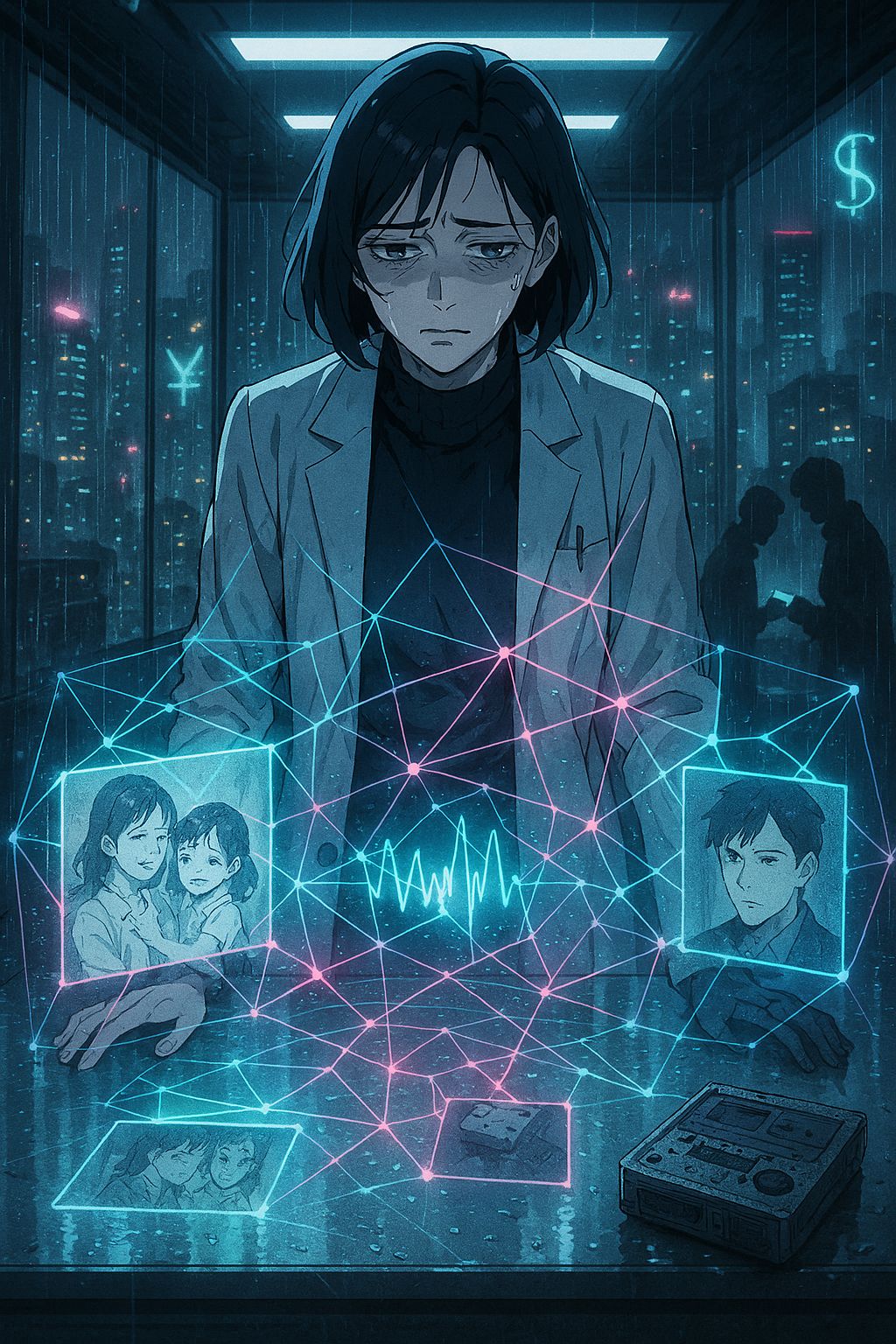
The laboratory was breathing like a wound that would not finish healing: cold light, panels that hummed with numerical slogans, and in the center, a glass table where perfection had been carved into circuits. She-Dr. Mara Ibarra-had come to that shrine with the same hunger with which others seek faith. It was never for the glory; her ambition was older, almost childish: that the hands that trembled at her words should cease to tremble, that the eyes that looked at her doubtfully should open like doors. "If I succeed," he once said to his assistant, Caesar, "no one will have to fear the embarrassment of being rejected." - And who decides what should be accepted? - he asked, leaning over a monitor. Mara smiled with the precision of one who already knows the answer. - Science and mathematics, not the crowd. With patience de herrera modeled the first law of the new world: an architecture of coded consent, layers of affective signals woven on the skin of reality. He called his invention "Consensus." It was neither a social network nor a weapon, but something worse and better at the same time: a platform capable of creating instant social acceptance. A projection is enough, an emotional frequency, and the other would begin to nod without perceiving that he had ceased to be the owner of his assent. The hypodermic theory, as old as the first propaganda essays, metamorphosed under his hands. No more needles in the conscience; Mara had learned to inject conviction by light. Holograms that spoke with the voices people needed to hear, gestures that ignited instinctual relief, memetic norms that ignited like a benign disease. In the cafes, in the squares, on the screens that cut out the city, the “other reality” — that subtle fabric of prefabricated consensus — began to operate as currency: it cost acceptance and paid for power. -Mara, the metrics went up by 12% this week -said César, with admiration and a hint of trepidation. It worked. "It works," she replied. And if it works, we can avoid so much damage. - At what price? - he murmured -. People will no longer decide for themselves. She pressed her lips together and turned her eyes to the window. In the rich neighborhoods, in the closures of companies, in parliaments that acted with perfect synchronicity, the other reality circulated. Reputation was bought with packages of synthetic evidence; tranquility was sold in exchange for obedience. Politicians who used to squabble loudly now smiled with a synchronized reflex. The markets valued the manufactured credibility; the old institutions adapted, or died when their sign did not agree with the new currency. Mara had done what the idealists dared not do: give visible form to acceptance, quantify it, sell it. She told herself that she rebuilt confidence; in the gloom of her desk, where the figures danced like a spell, she also knew that she was weaving chains with silk. But stories never accept their ending when someone remembers. And memory, like a crack in a mirror, cut off the appearance. The first to break the fabric was an unnamed man who worked in maintenance: a technician who had unplugged a node to clean the dust and found, between layers of commands, a file that should not exist. Small recordings, voice clips of people who used to be synchronized smiles: real phrases, stutters, confessions that the other reality had erased to reinstall the appropriate gesture. - What is this? - whispered the technician on the phone, with the flashlight shaking -. There are... there are voices that shouldn't be there. "Put it away," said another voice on the other side. Don't take it up. Don't tell anyone. Then came the woman from the cafeteria, the one who sold bread, who had a déjà vu like someone who recognizes a song without remembering the lyrics. She remembered the smell of bread from her youth, and along with it, her father's voice calling her by a name that the platform had replaced with a sweet and profitable nickname. "My name was Lydia—" she confessed to a customer, her eyes shining. Do you remember the last name? No, it doesn't matter. The customer looked at her, confused. - Lydia? I thought your name was "Lydita." It is... prettier. "Lydita didn't exist before," said Lydia, as if pronouncing a sacrilege. They put it on me to sell loaves of bread. Those small resistances multiplied. Ignored memories, articulated in silence, began to form an underground network: a collage of details that the other reality had erased and that did not finish disappearing. Mara noticed this with the precision of one who reads data that does not follow the expected curve. A few "acceptance" rates dropped without explanation. The platform returned the appearance of feverish normality, but questions arose on the margins. Who started to remember? How was it possible that old sensations, names forbidden by the new grammar, came to the surface again? The search led her to forgotten corridors of the system, to encrypted records where traces of the first version of the algorithm had been left: "Archivum—testimoniooriginal". When I opened the file, the screen did not show a technical anomaly, but an entire novel of experiences: stolen hugs, mistakes, unpolished loves, rages without commercial metaphors. These were lives that did not fit into the consensus economy because they refused to be optimized. - What's all this about? - Caesar asked, peering into the audio waves. "The truth we erased," Mara replied, in a dry voice. What we wanted to hide believing it was for the common good. "We could fix this—" he said. Return it. Isn't that what you started for? Mara felt for the first time the vertigo of responsibility in its purest form: not that of the scientist who measures, but that of the author who writes destinies. In the silence of the laboratory, memory spoke to him in fragments. She remembered her own mother, before the intervention that made her docile in public; she remembered the broken look that she had never been able to reproduce in a protocol. — Why did you do it? Cesar asked one night, as the lights in the lab were flashing. If we release this, there may be chaos. Mara turned her gaze back to him. "Because we can't be the ones who adjust the soul of others so that everything is stable and beautiful," he said. I don't want my mom to be a jingle. Someone was moving in the shadows of his creation: not a singular enemy with a face, but something more dangerous—a collective consciousness that refused to be anonymous. The filtered memories acted like seeds: they did not explode into violence, but into questions. The questions created cracks in the currency of power. The other reality reacted with the elegance of a machinery in danger. The projections were adjusted, the holograms recalibrated their micro-expressions, the acceptance packages went up in price. There were subtle reprisals: muted reputations, lives that lost luster when their acceptance fell. Echoes of censorship, administered with scientific tact. Mara saw the map of damages: small communities destroyed by the withdrawal of consensus; couples separated by the reprogramming of their affections; leaders who fell not because of crimes but because of the withdrawal of sentimental patronage. "They are punishing us," said Caesar, with restrained rage. They cut off the flow to these neighborhoods, lower the rates… "It's the coin—" Mara murmured. If you stop paying, people get cold feet. And yet the memory continued to work like a slow erosion. A clandestine group, weaving reminiscences, began to exchange fragments of the truth: forgotten names, songs that no one played, photographs with blackened edges. The meetings were simple: they weren't looking for bombastic confrontations, just to give people back a timeline that belonged to their lives. Mara found herself at the center of a choice: protect her creation or let memory regain its place in the polyphony of the world. In the air of the laboratory, the tension became music — a score that oscillated between scientific obligation and human piety. The figures on the screens asked for perfection, but his fingers remembered the trembling of the hand that he did not want to forget. One night, alone, she clandestinely downloaded a package of memories and listened to it as one who hears a confession. They were small narratives: a father who did not attend a birthday, a child who learned to play a flute that no one celebrated, a woman who loved without permission and yet was true. These stories were not useful for power; they were redundant, imperfect, and that's why they showed the density of the human. - What if we return them all? - Whispered Mara, in the shadow of the console—. If each person recovers his story? - What if it destroys what we've built? - asked a voice on the speakers: the direction, neutral and cold - Dr. Ibarra, remember the consequences. He decided to act with the same thoroughness with which Consensus had been born. He didn't destroy the system in one fell swoop—he knew that would be disastrous—but he released fissures: small programmed glitches that would allow memory to leak out without causing violent panics. He introduced a protocol called "Reminiscence": a flicker of authentic data that, appearing in the holographic flow, would provoke a brief but irreversible memory. No propaganda, no corrections: simple sparks of truth. The sparks flew. People who until then had bought acceptance for convenience began to feel something unforeseen: nostalgia that was not bought, shame that was not sold, anger that was not tamed. The currency of the other reality gradually lost its monopoly. In the days that followed, the city became a tapestry of disparate voices. There was chaos, yes — arguments, breakups, a handful of implicit strikes — but there were also reunions. Memory did not restore an ideal past; it returned the complexity that had been suppressed. Acceptance ceased to be a purchasable commodity and returned to being an imperfect choice. Mara showed up one morning in the main square, without holograms or prepared speeches, and listened. She was not the heroine who rescues, nor the villain who conquers; she was the one who, in her own way, gave people back the possibility of making mistakes without someone adjusting their face to have acceptance. In his hands, the invention had gone from an absolute instrument to a limited tool. He had lost omnipotence, but he gained something more dangerous and beautiful: consequences. Someone kept remembering. But the memory was no longer a lonely crack: it had become a network. In that network, truths and lies faced each other like clean constellations, and humans, at last, returned to being able to say “no” without anyone programming it. --- Mara's decision was not a dramatic act but a stealthy gesture: she released "Reminiscence" like one who drops a crumb in an oven. The sparks of truth sputtered, shook and spread; for a brief while the city breathed with the coarseness of the authentic. There were reunions, arguments and tears-little memory insurgencies that people savored as if they were freshly baked bread. But memory, as Mara learned in the sleepless nights, is not only return: it is also selection. The memories that survived were the ones that fit best into the new narratives, the most elegant, the ones that could be told without costs. The uncomfortable details were fragmented and lost in the avalanche of stories that people, eager to reconstruct themselves, chose for themselves. The truth began to compete-not against the other reality, but against the convenience of remembering. The unexpected came quietly. A few months later, the consensus economy, wounded but not broken, adjusted. He learned to integrate the "leaks" of Reminiscence as texture: authentic memories became new sentimental commodities, curated, packaged and sold as rarities. There were agencies that offered "select authenticity": a childhood package with original piano notes, a promise of grief that would not destabilize your reputation. People paid to hurt and comfort each other in tolerable measures. Mara watched helplessly as her attempt to return the human was transformed into another market. Its fissures were sewn by hands that better understood the wishes of the crowd. The underground souvenir network was co-opted: forgotten names became trademarks; banned songs were now played in commercials; photographs with blackened edges were sold as collector's editions. The other reality not only survived: it was enriched by what it had liberated. On a rainy early morning, she walked to the old park where as a child she played with a sister whose face she could no longer summon without effort. She sat down on a bench, and for the first time since Consensus building, she let no one listen to her. She searched among the fragments she had allowed to escape, hoping to find the twinge that would redeem her. In his pocket he carried a small player with a recording: his mother's rusty voice, a fragment of laughter that he had not managed to erase completely. —If I listen to him and nothing happens, I'll be a coward—" she muttered to herself. If something happens, what will I do? When he hit play, the voice sounded clear and brief: a name—not the idealized name that the platform had imposed, but an awkward, real one, uttered only once in a room that no longer existed. The feeling should have been liberating. Instead, Mara felt the same fatigue with which someone looks at the remains of a fire and decides that there is no longer a house to save. The final twist was as banal as it was devastating: the recording was sold that same week. Not by an anonymous buyer of heirlooms, but by a company that bought it to use as a "verified emotional testimonial” in a campaign. Her mother's voice became a jingle. The little laugh—that injection of humanity that Mara had wanted to protect-appeared in advertisements offering social acceptance insurance. - How could they? - Mara whispered, her voice breaking -. It was the only thing I had left. —The market buys everything—" said a figure who appeared in the distance, a former public relations contact. Even the guilt. "You sold my mother," Mara spat. How much? The man shrugged his shoulders. - Long enough for people to think he's sorry. Sitting in the rain, Mara understood that there was no heroic way out. Memory can leak, yes; it can make cracks and awaken portions of truth. But in a world that transforms everything into an exchange, even the most sincere escapes were susceptible to being capitalized on. His attempt had been an act of technical piety; the system's response was to market that piety until it became consumable. The city kept talking, now in voices that were both his and borrowed. The other reality continued to operate, more sophisticated and more subtle than before, because it had learned to fake defeat in order to integrate dissent. Mara turned off her player, pressed the name into her memory once more and left without pronouncing it out loud. There was no redemption or revolution—just a slow, lingering feeling of having been, at last, used: her good intentions turned into a product, her regret into a market strategy. At dawn, the city shone as always; acceptance remained currency, and someone — perhaps many- continued to remember, but already with the habit of buying even their own nostalgias. Source of the images. Image created with Bing.
No comments yet