 @mc5punk
more from that month
@mc5punk
more from that month
Short story: The First Step — Memory of an Afternoon
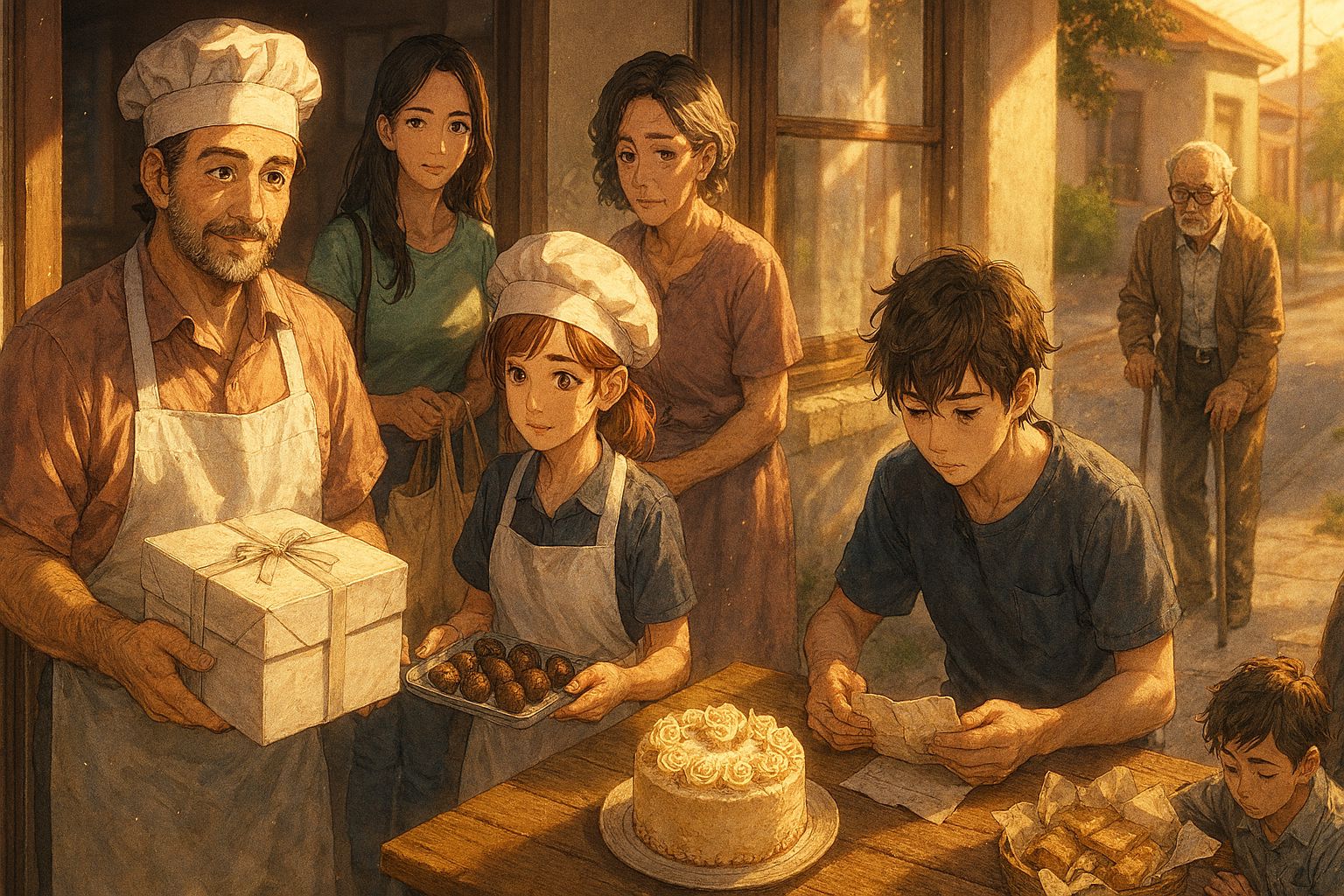
I always carry the smell of freshly baked dough in my skin. That aroma, a blend of flour, butter, and sugar, has accompanied me since I first opened my eyes to this trade; I wear it stitched into routine and memory. That afternoon, however, the scent felt different: it did not announce celebration but a timid attempt at repair. We carried a cake covered in carefully shaped cream flowers, homemade truffles still warm, and a box of cookies, all wrapped with care. They were not snacks; they were offerings. My name is Álvaro. I work at the corner bakery and have for years. With me was Marina, my apprentice, a young woman with delicate hands and the immense patience of someone who has learned to listen to dough. We adjusted flavors until the last minute: more vanilla in the cream, a touch of salt in the caramel, truffles with a moister center. We closed each box carefully. The note that accompanied the order had been left by Ana, the recipient’s daughter. Ana wanted her gesture to have something ceremonial; it would not be just a message, but also a way of asking for forgiveness. "Check the note again," I told Marina as we folded our aprons. "We can’t let something like this get lost on the way." “It’s inside,” she answered in a low voice. “Ana put some small dried flowers in the wrapping. She says it makes it less formal, more like home.” We walked through warm streets; the late light gave the shop windows a glow that seemed to soften edges. We did not speak much. There was a kind of respect between us, as if carrying someone else’s hope demanded silence. The bakery fell behind us, its door closing like the final scene of a small ceremony. Carmen’s house smelled of soap and windows that seldom remain shut. Lucas, her grandson, was the one who opened the door. He was fourteen and had a way of looking at the world that reminded me of young people of old: alert, protective, curious in a way that doesn’t yet understand adults’ quarrels. He froze when he saw us with the boxes. “Who are you?” he asked, with a thread of distrust that didn’t hide his surprise. “We’re from the bakery,” I said, holding the largest box with both hands. “Ana asked us to deliver this.” Lucas ran to fetch his grandmother before I could say another word. The silence that remained allowed me to hear the faint creak of the cardboard and the heartbeat of time: the feeling of bearing something that might change the course of an afternoon. Carmen descended the stairs, leaning on the banister, moving slowly. Her skin bore the marks of years, and her face told a whole life: nights and days, loves and absences, habits that sustain the everyday. She paused without noticing us at first, as someone who does not expect the past to return shaped like a cake. “Álvaro?” she said softly, a mix of surprise and fatigue in her tone. “From Ana?” I nodded. I felt her breath shift; she seemed to hold both incredulity and hope. I handed her the note with a hand trying to be steady. She read aloud in a low voice. The words were measured, like someone tracing a path they do not want to err on: “Mom: these have not been easy days and I regret what happened. I’ve been thinking about you a lot and I want to start again. I hope this can be a first step. I miss you and I love you. With love, Ana.” The letter spoke of seasons, of regret, and of the fear of asking forgiveness. It was simple, human, enough in its modesty. When she finished, Carmen left the sheet on the table; her fingers trembled slightly. A tear—or perhaps two—rolled down her cheek. There were no loud displays or grand gestures: the moment was small, and therefore intimate. Marina put her hand on Carmen’s shoulder with the naturalness of someone who understands without words. At that moment Sofía, the neighbor, appeared. She arrived with shopping bags hanging from her arm, bringing the rhythm of the street into the house. She entered without solemnity, with the ease of someone who lives nearby and knows others’ shadows and joys. “All right?” she asked, with the familiarity of shared routines. “They brought some desserts from my daughter,” Lucas said, explaining what was already clear to everyone but Carmen. Sofía smiled with that mixture of pity and relief that witnesses to reconciliations wear: she knows words often falter, but she trusts deeds. As we packed up, I saw Don Pedro on the sidewalk, leaning on his cane. He paused to watch us as if we were fulfilling an old neighborhood custom: performing small acts of humanity. “Good gesture,” he said from the curb. “Sometimes the small things weigh more than words.” I nodded. It was true, and in that gesture I felt complicit in something larger than a delivery: complicit in a truce. When the door closed, the house was reduced to small sounds: the soft slap of a lid on the table, the hum of the refrigerator, Carmen’s muted voice. Lucas began arranging the treats with reverence, as if each piece carried its own history. His movements were slow, almost ritualistic; the way he set the cake tray reminded me of rites that honor what one hopes to recover. “Grandma, can we eat it now?” the boy asked, trying to hold back the impatience of someone who did not want the moment to cool. She looked at him, and for a second all the years seemed to converge in her gaze. “Yes, my boy. Let’s start with something small,” she answered, and her voice sounded determined and tender at once. Later, while they cut a slice of cake, Carmen called Ana. I did not hear the whole conversation, but I caught the rhythm of words and the silences between them: hesitations, awkward explanations at first, contained laughs, and finally a “I love you” with a breaking voice. It was a call that began with fear and ended with the promise to continue. After she hung up, Carmen rested her forehead on her palm. She looked at me as if to offer thanks without speaking it. There was a mixture of relief and slow surgery in her features: something had shifted. I do not know if everything would become as it was before; I do not know if the wounds would fully heal. What I did see was how a humble, patient gesture opened a crack through which hope could slip. Before I left, I lingered on the sidewalk. Don Pedro chatted with Sofía. Their voices blended with the murmur of the street. I liked thinking that the city, in its small web of encounters, allows absences to be filled slowly. That night I returned to the bakery with my hands still perfumed and a nostalgia that would not leave me. I remembered the creak of the cardboard, the texture of the note between my fingers, Carmen’s gaze when she finished the letter. I thought of Lucas and how young people sometimes bear the task of bridging gaps without asking for anything in return. I thought of Marina, who without knowing it had learned another lesson: the kitchen feeds not only bodies but also repairs silences. Over time I saw them from afar again. Their house remained as it had been, the curtains at the same hour and the same warm light in the living room window. I learned they had called the next day and in the days that followed: they spoke, there were reproaches and awkward laughter and sincere promises. I learned too that reconciliation is a process, not a single act; that sometimes a first step is enough to begin walking, and that that step can be fragile and beautiful at once. I still keep the image of the tear-stained note in my mind and the sense that something simple—a cake, a letter, a few truffles—was capable of reshaping an afternoon. It comforts me when I close the bakery: there are gestures unseen that hold neighborhood life together. There are small, anonymous offerings that mend bridges. And so, for a moment, nostalgia becomes companionship and the trade feels like medicine. Source of the images. Image created with Bing.
No comments yet