 @mc5punk
more from that month
@mc5punk
more from that month
Short story: The Rope and the Tea
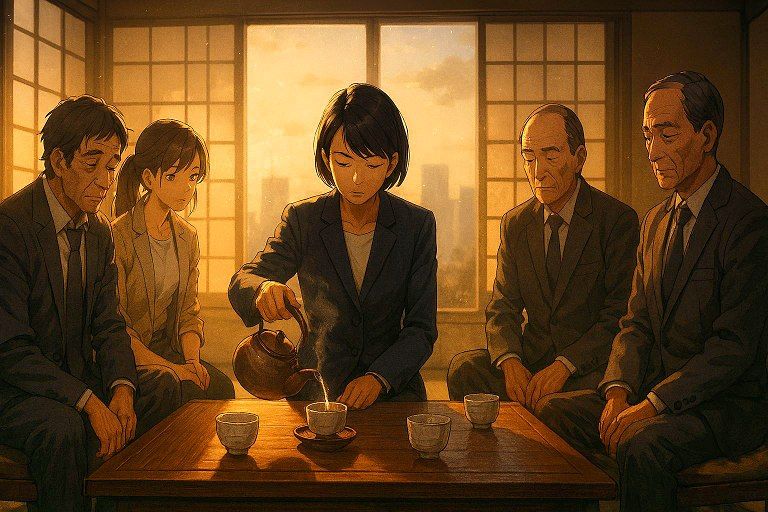
Sanae Takaichi was born in a humble neighborhood of Kashihara, where houses smelled of wood and winter and public conversations took place on the thresholds of temples. As a child, disputes with neighbors about taxes, street lighting, and heritage conservation seemed to her more than petty fights: they were civic exercises, rehearsals of what it meant to care for a place. Those rehearsals turned into a vocation that, over the years, pulled her into politics within the Liberal Democratic Party. What began as a series of local decisions became a life devoted to public administration, the defense of traditions, and, ultimately, the ambition to change the course of her country from the highest seats of power. There was in her a peculiar mixture: firmness and a capacity to listen that some mistook for calculation, others for tenderness. She served as Minister of Internal Affairs and Communications; there she learned to weave compromises between reluctant bureaucracies and the rapid technological demands of a nation that kept evolving. Within the LDP, her figure consolidated as that of a politician with clear convictions; her critics labeled her ultraconservative, while her supporters praised her consistency. But in private, few knew the web of doubts and reflections that accompanied her. Those doubts made her both cautious and bold. At her side a diverse team formed that soon ceased to be a mere group of collaborators and became key characters in a larger story. Kenji Mori, a veteran strategist, had the weary smile of someone who had seen campaigns rise and fall. He could read maps and perceptions, and his prudence was the perfect counterweight to the intensity of others. Aiko Fujimura, the young entrepreneur from Tokyo, carried the generational urgency: she wanted to break ceilings and labor models she considered obsolete. Daisuke Tanabe represented the party’s institutional memory: a veteran legislator, solemn, who understood politics as continuity and safeguard. Emiko Sato, secretary and confidante, knew the leader in silence; loyal and perceptive, she knew when to speak and when to close the office door so Sanae could think without pressure. The campaign that elevated her to the head of government was a contest between the possible and the imagined. It attracted traditional voters seeking stability and surprised young, urban, professional sectors that longed for real change. On the night of the victory, Tokyo’s streets filled with murmurs and anecdotes; there were fireworks and also long conversations between strangers who did not dare fully to believe in the new stage. In the strategy room Kenji spread maps and figures with the same patience with which he prepared a voyage. “We have support in the rural prefectures,” he said, “but in Tokyo the youth are divided. If Aiko speaks at the Convention, we’ll connect with an energy that still eludes us.” Sanae observed him with her characteristic calm. Her hands, hardened by years of seals and meetings, rested on the oak table. “Let her speak,” she replied. “Stability must not be synonymous with immobility; we need our voice to reach those who still hesitate.” Aiko’s intervention became an inflection point. Trembling in the corridors before mounting the stage, she found in Emiko an anchoring presence. “Don’t think about headlines,” Emiko advised. “Speak about what you know: jobs for young people, accessible childcare. That reaches farther than any slogan.” Before microphones and cameras, her mouth dry from adrenaline, Aiko delivered a sentence that resonated in squares and cafés: “I want my children to see that a woman’s place is not limited. If Sanae can lead the country, we can imagine other ways of governing.” The simple, direct sentence acted as a mirror: many were challenged by the idea that history could take a turn, and others confirmed their fear of losing certainties. Sanae’s inauguration was not a coronation but the opening of a long list of responsibilities. The economy demanded structural solutions: anemic growth, industries with obsolete models, and a rapidly aging population leaving gaps in the labor market and tax base. Added to that were regional tensions requiring diplomacy with firmness. In her office, surrounded by maps and documents, she understood that her leadership would be judged by concrete results rather than symbolism. Politics, however, is also the art of negotiating the inevitable. Daisuke, with his traditional bearing and patience honed over years, entered the office one afternoon. He carried the grave voice of someone who has witnessed political comings and goings. “Sanae,” he said, “some rapid reforms can fracture the party. We need consensus. Don’t forget where we come from.” She, who knew the texture of political time, closed the dossier she was holding and answered calmly. “I don’t forget our roots, Daisuke,” she replied. “But you don’t govern for the past; you govern for those who are to come. We can preserve stability without denying change. Will you help me find that middle ground?” Daisuke, for an instant, let his armor fall. There, in the silence between them, the possibility of an alliance emerged—neither fully conformist nor wholly rupture. Decisions took shape around negotiation tables and in public hearings. One night during a debate with entrepreneurs, a question erupted with the fury of business logic: “Why not allocate more funds to startups instead of bailing out dying industries?” a voice from the back asked. “Those companies create the future.” Sanae took the floor with deliberate precision. “Because both are necessary,” she answered. “I will not abandon those who depend today on existing jobs, but I will support those who create tomorrow’s jobs. I will seek for new companies to offer conditions that allow balancing work and childcare, so no one must choose between parenthood and career advancement.” Her words did not calm every voice. Protests multiplied in plazas, calls of concern came from business chambers, and gossip circulated in neighborhood dining rooms. Kenji watched from the benches with the gaze of someone who had learned to read fears. “There is fear,” he murmured. “It’s not just against you; it’s against the idea of losing security.” At a demonstration in front of the Diet, an elderly woman shouted with a voice dried by years of unchanging routines: “Don’t change what has worked!” Sanae decided to approach, not to impose authority but to build a bridge. “I understand your fear,” she said into an improvised microphone. “I am not asking you to trust blindly; I ask you to judge me by results. I will work for your security and for that of your children.” The way she spoke did not produce unanimity, but it opened a window: some listened with suspicion, others with cautious hope. Nights grew long for Sanae. Sometimes at the end of the day she called Emiko. Exhaustion crept into her tone. “Sometimes I feel I’m walking on a tightrope,” she confessed in one of those calls. “One wrong step and everything could unravel.” Emiko, with measured calm, replied as she always did. “And yet you do not walk alone,” she said. “You have built a team that knows how to lift the rope if it fails. Do not demand perfection; demand results.” It was not a promise of total peace but the constancy of companionship. The following months were a succession of difficult choices. Partial cuts were applied to balance unsustainable budgets while strategic investments targeted high-growth potential sectors. Unexpected alliances were formed with minor parties to secure majorities on key issues; concessions were made to unions to avoid paralyzing strikes; incentives were enacted for companies that implemented family-friendly policies. Politics, as always, turned into an elaborate staging of precarious balances between competing needs. Not all measures were well received. Some sparked protests in the streets; others elicited cold applause in financial centers. But there were impacts beyond the economy: more female portraits began appearing in government offices; formerly monotonous committees invited diverse voices; in universities, girls who had once watched with incredulity began writing a woman’s name in their notebooks as an example of what was possible. During a visit to a technical school, Aiko watched expectant faces and could not help being moved. “Look,” she whispered to Emiko. “It is no longer a distant idea.” Emiko smiled—not as one celebrating victory, but as one recognizing that small transformations require time. Daisuke, in the twilight of his career, visited Sanae on an evening that seemed to halt its own haste. They sat before a teapot; vapor traced slow movements above the table. “I never thought I would say this,” Daisuke said with a voice that mixed resistance and admiration, “but your leadership has changed the party’s conversation.” She offered him a cup as a sign of truce and reciprocity. “Thank you for walking this path with me,” she replied. “Politics is sometimes slower than necessity, but it deserves patience and steady work.” That afternoon remained one of the scenes chroniclers would remember for its simplicity: a truce between generations, an acknowledgment that changes require prudence without abandoning the gaze toward the future. Sanae’s legacy was not limited to figures and statistics. While economic indicators fluctuated over cycles of her administration, her imprint was more complex: she transformed the idea of who could lead; she left institutions with more inclusive protocols; she opened spaces that had been restricted. More importantly, she normalized the possibility of female leadership in public conversation. In neighborhoods, schools, and offices, different stories began to be told. Yet the full story demanded seeing the cracks and contradictions. In some sectors, she was subject to harsh criticism: for her past within the party, for decisions perceived as conservative, for ways of dialoguing with rivals that some judged overly conciliatory. That mixture of praise and reproach fed a complex narrative: she was not the perfect leader, but she was the leader who had reached a position previously occupied almost exclusively by men. Throughout her term, private conversations took on the depth of the human. Kenji, often with tired but steady eyes, reminded her to measure time. Aiko insisted policies be bold and concrete for younger generations. Daisuke sought to preserve useful legacies. Emiko, in the privacy of the office, maintained the balance between confidences and practical reminders. Those voices shaped decisions and the contours of government. At the close of her cycle, when months and years had woven together into assessments of successes and failures, a general sense remained that something had changed irreversibly: politics now aspired to include other perspectives. Young people who had once felt alien began to mobilize; women who had never considered politics as an option started running for local office; public discourse embraced new priorities—work-life balance, responsible innovation, and attention to demographic fragility. Sanae Takaichi walked the final stretch of her term with the seriousness of someone who understands that transformations are measured in long spans. She did not seek easy epicness; she preferred slow construction. Her legacy combined the symbolic and the pragmatic: she was the first woman to hold the head of government, and also the woman who, with her limits and virtues, tried to govern for a country divided between voices that demanded preservation and those that called for risk. The story ends not with dramatic closure but with a simple image: a teatable where, after years of discussions and decisions, Kenji, Aiko, Daisuke, and Emiko still sit. Their faces show fatigue and partial satisfactions. Sanae sets the teapot on the table and pours. The small, everyday gesture becomes the metaphor of an era: patience, conversation, and persistence as ways to keep the rope taut without letting it snap. Collective memory retained her decisions, the debates that ignited squares, and the changes initiated in offices and schools. It also kept the intimate dialogues, the whispered advice, the resignations, and the agreements. Politics, in its most human form, revealed itself: imperfect, necessary, and capable of opening windows to possible futures. Sanae Takaichi, the politician who walked from local squares to the official residence, left behind a contradictory and hopeful age in which the taut rope between tradition and change was maintained, in the end, with tea and shared words. Source of the images. Image created with Bing.
No comments yet