 @mc5punk
more from that month
@mc5punk
more from that month
Short story: Intervention of Steel and Smoke
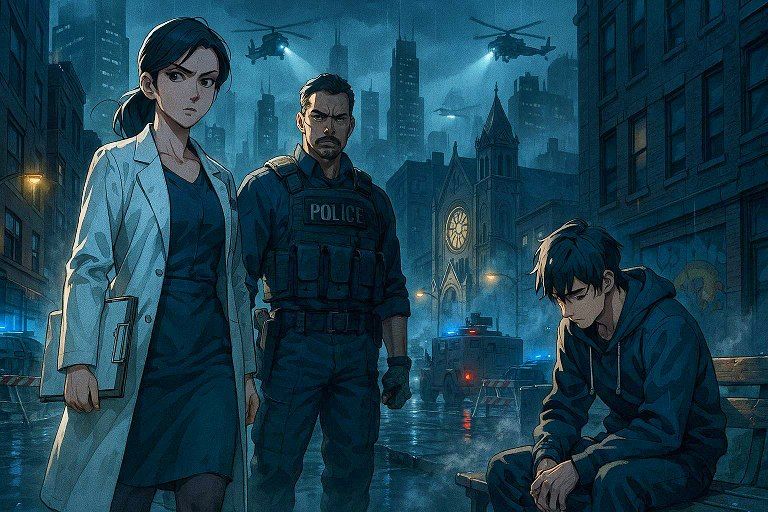
The day the Federal Government decided to intervene, Chicago woke as a city unfamiliar to itself. The sky, thick and low, pressed against the brick facades until they were silenced; the rain, which had begun as a nighttime whisper, left damp traces on the sidewalks and on the faces of those who stepped outside to look. Helicopters circled like metallic birds, casting fleeting shadows over parks and avenues; flashing lights painted walls blue and white, while barricades and fences divided the urban map into islands of controlled circulation. At the improvised command post—a truck surrounded by containers and generators—Marcos Rivera studied a plan with a calm that admitted no fissures. His voice, steady, cut through the space’s tension like a precise order: they had to act quickly and with minimal collateral damage. The Back of the Yards neighborhood, once the scene of long workdays and bustling markets, woke to find the public school converted into a shelter. The gym, now an asylum, bore the traces of interrupted lives: mats spread in uneven rows, patched blankets stacked in corners, long tables with trays of canned food and thermoses of coffee no one drank calmly. The school murals that once celebrated the neighborhood’s history with vivid colors now lay covered with boards; in one corner a chalkboard pinned with names and schedules served as a registry of absences and presences. Lucía Torres, standing near the door, gave instructions with the authority necessity grants. Her hands, used to grading papers and arranging schedules, moved lists and assigned shifts; her voice, though tired, would not yield to despair. “Distribute the blankets by age and condition,” she said. “The elderly go in the front rows; children in groups. No one goes out alone at dusk. Period.” Sofía Reyes, a single mother and owner of a bodega that had been looted the previous week, gripped her son’s hand tightly. The young woman felt a fear at the nape of her neck that wouldn’t sleep: her shop, her livelihood, her identity. In the gym’s improvised kitchen, Ana Ruiz stirred a pot as she organized volunteers into shifts. In a few days she had learned to measure time by spoonfuls of soup and by radio situation reports. The school functioned as the heart of a nascent neighborhood network: healing, distribution, and food all mixed in the sticky warmth of the place. Elsewhere in the city, in an industrial corridor where metal facades formed a maze, Diego “El Sombra” Morales’s warehouse hummed in dim light. Under bare bulbs, men moved boxes and counted bills with dirty hands. On the wall, a map with routes marked and names penciled in showed the organizational precision of an operation turned into business by force. Diego watched from his desk: tall, beard trimmed, eyes that measured risk and profit with the same metric. On the table, a family photo tacked up with a thumbtack showed a different Diego: a man holding a child, a seemingly normal family. That contradiction allowed him to justify any excess—the logic of power shielded by the humanity he chose to ignore. Samuel “Sam” Ortiz moved among the pallets like a recent ghost: twenty years old, his body stretched by nights on patrol and hands that had learned to squeeze triggers with the speed of someone seeking acceptance. Recruited at seventeen, the promise was simple: money, protection, a place in the hierarchy. But the hierarchy demands; loyalty requires sacrifice. Sam had seen executions that still weighed on his temples; the blood on the tiles reminded him that every decision was irreversible. On the night of the raid, Diego’s order—“open a corridor; if they come, burn the evidence”—sounded like a sentence. Sam obeyed. When the federals burst in, the warehouse became a theater of light and smoke. The stampede, the metallic chill, the smell of gunpowder and burning plastic: in seconds a young man lay on the floor, wounded, and the city had added another casualty. The first major coordinated operation was a ballet of contained noise. The federal checkpoint, with laptops caked in dust, maps pinned with thumbtacks, and radios beeping, functioned as the tactical brain. Captain Alan Hughes, in charge of logistics, handled timing and resources like someone assembling delicate machinery. “We’ll cut routes, we’ll close financial channels,” he said in a brief meeting, the urgency of someone aware of the problem’s immediacy. Naomi Blake, a local detective who had watched her district spiral for years, escorted the team from a flank. Her experience in night patrols gave her a sharp intuition; her skepticism made her demanding of intelligence. When agents burst into the warehouse, Naomi covered the flank with the calm of someone who knows danger can turn to tragedy in a blink. Sam’s capture was swift and brutal; Diego watched from a distance like someone observing the debris of a wall that had opened. The night’s rain mixed blood with water, sense with fury. Rivera, kneeling beside the young man, felt the city’s fate in the boy’s lost gaze. “Why did you get into this?” Rivera asked, not raising his voice. “There was no… work,” Sam answered, voice broken. “They offered me money. They promised protection.” Naomi, nearby, put a hand on Sam’s shoulder with restrained harshness. Her lips didn’t smile; her words were not a caress but a possibility. “If you want out, talk. Telling us what you know helps others not die.” As arrests split the opposing structure, the mafias’ response came with crueller, more diffuse methods: flash fires at small businesses, ambushes on secondary routes, tactical attacks intended to distract operations. Violence changed scene and face. Where battles had once been fought in daylight, attacks now took place at night, in warehouses less visible, in industrial corridors beyond the cameras. The train-crossing markets bore the weight: broken shop windows, a rusted bicycle leaning against a pole, a plastic toy stained with mud. The city, which had survived fires and strikes, was learning to live by a new rhythm: the intermittent heartbeat of danger. At home, disrupted life adopted defensive rituals. Windows were boarded up, porches turned into observation points, bicycles chained in desperate caution. Marta and Joaquín Pérez, a couple who had lived in the same house for over forty years, saw their routines blur. The kitchen—once a refuge of recipes and stories—became a place for whispered conversations and the safekeeping of documents. One cold dawn she murmured, “I don’t want to live in fear.” Her husband, with resigned firmness, squeezed her hand and said, “Then we’ll resist.” Everyday acts of courage formed another resistance. Neighbors organized night shifts; handheld radio alert networks were woven; teachers offered tasks and improvised classes so children kept some routine. Father Andrés, whose church had become a point of spiritual and material support, opened the confessional as a supply depot. His hands, weathered by years of ritual, handed out food and medicines; his deep, steady voice urged calm and action. In the church, lit candles created a microclimate of light in the dark, and worn holy cards passed from hand to hand as talismans of hope. The war was not just about weapons: it was also about resources and symbols. The Federal Government implemented financial blockades aimed at cutting access to accounts and suppliers; search warrants were served to firms acting as front operations; transfers that financed the organization were pursued. Many blows took effect: weapons, shipments, and bundles of cash were seized. But criminal machinery does not stop in a vacuum; it adapts. New leaders emerged, routes changed, partners reorganized. Violence became more selective and more lethal, as if the city were a board whose pieces were being quietly repositioned. One crucial night, an attack coordinated by Diego’s organization sought to break the encirclement: arson at distraction points, assaults on routes, and an operation to free detainees. The maneuver, organized precisely, forced Rivera and Hughes to redeploy forces and prioritize saving lives. At the train crossing, a controlled explosion brought down part of a wall, and the blast echoed through warehouses and tracks as if time itself had stopped. Sirens howled like sustained lamentation; agents ran; neighbors huddled under thresholds. The images of those days spread: smashed display windows, overturned stalls, children peeking in fear from behind curtains, elderly people wrapped in blankets. Each scene left a mark on the city, physical and psychological. Newscasts reported numbers, but numbers did not convey the ongoing sense of vulnerability: the city learned to measure its hours, to avoid streets, to trace alternative routes to get children to school. When schools reopened, they did so with new protocols: constant accompaniment, reinforced security, staggered schedules to avoid crowds. The makeshift jail, housed in an adapted hangar, witnessed confessions and silences. Under cold lights, an interrogation room with a hanging lamp and a metal table became the stage for consequential decisions. Sam, his voice still tense from pain, started to speak. His words, at first halting, took shape: names, schedules, distribution routes. Remorse could not erase the acts, but it opened the possibility for justice to piece together the puzzle. “Tell me what you know,” Naomi demanded—not cruelly but with the need to close the loops. “If you help us, we can cut routes. It won’t be easy, but it’s a start.” Sam’s cooperation enabled targeted strikes and arrests that eroded Diego’s operational power. Some members were taken into custody; other networks were dismantled; assets were frozen. Diego felt the noose: his empire of shadows showed cracks. His allies looked away. In a fit of pride and desperation he ordered an attack that produced the opposite effect of what he intended: more men arrested, recovered intelligence and an irreversible loss to his structure. As the federal campaign reduced the organization’s capacity, the community began weaving more enduring responses. Lucía promoted reintegration programs for young people; Naomi collaborated on witness support plans; Father Andrés coordinated psychosocial aid with NGOs; Rivera spoke at public hearings calling for security to be accompanied by socio-economic measures. In a municipal meeting room, projects for employment, trade workshops and scholarships were discussed; taking away weapons was not enough—options had to be opened. Under a judicial agreement that included rehabilitation and community work, Sam joined a program linking him to the school: maintenance help, activities for at-risk youth. His face, still marked by experience, sought redemption through tangible actions. His hands, once holding weapons, began to hold tools, paint and books. Not everyone believed in his commitment; distrust ran deep. But some children, indifferent to the past, offered trust without questions. Streets slowly returned to rhythm. Markets that had closed reopened under watchful community eyes; cafés put up “open” signs with a mix of defiance and caution; parks filled again with voices, though adults kept a vigilant eye. Federal presence, combined with community reorganization, restored a sense of containment in key sectors. Yet the wound did not heal overnight. Buildings bore scars: shattered glass, boarded facades, painted symbols that people would take years to forget. At a public hearing Rivera spoke plainly: “We will not rebuild everything with bullets,” he said. His words captured a community’s fatigue and a need to restore social fabric, not just impose order. Naomi, Lucía, and Father Andrés supported the plea with testimony and proposals: job training for youths, safe meeting spaces, investments to revitalize local businesses. The message was clear: security must be built hand in hand with real opportunities. In time, Diego was captured in an operation that exploited the gaps his own desperation had opened. Alone in his cell, facing the clarity of failure, he understood his choices would not bring back what he had lost. His fall did not erase the damage, but it produced a pragmatic sense of justice. For many, the closure was insufficient; for others it became the starting point for rebuilding. For now, the urban novel concluded with scenes of everyday life that felt like small victories against what had been. Children returned to play in the schoolyard; the laughter was more guarded, but it was laughter. Lucía organized art workshops to help process trauma; the blackboard filled again with assignments and next to it a schedule for psychological support. Naomi returned to patrols, tired but determined, watching safe routes. Rivera, ever alert, worked on plans of cooperation between forces and community to not just repel crime but to dismantle it through opportunity. Sam, wearing a worn T‑shirt, sat on a bench at the school watching children run and murmured softly: “I want at least one of them to have the option I didn’t.” The city remained marked: visible scars in the brickwork and less visible scars in the collective memory. The intervention had left fear, loss, and altered memory—but it had also awakened a new determination: stronger neighborhood networks, community programs underway, voices demanding a future. Chicago learned that security does not arise solely from force imposed from above, but from the concrete possibility of offering alternatives and mending the ties violence had frayed. In corners once ruled by shadow, people lit vigils, opened schools and businesses with the resistance of those who know what they have achieved is fragile. Hope, no longer certainty but a shared decision, spread in small acts: a community kitchen reopened three blocks down, woodworking workshops started for young people, a municipal scholarship program for vulnerable families. And though the city would keep measuring its hours, it had learned—at least for a time—to look forward. The war had left its mark; rebuilding had begun, slowly, with hands offered to repair what violence had broken. Source of the images. Image created with Bing.
No comments yet