 @mc5punk
Short story: The Plaza of Screens
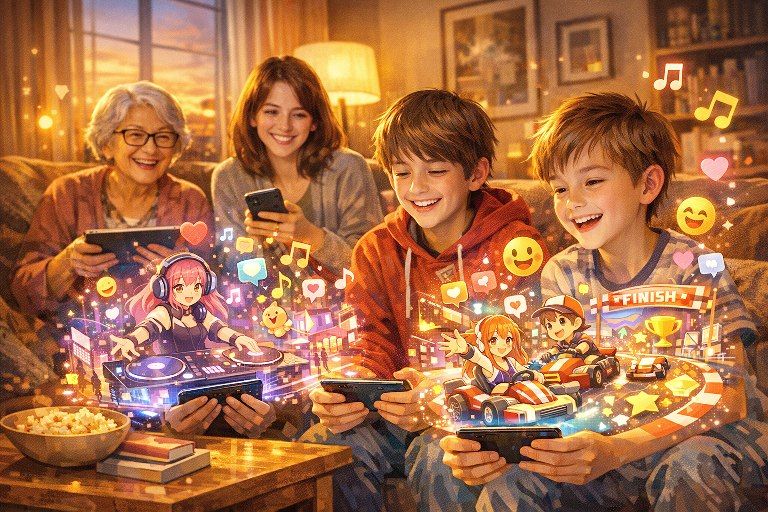
The afternoon slid lazily over the Las Acacias neighborhood, tinting the facades yellow and orange. Mateo arrived home with his bag half unzipped and his face still warm from the heat of the trip. When he opened the door, he was greeted by a scene both ordinary and profoundly new: his grandmother Clara reclined in her armchair with a tablet on her lap; Valeria, his mother, sitting at the dining table with her phone in hand watching an online cooking tournament; and Nico, his younger brother, already on the sofa with his phone in front of his face, ready to jump into a quick match as soon as the invitation appeared. “Did you get home late?” Valeria asked without looking up from her phone. “Traffic,” Mateo replied with a grimace. “But I have time to play a bit—what are you doing?” “I’m in the ‘Worlds’ plaza,” Nico answered without stopping his thumb. “Come in, there’s a meet-up in five minutes.” Grandmother Clara set the tablet on the table and, with the calm of someone who has watched decades pass, smiled. Her eyes crinkled in a gesture like that of someone hearing a repeated anecdote, but this time the anecdote came with emojis and sound effects. “A plaza? Those worlds again? When I was young, the plaza was real,” Clara teased, resting a hand on the armchair’s fabric. “You played hopscotch there, not those noisy things.” Mateo dropped his bag on the floor and sank into the couch beside Nico. In less time than it took them to settle, both had opened their games on their phones: within seconds, their avatars appeared side by side in a colorful scene full of virtual stalls, impossible sculptures, and animated signs. Valeria, not an habitual gamer, watched with curiosity. The idea of creating an avatar appealed to her more from the desire to share than from a competitive urge. “Can I join?” she asked, a little shyly. “I don’t even know where to start.” “Sure,” Nico said, pausing his game to show her. “It’s free—just create a character. Look, I customized this hat; I can lend it to you.” Valeria accepted the invitation with a smile. In minutes she had a simple avatar: tied-up hair, neutral clothes, and an expression that, while not capturing her real face, allowed her to walk through the virtual plaza with the same ease she would in the neighborhood park. Grandmother Clara, intrigued, leaned in and pointed at the screen as if it were a painting. “Look how they greet each other,” Clara said. “That’s instant! Back then you had to go down to the corner to see someone.” It was no coincidence that the whole family ended up in that digital space. For them, the phone screen had ceased to be a mere content receiver and had become an expanded living room: a place where generations talked, argued, and shared without complex technological intermediaries. Mateo remembered conversations with his friends: patience for waiting through downloads and patches had died out; time no longer tolerated long start-ups. If a title didn’t hook you in the first seconds, you moved on. “What do you do there now?” Clara asked, pointing to the small missions popping up above the market stalls. “Quick missions,” Nico explained confidently, as someone who has internalized mobile game logic. “They’re five minutes long; I do one between school and dinner and you still rack up rewards. They give small goals so you feel like you’re progressing even if you only play for a bit.” Valeria nodded, recalling the long afternoons of console boot-ups that once set the household’s rhythm. “I like that we can hop in and out,” she said. “Before, with the console, you had to turn everything on and wait for updates. Now you open the app and that’s it. Less friction, more getting together.” Meanwhile, a notification brought another familiar face: Lucas, the neighbor across the hall, materialized in the plaza. His avatar wore virtual headphones and a microphone; within seconds he started DJing music in the shared space, turning the plaza into a mix of fairground and concert hall. One by one other avatars joined: Nico’s school friends, Mateo’s coworkers who shared memes, neighbors who used to greet each other in the building chat and now met at this common point. “This is like real life, but without the traffic noise,” Lucas said with a laugh. “Here you stay if you like the people, not because you have an expensive device.” Mateo smiled, thinking about the practical importance of the smartphone in his region. In Latin America, the phone wasn’t just a symbol of modernity; it had become the primary console for economic reasons and ubiquity. It allowed parents and children to meet without the hardware gap separating them: the same app, the same game, the same plaza. Economic differences that in the physical world closed doors were minimized in that virtual universe. Suddenly an announcement popped up on the noticeboard: an obstacle race, ten minutes long—perfect for those with little time but craving a thrill. Nico sprang from the couch as if called to a personal challenge; Clara clapped with childlike enthusiasm; Valeria didn’t want to fall behind; and Mateo, focused, searched for the best strategy with his eyes fixed on the screen. The race was a whirlwind of jumps, slides, and laughter. In the house their voices mixed with the game’s sound effects: a perfect jump, a comical fall, a sarcastic comment. Although not everyone finished first, the feeling of having progressed was clear: a new badge, some virtual coins, and a supportive gesture received on the track. “People used to play for the graphics,” Valeria said as they put their things away. “Today it’s more about community. Did you see how that kid helped you when you nearly fell?” “Exactly,” Mateo replied. “This isn’t just pixels; it’s who’s with you when you’re connected. It’s the people, the conversations, and the small helps that make the game an excuse to be together.” That night, while the virtual plaza kept buzzing with events and avatars waved goodbye with gestures and emoticons, the real conversations in the living room resumed their place. Grandmother Clara, with the tenderness of someone watching a new family custom, told an anecdote from her youth about a fair where she had won a ring toss. Nico, full of youthful energy, recounted how he had made friends in a lightning tournament and discovered new musical styles thanks to those encounters. Mateo listened, thinking about continuity: the human need to gather now manifesting through screens and connections. “Are we playing again tomorrow?” Nico asked before turning off his bedroom light. “Yes,” Valeria answered firmly. “Five minutes before dinner. That way we connect without interrupting anything.” Grandmother added affectionately, almost in a whisper: “I’ll sit and watch you. Even if I don’t understand everything, I love seeing you all together.” With the lights off and the house quiet, Mateo lingered a moment looking at his phone, now set aside on the table. He thought about how leisure had ceased to be a solitary or merely recreational activity and had become a common language across generations. The phone, the digital plaza, short and free matches: they were not merely consumption elements but tools that enabled instant meeting, inclusion, and the continuity of social life. They had created an ecosystem where instant gratification did not oppose connection; instead, it facilitated it. He remembered the streaming logic—the habit of total content availability established by platforms that had taught families to consume whenever they wanted. That same mentality had migrated to video games: loyalty to a title was no longer automatic. If a game didn’t convince you in the first minutes, you discarded it without remorse. That’s why experiences had to hook players from the very first second to win over an audience that moved at notification speed. In the region, the smartphone had consolidated as the main leisure tool largely because of its accessibility and its ability to offer deep experiences without costly hardware. Players of different ages and means could participate from the palm of their hand, and that transformed family gatherings. Developers, aware that gaming competed with every other attention demand—messages, social networks, calls—adapted their designs: five- to fifteen-minute sessions, scalable rewards, a sense of progress even in short bursts. Thus, the game became compatible with daily life, not an activity that demanded it. Above all, this changed the way people belonged. Beyond graphics, the social experience was the true driving factor. Games that functioned as public digital plazas offered spaces where young people found identity and company. The free-to-play model, with its low barrier to entry and voluntary spending, ensured the family meeting point remained accessible to everyone, regardless of economic capacity. Still, Mateo knew not everything was perfect: instant gratification could erode attention and turn taste into a fleeting commitment. But that night, seeing his family laugh, argue, and help each other in a virtual race, he understood that instant reward wasn’t necessarily superficial. In many cases, it was the way to preserve a shared space in accelerated times. The Plaza of Screens dimmed slowly: avatars logged off, notification icons calmed, and the house returned to its usual quiet. Yet the habit was now established as a new ritual: meet five minutes before dinner, enter the plaza, greet each other, compete a bit, win a badge, and then close the app to return to in-person conversation. It was a small choreography that bound generations. And so, on an ordinary night in an ordinary neighborhood, the family discovered that entertainment had ceased to be an isolated activity and had become the shared language that allowed them to remain family in a hyperconnected world. Source of the images. Image created with Bing.
No comments yet