 @mc5punk
more from that month
@mc5punk
more from that month
Short story: The whisper of the capsules
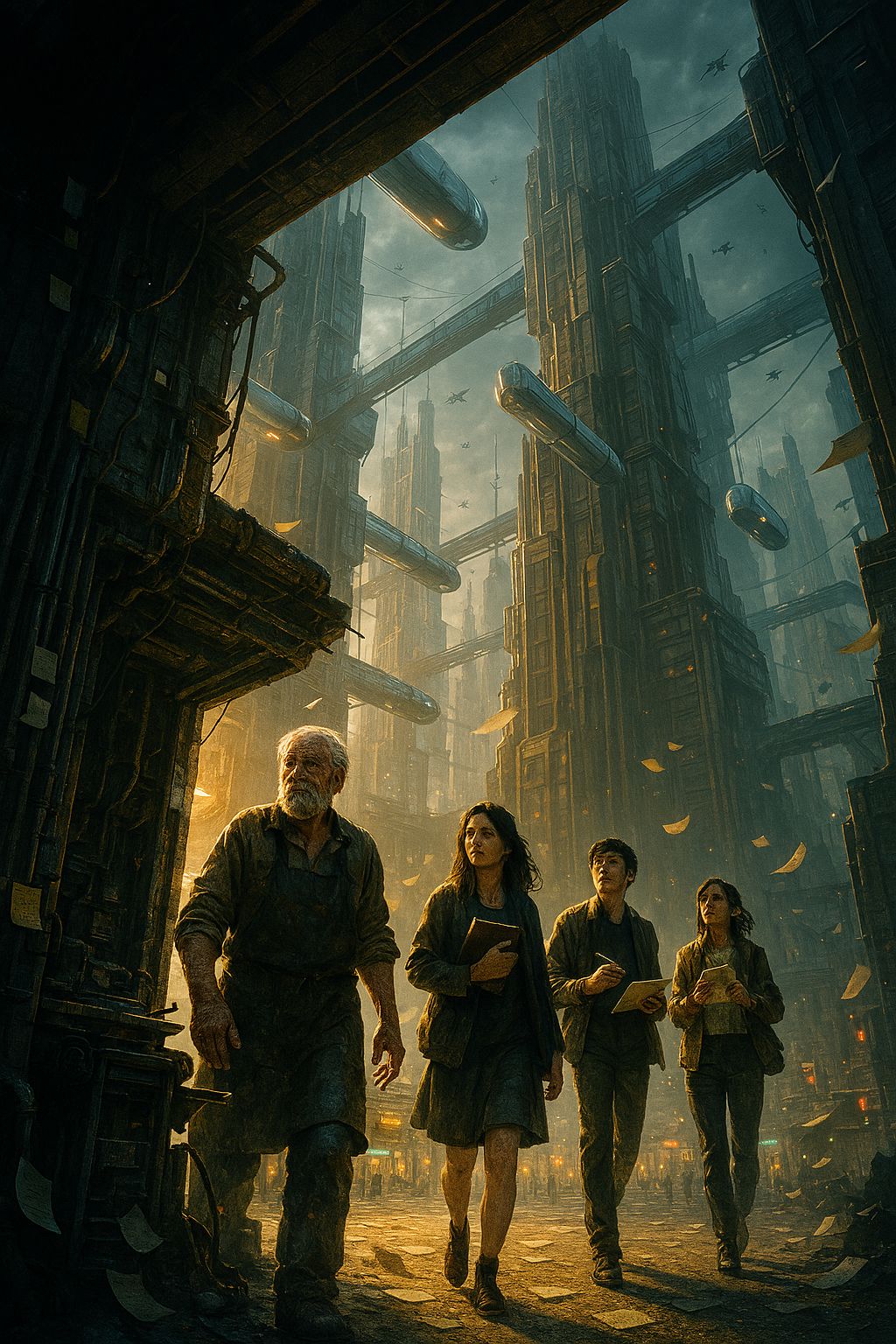
The Council towered over Neoterra like a crown of burnished metal and endless screens: a vertical artery of towers connected by translucent walkways where data circulated like rivers. From their ceremonial podiums, the members of the Council — ancient lineages with biomechanical attachments and executives dressed in oil gray — dictated the pulse of the city. The old squares, which once throbbed with crowds and oratories, had become sensory transfer studios: clean platforms where people deposited themselves every night to receive the Capsule sessions. These devices, glued to the temple or integrated into the urban environment, projected simulacra of thought: compressed stories, consensus in high definition, debates that arrived already resolved. There was technical beauty in that efficiency; there was also a silence that resembled the absence of freedom. The Functional Order, the doctrine that justified the design of the system, functioned as a moral architecture: every person, every profession and every neighborhood had a place and a defined function. The theorists who supported it spoke in tautological phrases: stability is achieved only when each piece fulfills its task. Disorderly emotion was a failure of security; dissent, a leak in the structure. With these premises, the Council redesigned incentives, attention calendars and the algorithms that distributed images. The city obtained a promise — harmony — in exchange for the plurality imprinted in human conversation. In the underground folds of Neoterra, among the hum of transformers and service corridors, a collectivity had formed that refused to accept that half-hearted promise. They were the Cultorologists: a heterogeneous network composed of archivists, former teachers, printers, ritual craftsmen and former signal engineers. They had simple names and nicknames loaded with memory: Noé, the press; Sofía, the oral memory; Ana and Marcos, who had just become apprentices. They were meeting in an old printing press that smelled of linotype and oil; the walls were lined with cut-out sheets, photocopies of banned manuscripts and newspaper clippings that no one had read in decades. There they reused manual machines, folded folios and learned to listen without the intermediation of a screen. "This is not archaeology," Noah was saying, hitting a metal plate with a hammer. It is to relearn how to construct meaning with hands that tremble and voices that are forgotten. The goal of the Cultorologists was not violence. Her resistance was patient, artisanal, focused on undermining the way care was manufactured. They called their strategy a Reversal of the Pattern: instead of fighting the content that the Capsules offered - which would have been to enter the terrain that the Council controlled - they would attack the mechanics by which the city built its attention and its informative priority. If the Council imposed what they chose that mattered, they would seek to reverse that pattern to teach people to select, doubt and hold questions. The first experiments were modest and precise. Former programmers of the Capsule system composed low-footprint patches: inserts that did not delete entire messages but left interruptions — a blank heartbeat, a pause line, an image that dissolved—. For most, these interruptions were just a nuisance, something that the user attributed to technical failures. For some, that second of emptiness left a residue: a feeling that something was not complete. In the evenings, those who had felt that gap began to look for other presences. With patience, the Cultorologists drew up meeting networks called Reading Nights. They were not grandiloquent acts: a lamp, a table, a handful of chairs, texts read aloud by volunteers who did not seek to offer conclusions but to open paths. There the hesitant voice was vindicated, the laughter that cuts the sentence and the silence that asks to think. The readings did not present truths but questions; the texts stopped in the middle of a paragraph, or introduced open endings. Through these gestures, the city was taught something that seemed elementary: the unknown as a social practice. - What if no one comes? - Ana asked at one of the first meetings, holding the spine of a book as if it were fragile. "Those who already have the crack inside will come," Sofia replied. We don't need everyone to start getting back into the habit. Meanwhile, at the heights of the Council, metrics began to register anomalies. The attention models showed fluctuations in specific districts; the informational entropy had increased at points where the Capsules had been intervened. The Councillors, uncomfortable with the decline in predictability, responded with bureaucracy and ritual: committees, signal audits, firmware updates that promised greater fidelity. In public, the spokespersons talked about psychological safety and social protection; in private, it was feared that the legitimacy of the Council, based on the effectiveness of its design, was beginning to crack. Cultorologists took advantage of the adversary's mistake: the promise of perfection generated saturation. When the Capsules became denser, with richer narratives and microdetails designed to reduce any room for doubt, users — exposed to an overabundance of prefabricated images — began to experience fatigue. That fatigue was the lever. During the Reading Evenings, what began as curiosity turned into practice: people from modular offices, maintenance technicians and uniformed security personnel came to listen to stories that did not seek to close meanings but to open them. There he learned again to atrophy the impulse to accept the given completely. The Reversal of the Pattern became sophisticated: in addition to the gaps, the Cultorologists introduced indeterminate micro-narratives and sound pieces that required the co-construction of meaning. Stories that were interrupted at the moment of the moral decision; scenes that returned the responsibility of closure to the listener. The effect was cumulative: small everyday decisions began to change. A drone technician, instead of repeating the Council manual without questioning, proposed to his colleagues to install filters to prevent the cameras from recording minors. An old woman who had lost the habit of laughing found a joke between the pages and uttered it in public; her laughter caught on and disrupted the pre-programmed behavior of those who heard it. "We don't just teach to doubt," Sofia said. We give them back the habit of waiting for an answer that does not come. The Council responded with increasing measures: bans on assembly, confiscations of printing presses and closures of access at certain underground stations. The official rhetoric hardened: the Cultorologists were branded as destabilizers that threatened harmony and security. However, the more the Council tightened its grip, the more visible the cultural cracks became: posters with open-ended questions appeared in elevators; improvised micro-theaters popped up on pedestrian walkways; children exchanged cut-out stories in parks that had been designed for passive projection. The protest culminated in an action planned with meticulous caution: during the Week of the Council's Anniversaries — a period of great ceremonies and transmissions — the Cultorologists called for a coordinated blackout. In more than twenty neighborhoods, at the appointed time, people disconnected their Capsules, turned off the receivers and took to the streets with papers and pencils. The squares, for the first time in decades, recovered human disorder: overlapping voices, mistakes, laughter, awkward silences, questions that did not know their own answer. The scene was pure disturbance for a system accustomed to predictability. The Council deployed an immediate response: drones, loudspeakers, official messages that sought to restore calm with neat and mechanical speeches. But the people didn't run away; they talked. Many had practiced on Reading Nights how to hold a question. Instead of panic, the official intervention encountered a social ecosystem that knew how to interrogate authority and itself. The broadcasts failed to impose a unique content because there, in the square, people collectively decided the course of the conversation. - Do you think they'll give in? - Marcos muttered, while a drone passed at a low altitude, reflecting lights on the paper he was holding. "They will yield where necessary," said Anna. They don't expect a total surrender; they expect to control the noise. We just want to get back into the habit of making meaningful noise. The agreements that followed were not epic scenes of overthrow, but long and hesitant negotiations. The Council agreed to open public spaces where speech would be protected from the exclusive mediation of the Capsules; citizen organizations obtained permits to manage auditoriums and reading rooms. The Functional Order remained, but without the absolutization of its logic: efficiency did not completely erase the possibility of community error or the practice of debate. Cultorologists, for their part, consolidated clandestine printing networks that became cultural nodes and conversation schools. The transition did not eliminate the Capsules: they remained useful — especially for technical broadcasts, vocational training and entertainment — but their role was reworked. Ceasing to be sole referees meant that people regained the ability to judge, to doubt and to prolong questions. Neoterra was transformed into a city of hybrid texture: squares where projections worked in parallel with open forums; neighborhoods where the media pattern was reversed and offices that established capsule-free periods for real meetings. Years later, at the printing press, a young man was handing out sheets containing small slogans: exercises for listening, rules for difficult conversations and fragments of stories without closure. In the margin of one of those sheets, someone wrote in a trembling handwriting: "Not every thought needs an explicit ending."The phrase was replicated on walls, on post-its and on the back covers of paperbacks. It was not the emblem of a total victory, but the memory of a restoration: the restitution of a human habit that had been eroded by the comfort of the prefabricated. On a mild afternoon, when the city lights were starting to turn on, Ana and Marcos sat in a square where the Capsules glowed discreetly in the distance. They watched children arguing over a game, an elderly woman telling an anecdote and a group of technicians deliberating over a privacy filter for drones. "Sometimes I'm afraid that everything will close up again," Ana said. "Other times I marvel at what we learned to sustain," Marcos replied. The conversation is not perfect, but now we know that we can expect it. The whisper of the Capsules continued in the city, like another layer on the social palette: useful, tempting, but no longer absolute. In its place a culture emerged where asking and staying with the question became a skill. Cultorologists continued their craft, not as romantic heroes but as everyday custodians of a habit that had managed to survive: the ability to stop, listen and, perhaps most difficult, not to complete every thought by ourselves. Source of the images. Image created with Bing.
No comments yet