 @mc5punk
more from that month
@mc5punk
more from that month
Short story: The Coffee Woman
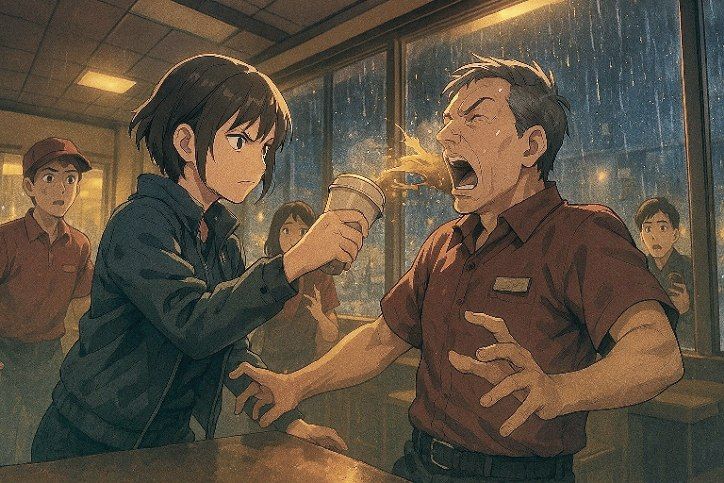
The rain had started as a whisper, then grew insistent, striking the asphalt with a cadence that seemed to set the city's pulse. On the corner where two avenues met, the illuminated sign of a fast-food place cast warm light over puddles reflecting streetlights and signs. Inside, the familiar mix of smells—hot oil, toasted bread, freshly brewed coffee—held a fragile normality: customers flipping through newspapers or looking at their phones, a mother trying to control an restless child, employees keeping their shifts with a practiced choreography. That afternoon, however, normality broke at a small but precise point. She appeared with lit eyes, her clothes slightly rumpled from the rain but her posture firm in a way that brooked no excuses. She stood in line with the expression of someone counting every lost second and tallying it as a debt. "I've been waiting twenty minutes," she said when she reached the front. "They told me my order was canceled. I want a refund." The young woman who served her replied with the professionalism of faces that repeat apologies daily: soft, measured. Her hands were damp from the bucket she used to dry trays; fatigue read across her face more than confrontation. "I'm very sorry, ma'am," she answered. "I can issue a refund, or while we resolve this, offer you a complimentary coffee." The customer let out a short, bitter laugh, as if the offer were an affront. "A coffee? Do you think that pays for my time?" the word came out sharp. "I don't want a freebie. I want my money back and someone to take responsibility." The hum of the place shifted frequency; some glances fixed on the scene, others tried to look away. An employee picked up the phone as if smoothing a rough sheet of paper: he paged the manager, and within minutes the person in charge appeared. She was a woman in her fifties, her face hardened by years of work and the calm of someone who had weathered many grievances. She walked confidently toward the customer, her voice modulated, patience trained like a muscle. "Please calm down," she said. "We'll check your order and, if applicable, refund you. Take this coffee while we sort it out." She handed over a cup that gave off a faint toasty aroma. The customer took it but didn't drink; she held the cup like a commodity, not a comfort. Her eyes searched the manager's face with a mixture of challenge and expectation. "Don't give me things to forget," the customer replied. "I want them to pay for my time. Don't give me half answers." The manager nodded and turned her back for an instant to access the register and begin processing the refund. It was a brief, routine gesture without drama. And in that thread of seconds, the decision that would upend everything was made. In a corner of the restaurant, a group of young people spoke in low voices; one of them recorded a video without looking at the screen. No one, except the newly arrived woman, noticed the premeditated movement. Suddenly, the cup waiting in the customer's hand tilted. A dark, steaming stream traced a precise and terrifying parabola. The impact was like a private thunderclap. The hot coffee struck the manager's skin with the force of a physical blow, leaving its mark on flesh and on the silence that followed. The woman's scream tore through the place; some covered their mouths, others ran. The sound of a cup hitting the floor, the slippery tiles, the alarm on a customer's phone replaying the recording: the scene multiplied into sounds and reactions. "It burned me!" the manager doubled over, hands trying to contain the burn, eyes wide with a fear that had no words. "Help! An ambulance!" Those present reacted with automatic moves and confusion. A couple of employees knelt beside her, soaked cloths and began pressing gently on the scorched skin with cool water. An enraged customer tried to reach the attacker as she, instead of staying, spun on her heels and fled toward the door. The rain embraced and hid her. A witness chased for a few steps, shouting, but the figure disappeared into the night. "Stop that woman!" someone shouted. "She had short hair and a dark jacket." Meanwhile, the manager was being attended to with first aid; the rest of the restaurant had become a theater of small urgencies: employees consoling the trembling, customers calling the police, others checking their phones and sharing the video that was already circulating as evidence. That video, blurry at the edges, showed the sequence: the exchange, the offer of coffee, the abrupt gesture, the pouring of the liquid. The images, tangible and cold, began to structure the public narrative of the incident. When the paramedics arrived, the shift was immediate. Professional hands took the woman's pulse, assessed her burns—redness, incipient blisters—applied dressings and placed her on a stretcher with a calm that seemed to conjure order from emergency. "We're taking her to the medical center for assessment," a paramedic told the informal press in the place. "She has second-degree burns and needs specialized care." Police sealed off the site like someone preserving a scene: they cordoned the entrance, logged phones, requested videos, and interviewed witnesses with the rigor of someone assembling a puzzle. Descriptions were fragmentary but consistent in general traits: medium height, short hair, dark jacket. From those fragments, officers began a search that would extend across the city. In the back-of-house, a regional supervisor met with the staff. His words tried to act as a support amid bewilderment. "We will review procedures," he said. "We will take the cameras, cooperate with the police, and strengthen security. We cannot allow anyone to be hurt like this." The employees nodded, but their faces showed that words were a patch for something deeper: a sense of vulnerability. They cleaned the spot where the coffee fell with mechanical motions, as if scrubbing could erase the memory of the incident. An employee who had offered the coffee as protocol wept silently in the kitchen; another worker stood outside watching police photograph and interview customers who rushed to describe what they'd witnessed. At the medical center, the automatic doors closed a world of fluorescent lights and hurried steps. The injured manager, bandaged and escorted by two nurses, leaned against white walls as if seeking to anchor herself to something solid. Care was precise: cleaning wounds, administering pain relief, evaluating burn extent. The doctors spoke calmly about measures and prognosis; pain, however, proved immediate and treacherous. "I didn't expect this to happen," the woman confessed between sobs, her voice thin. "I was just here to work." The following days brought a succession of paperwork and echoes. Images of the incident circulated on social media and among acquaintances, multiplying into conjecture and judgment. For some it was evidence of gratuitous fury; for others it was the extreme manifestation of daily frustration morphing into violence. Police released parts of the investigation: witness statements, camera footage, and a call for public assistance to identify the attacker. Meanwhile, the manager faced a recovery that was not only physical. The burns left visible scars, yes, but also a mark on the memory of someone who had experienced the sudden betrayal of the workplace. Nights brought nightmares in which the customer's figure repeated itself, sometimes with a clear face, other times distorted by the fear. Returning to work was slow: the restaurant reopened with limited hours, more security presence, and revised protocols, but the atmosphere had changed; shifts were full of caution and conversations that revolved around the uncomfortable question: how to prevent violence that springs from the everyday? In the city, the story became conversation. Radio programs addressed the topic, panel shows discussed retail safety and tolerances in public spaces, and neighborhood groups asked for more police presence at critical hours. For the company that owned the place, the episode prompted policy reviews: conflict-management training, response protocols for assaults, and investment in better surveillance cameras. But beyond administrative measures, the evidence remained that a small act—a canceled order, a wasted minute—could, by the choice of one person, explode into harm affecting others. The search for the attacker continued for weeks; police followed leads, analyzed footage, interviewed possible witnesses, and received anonymous tips pointing in different directions. Each lead was hope, each false alarm a frustration. In the neighborhood's collective memory remained a simple and terrible image: the coffee cup, ordinary and harmless, turned into an instrument of harm. That image fueled conversations about empathy, boundaries, and social responsibility. Neighbors spoke in cafés and shops, murmuring like people trying to understand the incomprehensible: how someone crosses the line so easily, and what signals, if any, were missed. The rain returned another afternoon and soaked the city with the same discipline. The lights of the restaurant remained lit, though the glow felt more contained, as if aware that something had shifted. Employees, now trained in new protocols, exchanged looks that mixed professionalism with the caution left by such an experience. The injured manager, still bearing a bandage, resumed work gradually, her recovery driven by medical care and a spirit that swung between determination and fatigue. In the police file, pages accumulated: statements, images, notes. The attacker was still a name waiting to be filled in that record. And in the city, the story remained as warning and memory: a burst of violence born from a disagreement that left visible wounds and others more silent—the ones that settle into the fragile trust that underpins everyday life. In the end, the lesson was not in hunting for simplistic culprits but in acknowledging that public life needs limits and tools to manage confrontations. Measures do not exclude repair: the refund and apologies that initially seemed insufficient became firmer procedures meant to prevent frustration from turning into physical harm. The rain stopped after several days, leaving the pavement clean but with a sheen that betrayed memories. Nights returned to normal, but in the shifts and conversations the mark of the episode remained—a question that does not fade easily: what could have been done to prevent an ordinary cup of coffee from becoming a weapon and a canceled order from ending in injury? Source of the images. Image created with Bing.
No comments yet