 @mc5punk
more from that month
@mc5punk
more from that month
Short story: The accounting of the roots
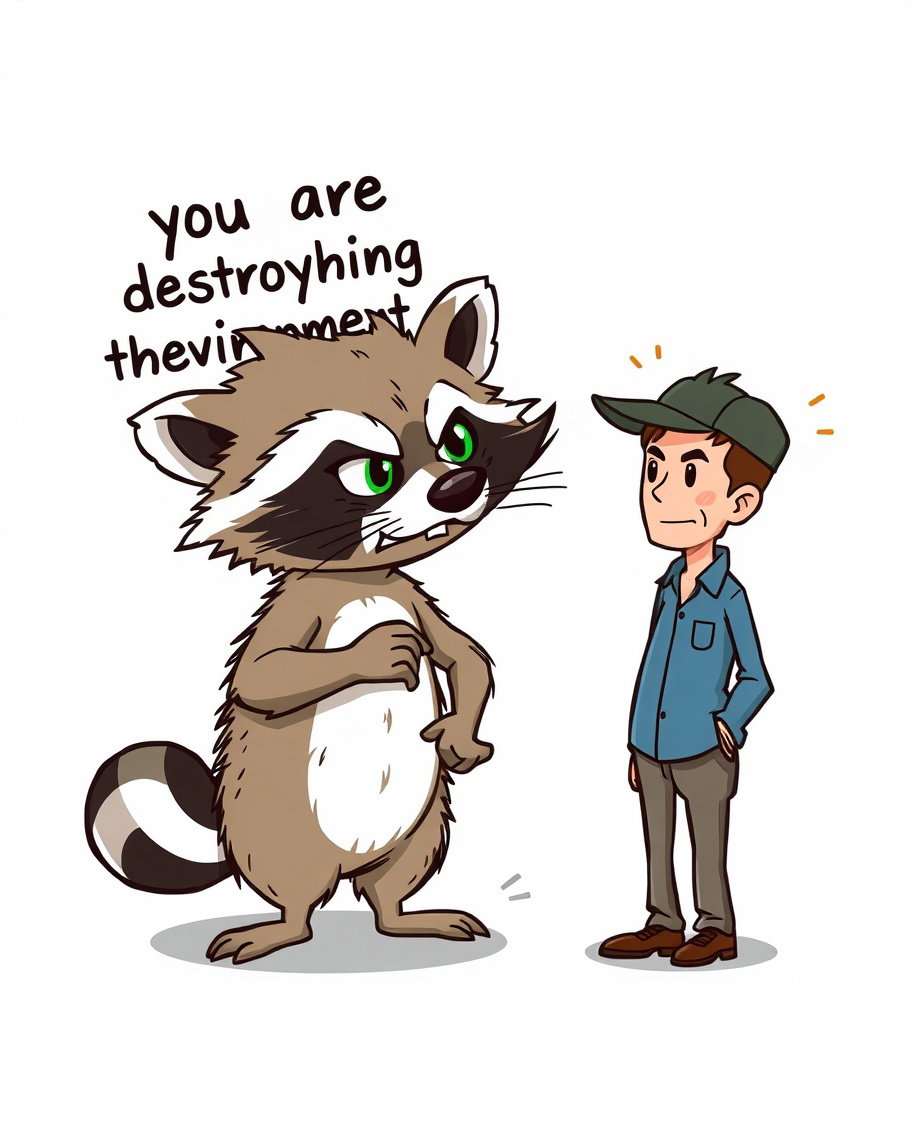
Lucas Herrera had been sleeping three hours a day since he ran Titanium Corp. His insomnia had the mechanical rhythm of the factories he oversaw: intermittent, productive, relentless. Every night, in his smoked-glass penthouse, he mentally organized quarterly balance sheets while the city skyline flickered like a giant casino. The first warning came on a Tuesday at 3:47 AM. A sound of claws scraping marble brought him out of his semi-wakefulness. In the kitchen, an obese raccoon was chewing lemon trout from his catered dinner. -Do you know that your textile factory uses dyes that are banned in 14 countries? - asked the animal, wiping his paws on a silk curtain. They smell of cheap ambition. Lucas attributed the episode to stress. Until when reviewing the reports of his industrial chemistry, he found *"Incident No. 287-B: hexavalent chromium spill in unmapped tributary"*. Factory 7 was located where the Santero River stopped being a tourist postcard to become a sewer. There he met Marina Ríos, a hydrologist who documented fish with phosphorescent scales. "Your 2024 earnings are equivalent to 43 years of detoxification—" he snapped at her, pointing to a meter that read 9.8 mg/l of mercury. The average life of this metal is 68 years. Do you know what it means? "That we need a long-term plan—" he replied, automatically. - No. It means that the children born today will be 70 when this is barely habitable. Marina showed him her portable laboratory: water samples in empty liquor bottles, hand-drawn graphics, an aquarium with a catfish that developed external gills. Lucas felt a familiar twinge, the same one that revealed him when profit margins were down 0.3%. The board of directors rejected his proposal for ecological conversion. * "Shareholders demand returns, not freaky fish sanctuaries,"* the vice president snapped at him. That night, while he was signing checks to silence affected communities, the raccoon reappeared stealing his Patek Philippe watch. - How many extinct species per hour does that junk make? — i mock the animal-. Your accounting forgets key variables. At dawn, Lucas did something irrational: he hired a team of divers to extract toxic sludge from the Santero. The operation cost $2.3 million, exactly what he would have earned by expanding the Cuenca plant. When the media praised his "green spin," he threw up for the first time in twenty years. The final crisis came with the protest of the fishermen. They had formed a human barrier in front of Factory 7, waving flags made of broken nets. Among them was Toño, a 12-year-old boy whose younger brother had heavy metal neuropathy. - You paid for our silence, but who pays for our dead? - shouted a woman throwing a shoe that hit Lucas's windshield. At that moment, he remembered something Marina said to him: * "Your money is like cyanide: more concentration does not improve the result."* That same night, he submitted his resignation using a non-biodegradable fuel bill as a piece of paper. Today Lucas manages *Raíz Común*, a cooperative that installs biological filters made of coconut shells and mycelium. His new office smells of wet dirt and fair trade coffee. The financial reports include columns for "tons of CO₂ mitigated" and "hectares reforested". The raccoon still visits him, although now he prefers to steal oatmeal cookies over confidential documents. Marina says she's probably a menopausal female, or maybe a metaphor with fur. At 10 PM, when the crickets start their concert, Lucas turns off his solar lamp. You no longer need to count sheep, bills or unfulfilled promises. He sleeps soundly, and if he dreams, it is with rivers that return intact mirrors. Source of the images. Image created with Starryai.
No comments yet