 @mc5punk
more from that month
@mc5punk
more from that month
Short story: The Hispanic American Union: A Path to Prosperity and Solidarity
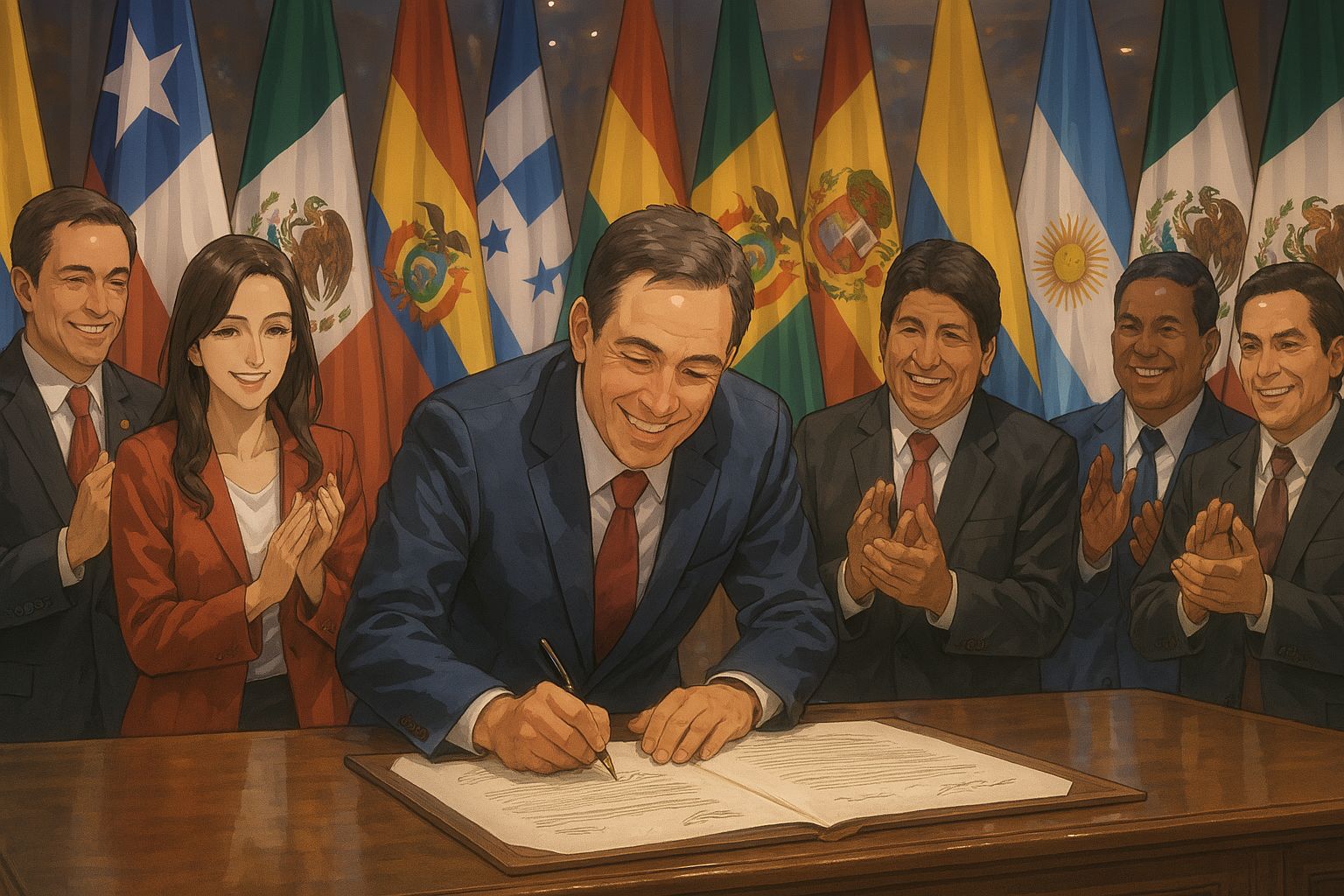
In the not too distant future, the Latin American countries were at a critical crossroads. Economic inequality had reached alarming levels, with millions of people living in poverty and without access to basic opportunities. Political and social crises were happening, and the lack of cooperation between nations had exacerbated the problems. In this context, a bold idea emerged: the creation of a large continental trade and political bloc that could transform the reality of the region. The Summit of Bogota The historic summit was held in Bogotá, the vibrant capital of Colombia, a place that symbolized the cultural diversity and richness of the region. The leaders of nations such as Mexico, Argentina, Colombia and Chile gathered in a majestic convention center, where the walls were adorned with local art and the aromas of Colombian gastronomy filled the air. For days, the presidents and ministers of economy debated in an atmosphere of camaraderie and urgency. On the first day, the president of Mexico, a fervent advocate of integration, presented a report highlighting how the union of their economies could increase regional GDP by 20% in the next decade. His speech was passionate, full of statistics and examples of how cooperation had benefited other regions of the world. He spoke about the need for a unified market that would allow countries to compete on equal terms on the global stage. However, not everyone was convinced. Some leaders expressed concern about the loss of sovereignty and fear that larger economies would dominate smaller ones. The president of a Central American country, with a more fragile economy, raised his doubts about how his nation could benefit from an agreement that, at first glance, seemed to favor the most powerful. Overcoming Challenges As the negotiations progressed, tensions arose. In one of the sessions, the President of Argentina raised the need to establish mechanisms that guarantee equity in trade. He proposed the creation of a compensation fund to help the most vulnerable countries adapt to new market conditions. His proposal was met with applause, but also with skepticism from some leaders who feared that this could divert resources from their own economies. To address these concerns, forums and workshops were organized in which citizens, entrepreneurs and academics were involved. Round tables were held in which the benefits of integration were discussed, and success stories of small and medium-sized enterprises that were already collaborating at the regional level were shared. The active participation of civil society helped to build a sense of belonging and unity. In one of these sessions, a group of young entrepreneurs presented an innovative project that used technology to connect local producers with international markets, which inspired many leaders to see the potential of collaboration. The Signing of the Treaty Finally, after months of hard work and intense negotiations, the treaty formalizing the creation of the bloc was signed. The ceremony took place in a majestic auditorium in Bogotá, where not only the leaders gathered, but also representatives of civil society, artists and citizens who had followed the process with enthusiasm. The signing of the treaty was an emotional moment, full of applause and cheers. The leaders pledged to work together to build a prosperous and sustainable future. The treaty not only established a common market, but also included clauses on labour rights, environmental protection and promotion of culture. An intergovernmental council was created that would be responsible for overseeing the implementation of the agreed policies and resolving disputes between member countries. The Implementation and its Results With the treaty in force, the countries began to implement the agreed policies. Monitoring committees were set up to ensure that the promises were kept. Customs were modernized, and tariffs that previously hindered trade were eliminated. Companies began to benefit from a wider market, and consumers enjoyed a greater variety of products at more competitive prices. Small and medium-sized enterprises, which had been the most skeptical at first, began to see the benefits of integration. Trade fairs were organized where entrepreneurs could showcase their products and connect with buyers from other countries. A Colombian coffee producer, for example, managed to export his product to markets that were previously inaccessible to him, which not only increased his income, but also generated employment in his community. As the bloc grew, so did collaboration in areas such as education, health and culture. Student exchange programs were launched that allowed young people from different countries to get to know new realities and share experiences. Universities throughout the region began offering scholarships for students from member countries, fostering a sense of shared identity and a deeper understanding between the diverse Hispanic American cultures. In the field of health, cooperation networks were established to address common diseases and improve access to medical treatments. The countries shared resources and knowledge, which resulted in a significant improvement in medical care in the most vulnerable areas. Joint vaccination campaigns and public health programs were implemented, benefiting millions of people who previously had no access to basic services. The Celebration of Diversity Culture also flourished in this new context of collaboration. Cultural initiatives celebrating the diversity of the region were promoted. Music, dance and gastronomy festivals were held in different countries, where artists from all over Latin America gathered to share their talent. The music of salsa, tango, mariachi and other genres resonated in every corner, creating an atmosphere of joy and unity. An emblematic event was the "Festival of Integration", which was held annually in different cities of the bloc. During this festival, theater plays, art exhibitions and gastronomic fairs were presented that showed the cultural richness of each country. The participation of the community was massive, and the streets were filled with colors, rhythms and flavors that reflected the shared identity of the region. A Common Future Over time, the trade and political bloc became an example of cooperation in the world. The Latin American countries not only managed to improve their economies, but also strengthened cultural and social ties. The union allowed them to face global challenges, such as climate change and economic crises, with a unified voice. Together, they developed environmental policies that promoted sustainability and the protection of natural resources, aware that their future depended on a healthy environment. The story of how the Hispanic American countries came together to create a great continental commercial and political bloc became a symbol of hope and progress. Collaboration and solidarity proved to be powerful tools to transform realities and build a better future for all. The leaders who had once gathered in Bogotá were now seen as pioneers of a new path. In every corner of the region, people were talking about the importance of unity and how, through working together, they had managed to overcome historical barriers. The integration had not only brought economic benefits, but had also sown a sense of belonging and pride in the Hispanic American identity. Thus, the great commercial and political bloc was not only consolidated as an economic entity, but as a beacon of hope for the world, demonstrating that union and cooperation can change the fate of entire nations. In this new chapter of history, the Hispanic American countries looked in the mirror and saw not only their differences, but also the strength of their diversity, united in a common purpose: to build a prosperous and sustainable future for future generations. Source of the images. Image created with Bing.
No comments yet