 @mc5punk
Short story: The Silence of the Pinewood
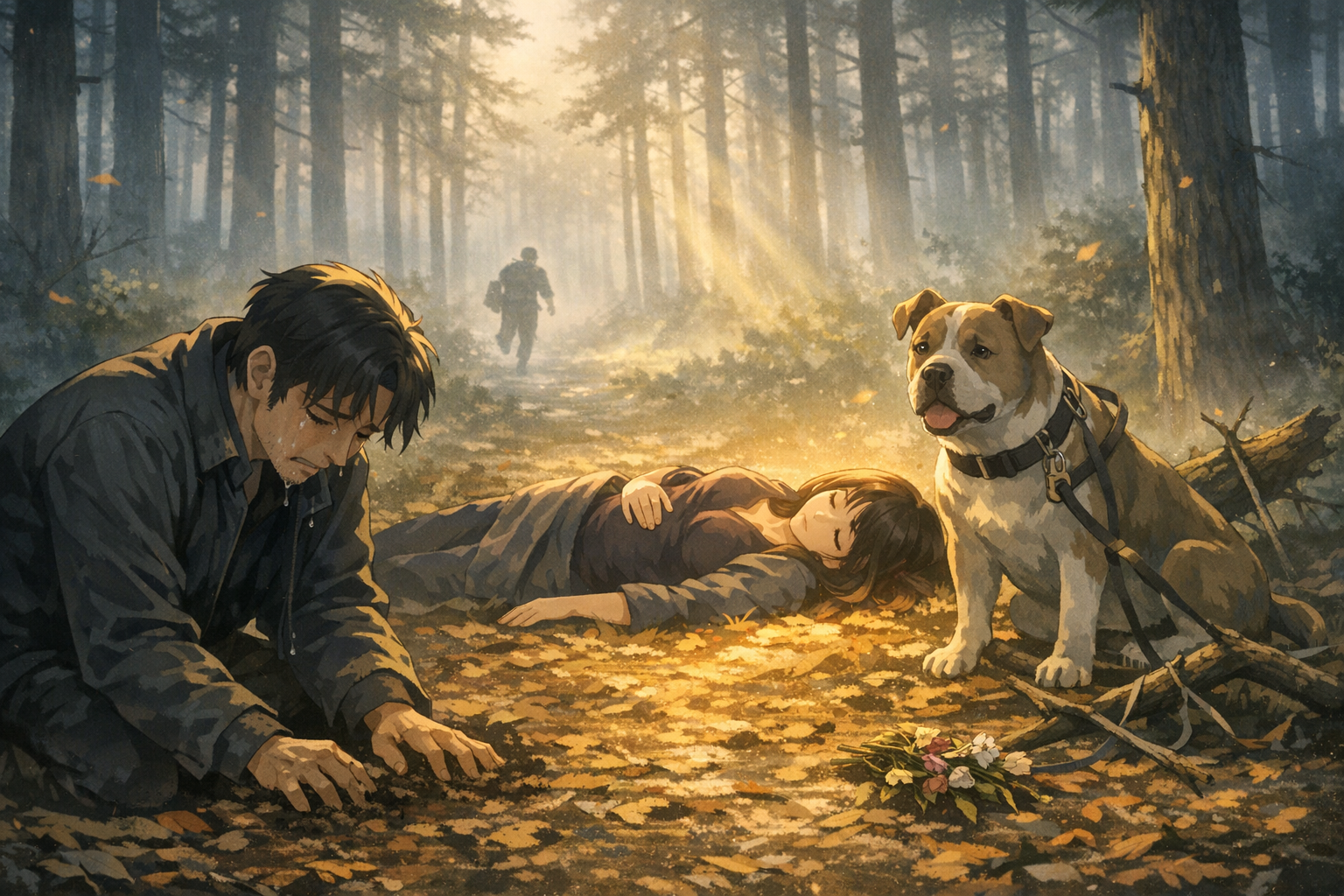
The pinewood of Clairval smelled of resin, dampness, and a cold that seemed to reach into the bones. Through the crowns of the pines, light fractured into pale strips that fell across the paths. Sofía Laurent walked slowly, her right hand cradling the belly where a future still unfamiliar with shadows beat. Her coat shivered in the wind; her breath kept a calm rhythm. Rocco, the pit bull, strained at the leash with the force of his youth: the dog sniffed every branch, every nook of the trail as if claiming belonging to that landscape. The morning had that slowness of things that seem built to last. Marc Delorme had not been able to accompany her. His shift at the factory had kept him until the last minute. The night before there had been a brief argument: duties, fatigue, a decision made hastily to avoid time turning into a fight. Sofía insisted she needed the woods to order her thoughts; Marc, hurried by work, said she should go down alone and he would arrive later. It was a clumsy, everyday negotiation, an agreement that on other occasions had been nothing more than an anecdote. No one imagined that walk would close a chapter forever. As she neared the clearing, a scream sliced the air and tore everything apart. It was not the long moan of illness nor the muffled call of someone asking for help: it was a sharp shock, an exhalation of panic that pierced trees and time. Antoine, who was splitting wood at a distance, dropped the axe and ran through the branches. What he found made him stagger at the edge of the world: Sofía lying on the ground, hair matted with blood, her face halfway between life and absence; Rocco immense, panting, bewildered, the leash tangled like an unresolved question. Antoine, voice broken: “My God! —he shouted— Sofía! Sofía, answer!” Rocco, between pants, sniffed the earth, unable to understand the human gravity of what had happened. The minutes that followed were a succession of brusque movements and jumbled words. Neighbors arrived, an ambulance, the municipal inspector. The wounds were deep and multiple. The bites on her limbs and head showed the violence of a sustained attack; blood soaked leaves and earth with an indifference that gave the pinewood a new tone. In a matter of minutes, what had been an ordinary outing became a scene of devastation. Sofía died there, without the future she carried inside even being able to be born in words. When the news reached the town, it spread with the speed of the unbelievable. The courthouse weeks later filled with faces that needed a name for their pain. Cameras and whispers occupied the corridors as if waiting for a conclusion that could order the chaos. Marc entered stooped, shoulders weighed down by what had happened: the absence, the family's anger, the word “negligence” already floating in the air. Clara, Sofía’s sister, did not let distance become routine; she confronted Marc with eyes fixed in accusation. Clara, pulling her voice until it broke: “How could you let her go alone with him? She was pregnant!” Marc, eyes red but voice controlled: “It wasn’t my intention. I thought she could handle him. I didn’t imagine... I never imagined this would happen.” In the courtroom, the prosecutor unfolded his thesis with the gravity of one who measures consequences: “He allowed a pregnant woman to walk alone with an animal that represented a demonstrable danger. That is not a minor negligence; it is an omission that cost a life.” His voice pressed the need to show the law as a shield for the community, an answer against improvisation that, he argued, had cost the most precious thing. The defense, Maître Girard, replied with the composure that comes from putting facts in order: “My client could not have foreseen an episode of this magnitude. Rocco had no history of aggression. Marc and Sofía lived with the dog; the animal did not show signs of uncontrollable violence.” His argument sought to move the tragedy from the realm of personal guilt to that of an unpredictable fatality. Witnesses unraveled the story in fragments. Antoine recounted afternoons when Rocco would run after sticks and return to Marc’s hands with nothing more than a playful bark. Neighbors spoke of torn cushions at home, of broken toys, of one occasion when Rocco ripped a curtain, but nothing indicating a lethal aggression. Inspector Baudry showed photographs of the scene: stains on the leaf litter, tracks that disappeared among roots, the trace of a brief but fatal struggle. On the evidence table appeared Sofía’s notebook, with lists of names for the baby and small phrases that sounded like promises: “I want everything to be okay. I imagine you pregnant and happy. We must travel to the coast next summer.” Inspector Baudry, pointing to the images: “The injuries are consistent with a prolonged attack. There was no timely intervention, and the wounds to the head and limbs caused the massive blood loss.” Maître Girard: “That does not prove Marc foresaw or sought this outcome. It proves a tragedy, yes; it does not prove malice nor foreseeability equivalent to a criminal offense.” At one point during the proceedings, with the room holding its breath, Marc took the stand. His voice trembled, more from the weight of memory than from the presence of the court. “If I could go back, I would —he said— I would accompany her every time, I would have kept the leash shorter. I didn’t mean to put her in danger. I never thought it would end like this.” His words came out like ash: they healed nothing; they only made visible the internal collapse of a man beyond remedy through explanation. Clara, eyes fixed on him, answered: “She didn’t ask to die. She asked for company, for someone to look after her. That is not too much. How did you not see it?” Her voice was accusation and lament; it contained the claim of a family that had lost a sister and the child she carried. Meanwhile, Rocco was taken away. Sent to quarantine for evaluation, the pit bull became the subject of experts. Veterinarians and behaviorists reviewed his history, his conduct, his training records. They sought in his past a pattern, a sign that would explain what happened. Rocco’s gaze, however, did not carry the burden of human guilt: the animal sniffed, lay down; his ignorance of the law rendered him tragically innocent and, at the same time, the axis of accusation. The pinewood bore the mark of an absence no one knew how to name officially. Paths that once echoed ordinary steps now held a sharp silence. The town square filled with voices; cafés and benches turned into parallel courts where people asked what responsibility meant and where recklessness began. Should the law stand as a warning to owners? Would it be fair to hold a man accountable for a death that sprang from a dog’s mouth? In conversations, some defended strict justice as prevention: “If there are no consequences, no one will take care,” said a shopkeeper. Others, looking at Marc, spoke of the cruelty of punishing an individual who had already lost what mattered most. “Prison doesn’t bring back life,” said a woman in the square, and her phrase lingered as another truth. Marc returned to the house where mugs on the counter still held the trace of a routine that no longer existed. Every object was a memory trap: the scarf Sofía loved, a shopping list with smeared ink, a mug with a coffee stain that silently testified to a shared morning. In Sofía’s closet, Clara found clothes folded with care—little dresses—and notes with names that now sounded like epitaphs. She kept a garment as one keeps the map of what’s lost: the fabric smelled of her and of impossibility. One afternoon that seemed to apologize with soft light, Marc went back to the pinewood. Nothing and no one stopped him. He knelt where flowers had been left by neighbors who did not know any other gesture than offering. He put his hands in the earth like someone seeking shelter in the primitive, like someone who asks the world for a key to undo time. Marc, voice reduced to a thread: “Forgive me… forgive me for not being there.” The earth did not answer. Only the breeze swayed the pines’ crowns with a gentle consistency that had no words. The day of the sentence arrived. Judge Renaud sat behind her bench with the serenity the role demands. The evidence had been heard, the testimony presented. Now the law had to speak not only to the facts but to what those facts might mean for the future: a precedent, a warning, an interpretation of responsibility. In the courtroom, the wait became painful; for some, the verdict would be reparation; for others, a word capable of deepening the wound. When the sentence was read, it did not produce the effect of an absolute closure. The decision—whatever its severity—resounded beyond the courthouse walls: in cafés, on benches, in mailboxes. The discussion continued in town: how to walk dogs, what measures to take, when the law should intervene. In that collective murmur something good persisted: more people began to measure their responsibility with new care. In that collateral effect lay perhaps a glimpse of preventive justice. But the law did not return Sofía or her child to the life they had stopped being. The absence remained an incontestable truth. Clara, voice calmer and gaze fixed on the horizon, left a flower at the clearing and murmured: “I promise I will not forget you.” Marc continued his life with the particularity of someone who carries an unsurpassable pain: small salvations and many renunciations. Rocco was rehoused after evaluations, his fate decided by experts who tried to measure the complexity of the animal with human categories. The pinewood of Clairval kept breathing, indifferent to the men’s verdict. Its paths preserved forever the memory of a walk that began like any other and ended as an open wound. In town, the lesson remained planted: human fragility demands care, and living with powerful animals requires precautions that sometimes come too late. In the silence that followed, Sofía’s promise—written in a notebook now folded among pages—remained suspended: names that would never be spoken aloud, plans never made, an absence that admits no consolation. Source of the images. Image created with Bing.
No comments yet