 @mc5punk
more from that month
@mc5punk
more from that month
Short story: The Last Soviet Citizen
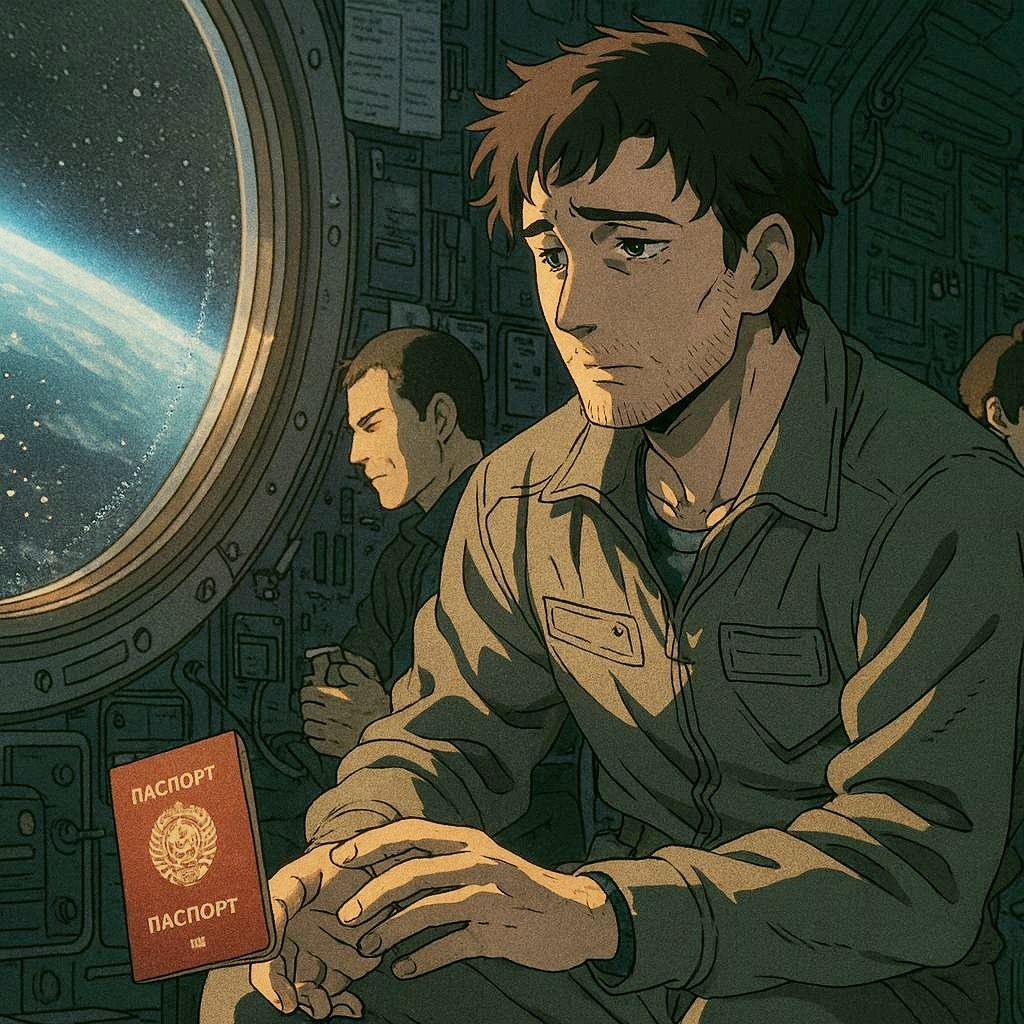
May 1991. The launch pad ignited like a waking heart; the rocket spat fire and pressure, and the capsule separated from the ground with the absolute violence of someone breaking chains. Sergei Krikalev tightened his gloves, felt the pull that drives blood to the head, and for a moment life reduced to a sequence of instructions and the mathematical probability of return. With him were Anatoly Artsebarsky, with his rough voice and workshop calm, and the Briton Helen Sharman, curious and contained, carrying the novelty of having reached a place where so few had been. —Are you still not used to seeing Earth like this? —Artsebarsky asked as soon as the capsule stabilized. —Never, —Sergei said, staring at the blue curve cutting into the black—. It’s like reading a book that turns its pages without warning. The Mir station welcomed them with its familiar creaks, its panels like ribs, and its mechanical rhythms. The mission was concrete: five months of work, inspections, replacing parts, installing new modules. Every task was planned in lists that hung on the wall, paper butterflies that gave structure to the daily routine where repetition was both salvation and condemnation. The first months passed as expected: calibrations, system checks, experiments in biology and materials, radio talks, and laughter during free periods when tension loosened. Mir—small, metallic city—was home and workplace. Time, measured in revolutions around the planet, kept the cadence of a pendulum: dawn every ninety minutes, micro-rests, exercise on machines that simulated gravity. On Earth, however, history was breaking into pieces. August brought rumors that began as loose threads and soon became nets catching normalcy. Brief transmissions arrived: news of an attempted coup against Gorbachev, images not always easy to understand, reports written in haste. Ground–station controllers relayed: “Remain on Mir until further notice.” The phrase echoed over the speakers: an administrative instruction that in practice meant extension. No one initially imagined that that “until further notice” would become a sentence. Bureaucracy tangled with economic crisis; budgets dwindled. Scheduled rockets did not launch. Launch-support services lacked funds or authorization; timetables became lists nobody signed. —What does “until further notice” mean? —Helen asked one night, her voice thinned by fatigue and distance. —It means they don’t know what to do down there, —Artsebarsky said bluntly—. It means the world we thought stable is changing. October arrived with a cutting silence: the relief crew did not show. Baikonur, the cosmodrome that had been the red carpet for so many launches, fell under the sovereignty of a republic declaring independence: Kazakhstan. Borders, which look like lines on maps, soon had the power to change plans. For Krikalev and his colleagues, reality grew strange: they were citizens of a nation losing its hold over the platform that had launched them into space. —I am a Russian at a foreign base, —Sergei said in a private transmission, almost in confidence, as he rubbed his forehead and looked at Earth’s lights—. What does a man do when his passport can’t find its country? The question floated without a clear answer. Documents became relics: stamps that lost validity, names of states fading from official bulletins. Politics, fierce and pragmatic, crept into daily paperwork: canceled launch contracts, unpaid suppliers, personnel lists subject to new loyalties and flags. December felt like a historical shears cut. On the 25th, officially, the Soviet Union ceased to exist. Fifteen republics emerged as new independent states. For Krikalev it was both news and abstraction; he was on Mir, watching humanity announce the end of an era while his body floated with the forced calm of someone who must continue with scheduled duties. On the station, the phrase “last Soviet citizen” began to circulate in transmissions and newsrooms. Officially, for a few more days, his name remained registered under a country that no longer was. The days turned into stark numbers: 5,000 orbits; over 28 million kilometers traveled around Earth; 311 days slipping between tasks, transmissions, and silences. The gulf between station life and life on Earth showed on his body: five kilos lost, muscles reneging on their use, bones craving the authority of weight. Weightlessness leaves a precise, brutal bill: what the body learned in gravity is forgotten, and every return is a process of physical reconstruction. —You don’t know how much it will cost you to stand again, —a doctor told him by radio when the return was finally planned—. Prepare to learn how to walk again. Sergei heard it without complaint. On Mir he had learned that complaints floated and dissolved in recycled air. Beyond the physical there was the symbolic: his passport, printed with the USSR emblem, had become an object with its own history; his hometown had a new name; the currency people used had been replaced in their pockets by bills with different faces and colors. Meanwhile, on the ground, some did not abandon the wait. Seventeen technicians, cosmonauts, and officials worked against disorder: they translated decrees, reprogrammed missions, negotiated with new authorities at Baikonur, pushed for flights to resume. Their labor was an improvised web of bureaucracy and humanity that, despite everything, sustained the possibility of return. Negotiations over cosmodrome use, necessary payments, and international responsibilities intertwined with the reality of men in orbit needing a spacecraft to descend. When finally the return was decided, the reentry capsule was prepared like someone readying an exhausted animal for the journey home. The atmosphere—air humanity takes for granted—bit into the craft with controlled fury: heat, vibrations, deceleration. Reentry is a kind of purge: the machine does what it must, and the man trusts the skill of those on Earth who had wrestled with politics to open the window for his descent. On March 25, 1992, the capsule touched down. A tenth of the familiar world felt strange and renewed. When the hatch opened, Sergei’s knees trembled like dry leaves. He could not stand without assistance; the first steps were slow, ceremonious, and painful. —You’ve been 311 days without gravity, —a physician said, holding him by the arms—. It is no small thing. —But I saw a country disappear while I floated, —Sergei murmured, with a mix of irony and sorrow—. I became a living archive of a territory that ceased to exist. Honors came quickly and publicly: medals, official declarations, the title Hero of Russia as formal recognition. Insignia gleamed on his chest and translated institutionally a sacrifice that had technical and symbolic dimensions. The press tried to sew the narrative: a man who left as a Soviet citizen and returned as a Russian; an involuntary witness to the collapse of a superpower from the silence of orbit. Yet decoration did not heal the fatigue nor undo the intimacy of the experience. Muscles regained strength with long physiotherapy; the body’s memory realigned. Sergei reintegrated into professional life: he took part in new missions, assumed administrative and technical responsibilities, and over the years became director of flight operations. He returned to space six times in total, adding experiences, wisdom, kilometers, and human bonds that can only be understood by sharing the same artificial atmosphere. Still, a persistent melancholy shades his account. In interviews and conversations his voice grows measured when he recalls those days on Mir when politics slipped through the cracks of daily life. It was not easy to be a professional who, doing his duty, watched his national identity be transformed into an administrative act. Postcards brought back were different: new flags, different street names, redesigned banknotes. Human geography was reconfigured into maps that no longer tracked his point of departure. In the station’s intimacy, relationships between crewmates became another way to measure history. Artsebarsky, with his dry humor and readiness to fix what failed, and Helen, with her exploratory glance, left imprints: laughter shared in weightlessness, late-night conversations about what each had left on Earth, small gestures that preserved sanity. Those dialogues remain like little torches illuminating the vastness of memory. “What do you do with a passport that can’t find its country?” was the question, echoed by journalists and young people, that often made Krikalev pause. His answer—simple and profound—has usually been almost literal: you live. Bureaucracies are remade, new documents issued, records transferred; daily life reconstructs the administrative. But for the individual the experience lingers: the sensation of having been subject to a change he did not ask for, of having been observed by history from a place history seldom returns to. His story—the man who orbited the end of an era—remains read as a powerful metaphor: politics reaches even those floating beyond the planet. Mir’s isolation did not suffice to protect him from the consequences of decisions and crises made at distant tables. He was an involuntary witness to the transformation of the world known to his generation. Over the years Sergei Krikalev became a reference figure: respected technician, trainer of new generations of cosmonauts, flight operations manager, and in collective memory the symbol of a transition lived firsthand. His six spaceflights and long career speak of professional continuity beyond political rupture; they also speak of the human capacity to adapt, even when the center of identity shifts. Even today, when asked about Mir or those 311 days, his gaze turns both distant and precise. He speaks of small details—the constant hum of the ventilation system, the sunrises repeating like a metronome, the texture of rehydrated food in quiet moments—and of the grand images: Earth, immense and fleeting; borders on maps that suddenly changed color. Krikalev’s narrative is more than a survival chronicle: it is a non-fiction novel in which the dramatic is not the technical epic but the human condition facing history. It is the story of a man who did his job while the world rewrote its names. It is a confirmation that sometimes political decisions step on those who carry out daily work. And, above all, it is a warning: the lightness of space does not exempt anyone from the weight of human decisions. In a late interview, asked to define those experiences in a few words, he said: —I floated above the end of an era. I learned that homeland is not always on a map; sometimes it is in the hands that help you stand when you return. That sentence, full of nostalgia and dignity, sums up the complexity of a life that links technique and memory. Sergei Krikalev did not only return to Earth with medals and figures on his record; he came back with a story that reminds us that space, however distant, is not immune to human politics, and that history can reach us even when we are farthest from Earth. Source of the images. Image created with Bing.
No comments yet