 @mc5punk
Short story: The House of Thread: The Infant Who Learned to Be a Monkey
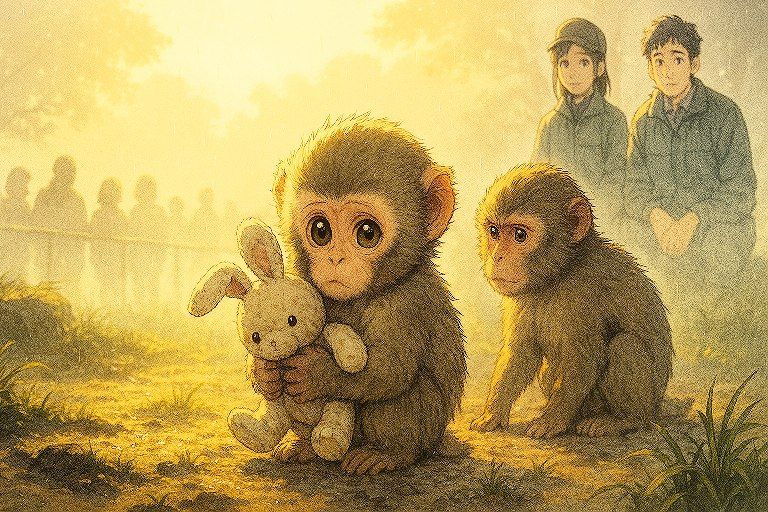
In the tempered gloom of dawn, mist clung to the branches of Sora Zoological Garden, as if trying to shield from view what was happening there. She was born in July, small and cold, and the first time she sought her mother’s warmth she was met with silence. The infant was set aside. The keepers named her Kiri. She was barely a whisper of life, the size of a promise. The mother, young and frightened by the heat waves of that summer, did not know how to take her. The park’s veterans murmured that sometimes inexperience and heat make instincts falter; they said it as one explains a storm. For Kiri it wasn’t an explanation: it was abandonment. The first days in the incubator were a succession of impeccable routines and trembling hands. The primate nurses worked endless shifts; some keepers brought coffee at two in the morning and others stayed reading the irregular glow of the machine that kept the temperature. Nights were long and, for those who had never seen a newborn of her species, every breath was a miracle to be protected with almost sacred measures. At first they held her in cloth. The first nights the little one clung to rough towels that smelled of sweat and soap, looking for a kind of embrace. Nothing soothed her completely until, in a box of donations forgotten in a closet, a stuffed toy appeared: a bunny with worn tips and sewn eyes. They called it Tsumu. From the first heartbeat, Kiri and Tsumu were one. “Look how she clings to it,” said Hana, the keeper who spent nights beside the incubator. “She doesn’t just sleep; she eats, plays, and walks with that little bunny pressed to her chest. It’s as if she has found a cloth mother.” Hana had large, callused hands from hoses and pruned bushes; yet when Kiri curled up against the toy, her fingers grew gentle. She was the one who first put a small cotton scarf on her to stop her from scratching and who hummed an invented lullaby in the dimness of the night shift. In Hana’s voice there was fatigue, but also the warmth of someone who had decided not to fail. The toy was not only comfort: it was a bridge. With Tsumu in her arms, Kiri allowed herself to explore the world with a certainty she had not yet found in human hands. She walked through glass and mud corridors with the toy clutched, and visitors who came to the zoo noticed something not taught in manuals: a tenderness suspended in time, capable of halting steps and drying unexpected tears. The visitors’ cameras and the park’s own cameras captured that scene again and again. Recordings showed the infant hugging her toy while trying pieces of papaya, sleeping with her snout pressed to the cotton, turning her head at the slightest sound. Soon videos of the infant with the toy in her mouth began to leap from phone to phone; on social media a story emerged that no one had asked to write and yet everyone wanted to read. At the same time the human affection grew, the keepers knew Kiri had to learn to be a macaque. The main enclosure was not empty: a troop of fifty-six individuals lived there, rough and wise, each with scars that told winters and grudges settled in pieces. There were males who commanded respect by stance, females with eyes that measured threat, and youngsters who played with the insolence of youth. The troop was a school made of smells, tastes, and small lessons of social survival. They began a slow and patient socialization process. First, noses and glances through nets; then supervised hours on the same ground; finally, tentative encounters that smelled of discovery. Barriers were placed to allow visual contact without full physical contact; hours were exchanged between the incubator and the main grounds; curious macaques were invited to roam, to sniff, to learn that this was not a strange creature but an infant born of the same blood. The first approach was not friendly. When the infant, still glued to Tsumu, was introduced to the troop in January, several adults surrounded her with distrust. In the videos her chest seemed to shrink; there were moments when Kiri retreated, hid her face between the toy’s legs, and seemed to ask whether she would ever belong to that place of shadows and fur. A juvenile swatted the air with an arm, another sniffed and pushed her aside with a low growl; the tension cut like a string. “Don’t worry,” Ryo, head of the primate area, whispered softly as he adjusted the camera. “Beginnings are always difficult. Leave her a little more time; let them smell her at their own pace.” Ryo had spent years caring for animals who sometimes needed more understanding than medicine. He knew the troop’s rules: don’t rush, don’t intervene unless necessary. His experience allowed him to read the troop’s cues: a held look, a slow approach, a grooming offered. He knew patience was the most effective tool, and that human closeness should be a cautious shadow so as not to hinder natural behavior. On February 5, Sora Garden decided to present her to the world. They posted a message on their X account: a blurry photo of an infant with a stuffed bunny and a simple sentence. What followed was a cascade. Thousands of people wrote words of encouragement. In a few days, tags like #FuerzaKiri and #TsumuInvincible filled comments with drawings, messages, and promises of visits. Stories multiplied: artists drew the bunny with flowers, a girl sent a porch full of hearts, a grandmother wrote that she saw her granddaughter in Kiri. The following weekend the park received about eight thousand visitors, double the usual number. Families, couples, and solitary visitors came to look at the infant who slept with her toy and to feel, for a moment, that something small could heal them. The impact was not only emotional; it changed the zoo’s routine. Shifts were reorganized to handle visitor flow, informational panels were set up to educate about the species, and barriers were placed to allow viewing without disturbing. Many visitors left notes and drawings in a box by the fence, and volunteers would collect those letters, read them, and cry in silence. The global attention that arrived in a thread of notifications became tangible presences: hands clapping at distance, eyes following every gesture of Kiri. Kiri weighed less than two kilos. She still received assisted feeding, bottles offered by hands smelling of bleach and coffee; it was a precise choreography: whoever fed her had to measure dosage, temperature, and patience. But with each day the cracks healed. Troop members began to groom her: a simple, ancient gesture that contains an entire language. An adult brushed her with a palm, another removed a fly from her face. Those touches were small approvals. “I saw her last night,” Mei, a volunteer, said with contained voice. “A young male passed his hand along her back. She accepted it. She was still, as if learning to trust another’s hands.” Mei had a habit of bringing small portions of peeled fruit for those who accepted being approached; the night she spoke, she had watched Kiri for hours, measuring each movement as if charting the growth of a sprout. Her words carried relief: the infant was no longer a strange lump among others, but a piece within the complex mechanism of the troop. Tsumu remained, ear frayed, yet indispensable. Even as the group taught her to fight for fruit or recognize rivals, the infant found in that toy a calm nothing else could provide: she curled up, closed her eyes, and for a second the world became a warm room with shadows breathing at the same rhythm. The bunny, its seam mended again and again by Hana, was a reliquary of security. With each visit Kiri grew on social media; millions saw her story and took it to heart. On the screen her face became a symbol of tenderness and resilience; comments mixed jokes, drawings, and travel plans to see her. In real life the changes were more discreet and profound. The infant mimicked gestures, snatched a piece of banana, hid and reappeared with a leaf dangling from her mouth. She learned that the troop’s rules and tenderness were braided together: those who approached had to respect rhythms, those who stole a fruit risked a reprimand, those who groomed were admitted. Weeks later Ryo posted a short update on the garden’s account: “Kiri is improving her interactions… she learns day by day how to live as a monkey within the troop.” No one noticed the tremor in his voice when he wrote it. No one read the silences behind the sentence: sleepless nights, heaters turned on, the fear that heat might erase the story again. Public statements were precise and brief because information and the care of a creature still forming had to be guarded. On a fine rainy afternoon, when the light was barely a murmur and the mud smelled of leaves, Hana watched the infant from the enclosure’s ledge. Kiri slept tangled with Tsumu, and beside her a young macaque watched over her, its shadow cut against the wet earth. Hana let out a small laugh, a mixture of relief and exhaustion. “Look,” she said without taking her eyes off them. “She’s not alone.” Kiri opened her eyes, looked around, and for the first time put the toy down on the ground. She looked at it for a second, as if greeting an old friend, then rose to fetch a stick. It was a tiny, nearly imperceptible gesture, but charged with new courage: she recognized someone nearby, that the cloth embrace could be accompanied by real hands. The troop did not receive her like a queen, nor did she pretend to be one. They did what true things do: with tests, with blows, with caresses. Step by step, Kiri learned to stitch her small world to other furs. Days followed with their mix of routine and surprise. There were mornings when the infant was defiant, tugging another’s tail as if daring fate; others when she curled silently in the shade of an adult while the rain turned her hair. The keepers took notes, recorded weights, logged the duration of each interaction; sometimes those sheets seemed more important than public reports because they were the intimate map of recovery. Visitors over time ceased to be mere spectators and became emotional collaborators. They brought letters placed in a box by the fence: drawings, promises, a train ticket that read: “Thank you for returning hope.” Some children left small dolls; most of the offerings were for Tsumu, as if people wanted to bolster the army of comforts that helped the infant. Volunteers collected the notes and pinned them to an internal board so sleepless nights would be more bearable: reading that someone elsewhere thought of Kiri gave strength. One mild winter day while low sun struck between the treetops, Ryo approached Hana and Mei in the service corridor with a smile trying not to sound proud. “You’ve done great work,” he said. “It’s not just because of the toy; it’s because you respected the timing.” Hana shook her head humbly. “It wasn’t only that,” she replied. “She brought something else: the courage to cling to something small when everything around seemed enormous.” Mei added softly: “And we learned from her. She taught us not to hurry affection.” Kiri’s story, however, was not reducible to displays of affection or viral posts. There was a thread of nostalgia running through every act: nostalgia for the embrace that never came, for the mother’s silence, for the certainty broken at the start. That nostalgia transformed into care: human hands tried to cover the lack with daily acts— a warm bottle, a guarded rest, a shared piece of fruit. Over time the troop accepted her with reservations that gradually eased. Groomings became more frequent; games began to include Kiri, sometimes clumsy, sometimes confident. She learned hierarchy as she lived it: respect for elder stares, fleeing from a hard clash, quiet joy when a companion handed her a peeled fruit. Kiri copied gestures and learned to make small jokes understood only by those who grow among fur and leaves. Days passed and the networks kept watching. Views on Sora Garden’s profiles reached numbers the staff could hardly believe. But inside the enclosure, the real change was smaller and more valuable: the infant stopped relying on the toy for all her comfort. Tsumu remained, mended with new seams, but Kiri began sleeping with her head on a companion’s lap, accepting a playful shove and responding in kind. One afternoon, when light took on a peculiar golden tone, a silent crowd gathered in the enclosure’s stands. Among them a girl held the letter she had left weeks earlier. Kiri emerged across the grass with a determined gait, Tsumu no longer on her chest but dangling from one arm in a childlike gesture. She approached the edge, sniffed the air, and for a moment paused. Her eyes met the girl’s. There was a brief, almost mystical connection: the girl raised a timid hand in greeting, and Kiri, as if recognizing the gesture, returned it with a nod. Those moments contained the essence of what had happened: the infant who had been rejected at birth and raised with the help of a toy now belonged to a wider network of affection. It was not a complete cure—the scars of that beginning do not always vanish—but a transformation. Kiri had woven new belong- ings and, in doing so, gave back hope to those who watched her. In the following months the rhythm of Sora Garden adapted to the infant’s presence; keepers remained vigilant, visits sustained interest, and the troop continued its silent work of teaching her. Kiri grew, not only in size but in confidence. Her steps left tracks in the earth that slowly filled with others’ prints; her games became bolder; her naps longer and more shared. Sometimes nostalgia is a house that rebuilds itself. Kiri kept the marks of that first cold in her steps; and Tsumu, frayed at the seams, stayed as proof: that comfort can be cloth and, without knowing it, the bridge to a family of fur. In Sora Garden, as long as mist continued to kiss the branches at dawn, there would remain the story of the infant who learned to be a monkey, with the memory of abandonment turned into shared affection and the certainty that even the most fragile stories can find a house of thread in which to grow. Source of the images. Image created with Bing.
2 comments
What a fascinating story! 📖 I really enjoyed the way you structured the narrative. As a PR student, I truly appreciate good storytelling. Thanks for sharing this piece!
You are welcome 😄